Baltimore Ravens lineman D.J. Fluker, a Foley native, was victim of alleged assault in Maryland
Baltimore Ravens lineman and Foley native D.J. Fluker was the victim of an alleged domestic assault in Maryland earlier this month, ESPN reported.
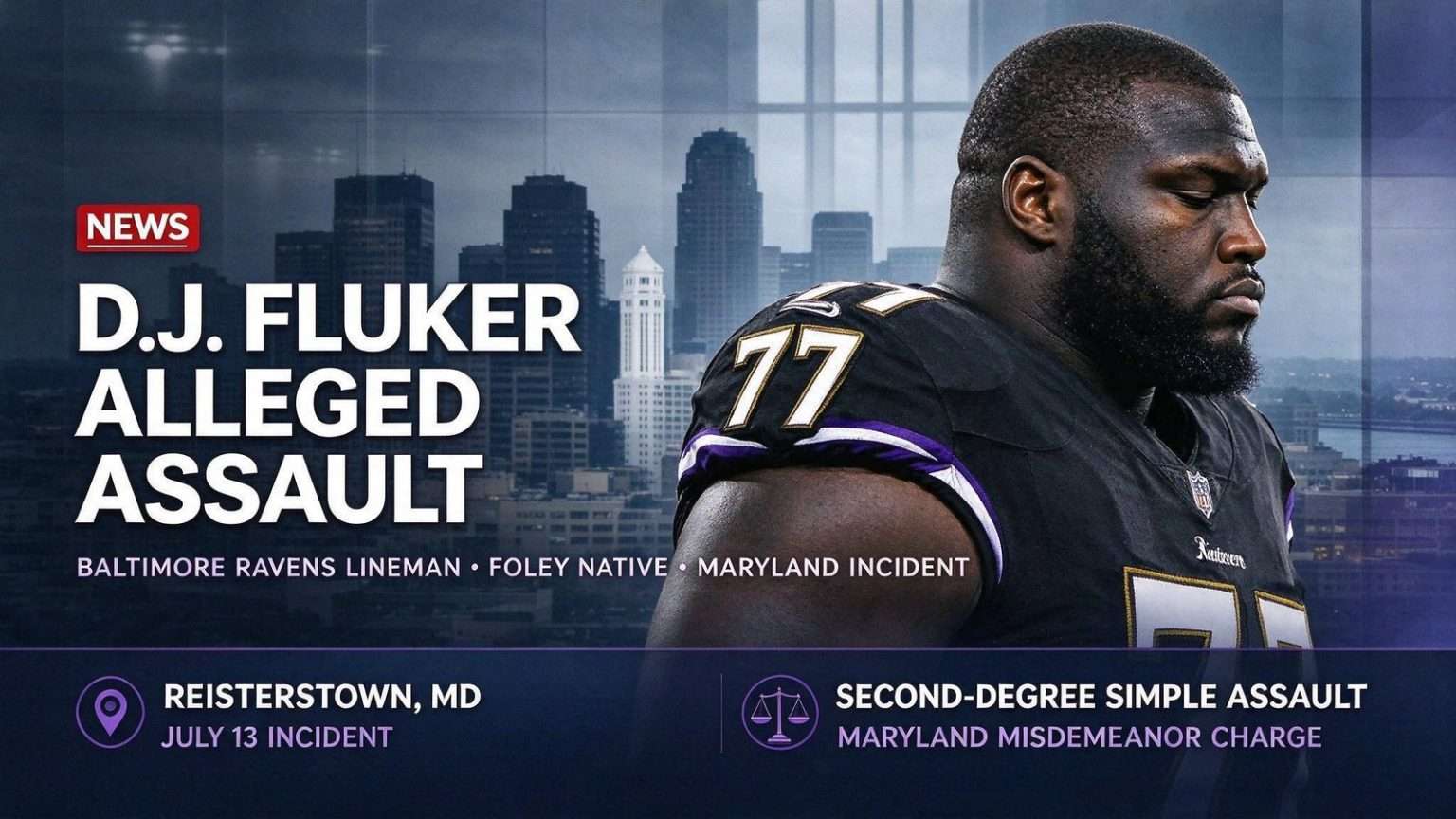
Baltimore Ravens offensive lineman D.J. Fluker, a Foley native, was the victim of an alleged domestic assault earlier this month in Maryland, according to a report by ESPN. The incident happened July 13 in Reisterstown, Maryland, and details emerged through a police report reviewed by the network.
Fluker told officers that his girlfriend, Kimberly Davis, punched him in the nose during an argument. Davis was arrested on a charge of second-degree simple assault, and a witness was present, the report said. Fluker told police it was not the first time Davis had assaulted him, an assertion that investigators documented in the account of the encounter.
Video obtained by ESPN showed Davis repeatedly hitting Fluker during a late-June incident in which the two argued over the care of their daughter. The recording added a second documented episode to the timeline, though the criminal charge that followed stemmed from the July confrontation in Reisterstown, a community in Baltimore County northwest of the city.
Second-degree simple assault is a misdemeanor charge under Maryland law, covering attacks that cause or attempt to cause physical injury or that put a person in fear of it. It carries a substantially lighter penalty than first-degree assault, which typically requires serious injury or the use of a weapon, and misdemeanor cases of this kind are ordinarily handled in the district court system where the alleged offense occurred.
The report placed Fluker in the middle of a private dispute that became a police matter, and it put the veteran lineman in an unusual public position. Domestic violence cases involving professional athletes typically draw heightened scrutiny, but cases in which the male athlete is the reported victim and the woman involved is the arrested party are far less common in the public record, and the ESPN report was notable for documenting the allegation with both the police account and video.
There was no indication in the report that Fluker sought medical attention or that his injuries went beyond the punch he described to officers. The charge against Davis was filed based on the statements of Fluker and the witness, along with what investigators documented at the scene.
Fluker’s Path From Foley to the NFL
Fluker’s connection to south Alabama runs deep, and it is a central part of why the story resonated in the Mobile area. He played at McGill-Toolen Catholic in Mobile before graduating from Foley High School, an unusual high school path that made him a known name on the Gulf Coast before he ever left the state. As a dominating offensive line prospect, he was one of the most heavily recruited players in the region during his high school years.
He went on to play college football at the University of Alabama, where he blocked on the offensive line for teams at the peak of the program’s modern dominance. Fluker left school early for the NFL after establishing himself as a powerful run blocker in the Crimson Tide’s ground-heavy attack, and his college career remains a reference point for offensive linemen across the state’s recruiting circuits.
His professional career brought him through multiple NFL stops before Baltimore. He signed with the Ravens as a free agent this offseason after spending the previous two years with the Seattle Seahawks, giving the Ravens a big, experienced body for their offensive line rotation and giving Fluker a fresh start in a new organization after his Seattle tenure.
The move to Baltimore also relocated him to the Maryland suburbs where the July incident occurred. Training camp timing meant the episode surfaced in the middle of the NFL calendar’s busiest stretch, when rosters are being evaluated and every personnel storyline draws coverage, adding attention to what was already a sensitive legal matter.
How the Allegations Came to Light
The account of the July 13 incident reached the public through ESPN’s reporting rather than through any announcement from the Ravens or the league, which is the usual path for cases involving players that do not result in team discipline or high-profile legal proceedings. The network’s report included the police narrative, the charge against Davis, and the existence of a witness, giving the story a level of documentation that celebrity-related assault reports often lack.
According to that reporting, the argument that led to the arrest followed a familiar domestic pattern: a dispute between partners that escalated into physical contact, a call or response that brought officers into the situation, and a decision by police to make an arrest based on what they documented at the scene. Fluker’s statement that the assault was not the first was recorded as part of that account, and the late-June video the network obtained corroborated a pattern rather than a single isolated confrontation.
The fact that the couple share a young daughter added another layer to the episode, since the late-June argument specifically concerned the child’s care. Domestic incidents involving custody disputes and co-parenting strain are among the most common scenarios officers encounter, and they present complicated questions for prosecutors, who must weigh the welfare of the child and the family’s future against the criminal charge itself.
Reisterstown, where the July incident occurred, is a suburban community in Baltimore County, and criminal cases there move through the county’s court system like any other local matter. What happens next depends on prosecutors, on any resolution Davis reaches with the court, and in the interim on whether the matter draws attention from the NFL under its personal conduct framework.
The League and Domestic Violence Scrutiny
Any domestic violence allegation involving an NFL player automatically triggers attention under the league’s personal conduct policy, which the league tightened considerably in the years after a series of high-profile cases reshaped public expectations around the issue. The policy gives the commissioner’s office authority to investigate and discipline players regardless of criminal outcomes, which means legal resolutions and league outcomes proceed on separate tracks.
In this case, the structure of the allegation is inverted from the scenarios that drove the league’s policy overhaul: the player is the reported victim, the arrested party is his girlfriend, and the documented conduct is against him. The league’s investigative machinery was built around cases where players are accused, and it remained to be seen how or whether the matter would intersect with Fluker’s standing on the roster, since a victim of an alleged crime is not ordinarily subject to discipline at all.
For the Ravens, the report arrived as the team was working through camp and preparing for the season, and the organization faced the delicate task of acknowledging a sensitive personal matter involving one of its linemen without inserting itself into an active legal situation. Teams in such cases typically defer to law enforcement while monitoring the situation, and there was no immediate indication the club planned any action related to the report.
The episode also plays against a broader backdrop of growing public awareness that domestic violence victims include men, a population that advocates say underreports abuse at high rates because of stigma and skepticism. Fluker’s decision to tell officers the truth about what happened, and to have the account recorded, put one of the region’s most famous football exports into a conversation that advocates have long said deserves more visibility.
A South Alabama Story at Heart
For readers along the Gulf Coast, the story carried a particular weight because of who Fluker is in the region’s football culture. He grew up in the area, starred in high school football here, and rose through the Alabama program at the moment it became the sport’s dominant force, which made his eventual NFL career a point of local pride. Players with that profile are followed closely in Mobile and Baldwin counties, and news about them circulates quickly.
His high school route through two programs, McGill-Toolen Catholic and Foley High School, itself tells a story about Gulf Coast football. The Mobile area’s private school powers and the public school programs of southern Baldwin County both produce Division I talent at a rate that belies the region’s population, and Fluker’s path through both worlds made him familiar to fans across the area long before his college recruitment made him famous statewide.
At Alabama, he played for a program that was then in the middle of an unprecedented run of success, blocking for offenses that leaned on a physical running game and an offensive line that was routinely described as one of the sport’s best. Linemen from those teams entered the NFL with reputations forged in the most scrutinized environment in college football, and Fluker’s early professional opportunities reflected that pedigree.
His subsequent professional journey, from his original NFL team through Seattle and on to Baltimore as a free agent, is the standard arc of a veteran offensive lineman: valued for experience and physicality, moved between organizations as rosters and coaching staffs change, and asked to stabilize a line wherever he lands. The Ravens signed him this offseason expecting exactly that kind of contribution, which is why the personal news broke at an awkward moment in the team’s calendar.
What Comes Next in the Case
Legally, the case now sits with the criminal justice system in Baltimore County. Davis faces a second-degree simple assault charge, a misdemeanor, and the disposition will depend on the prosecutorial review of the evidence, including the officer accounts, the witness statement, and the video record that ESPN obtained covering the separate late-June incident. Misdemeanor domestic cases can resolve through plea agreements, diversion programs, or trial, and timelines vary with the court’s calendar.
For Fluker, the immediate questions concern football rather than the courthouse. He remains under contract with the Ravens, and unless the league’s conduct policy review produces some action related to the matter, his standing with the team is a football decision. Veterans on new teams in camp are evaluated on performance and health, and the offensive line competition in Baltimore gave him a clear professional focus as the legal process unfolded away from the facility.
The couple’s daughter is a consideration that will outlast the criminal case. Courts and families navigating co-parenting after a domestic violence arrest typically deal with custody arrangements and protective conditions, and those private arrangements are largely outside the public record. Advocates emphasize that in cases with children, the priority of every institution involved is the child’s safety and stability.
However the case resolves, the documented account of a professional athlete reporting abuse against himself has already done something unusual: it has surfaced, in mainstream sports reporting, the reality that domestic violence does not have a single gender of victim. Advocates for male victims have long pointed to the gap between how often men experience abuse in intimate relationships and how rarely those cases become public, and an ESPN-documented account involving a recognizable Alabama native adds a data point to that conversation.
For now, the facts on the record are the ones in the report: a July 13 arrest in Reisterstown, a second-degree simple assault charge against Kimberly Davis, a witness present, a nose punch described by Fluker, his statement to police that it was not the first such incident, and video of a late-June altercation over the care of the couple’s daughter. Everything beyond that belongs to the courts, the league’s processes, and the private life of a Foley native whose journey from Gulf Coast high school fields to the NFL continues under circumstances no one involved would have chosen.