
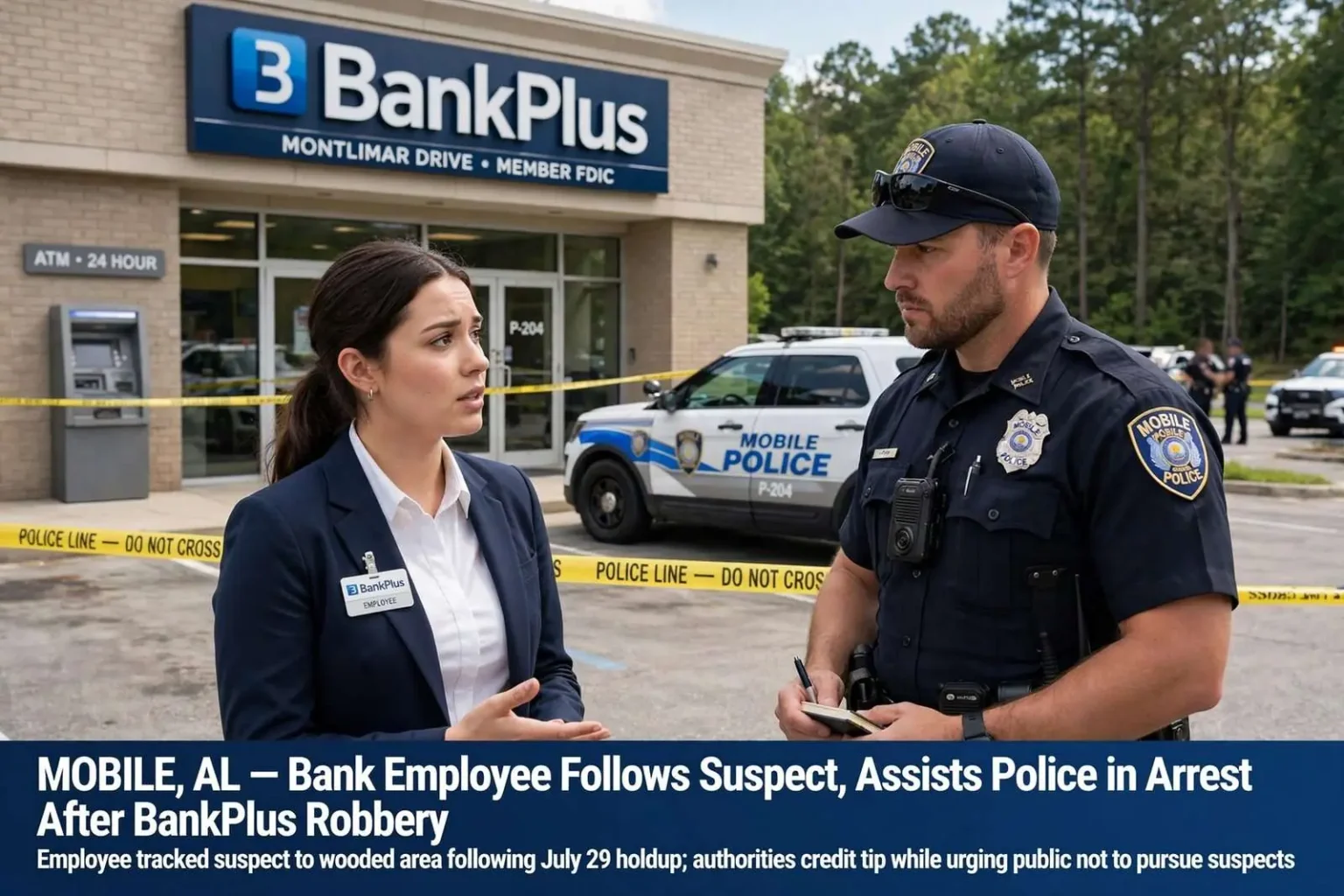
MOBILE, Ala. — A bank employee followed an alleged robbery suspect out of the building after a holdup, helping police make an arrest, according to federal court documents. The unusual move drew both gratitude and a caution from investigators, who credited the employee’s observations while urging the public not to imitate them.
The robbery happened July 29 at BankPlus on Montlimar Drive, a branch in west Mobile, with Mobile police responding shortly before 10 a.m. Investigators arrested 19-year-old Dillin Tucker in connection with the robbery, initially charging him with first-degree robbery under Alabama law. Court documents show he now faces federal charges as well, a common path in bank robbery cases because banks are federally insured institutions and such robberies fall under federal jurisdiction.
According to investigators, Tucker entered the bank wearing a black mask and a gray hoodie pulled over his head. An FBI agent said Tucker handed a note to a bank teller that read: “Don’t Panic this money aint yours if you make any move I’m going to blow all of us up I Don’t care about Dying!!!”
Court records say the teller activated a silent alarm before placing $2,400 into Tucker’s black plastic bag. Silent alarms allow employees to alert authorities without signaling to a robber that police have been summoned, and they are a standard security feature in bank branches. By the time officers arrived, the suspect had already left the building — but not before a second employee made a decision that would prove critical to the case.
The employee who followed
The federal complaint states that another BankPlus employee got into her vehicle and followed Tucker after the robbery. She told police she watched him go into a wooded area and emerge in different clothes, an attempt to change his appearance quickly before continuing on. That detail — the clothing change observed in real time — gave investigators a much clearer picture of the suspect’s movements in the minutes immediately after the holdup.
Officers later found the clothes Tucker wore during the robbery, along with the cash, inside a backpack. Physical evidence linking a suspect to the scene is often among the most important elements in prosecuting a bank robbery, and the recovery of both the clothing described by witnesses and the stolen money gave investigators a strong foundation for the charges.
Mobile police issued a statement to FOX10 News cautioning against following suspects. “We don’t advise anyone to follow a subject, especially in a situation like this. While we appreciated their information, this puts their safety at risk,” the department said.
The department’s warning reflects standard guidance from law enforcement agencies nationwide. Robbery suspects may be armed or desperate, and pursuing them — whether on foot or by car — exposes civilians to risks that trained officers are equipped to handle. In this case, officials made clear that the information the employee provided was valuable, while stressing that the safer course is always to observe from a distance, note details such as direction of travel and vehicle description, and call 911.
The employee’s actions gave investigators more than a direction of travel, however. By reporting where Tucker entered the wooded area and that he emerged in different clothing, she helped officers understand that the suspect had likely stashed or discarded items along the way, prompting a more targeted search of the area that ended with the recovery of the backpack.
Surveillance and the federal case
Federal investigators say surveillance footage shows Tucker visited the bank two days before the robbery without conducting any business. That kind of pre-robbery visit is a detail investigators routinely look for, and footage of it can help establish planning and intent in the case. Modern bank branches typically maintain multiple camera angles covering entrances, teller counters and parking areas, giving prosecutors a minute-by-minute visual record when a robbery occurs.
The decision to pursue federal charges in addition to the state first-degree robbery charge reflects how these cases are typically handled. Because BankPlus is a federally insured financial institution, robbing it violates federal law, and cases are commonly presented to federal prosecutors who can bring charges carrying significant prison terms. A defendant in such a case can face both state and federal proceedings arising from the same incident.
Records show Tucker made his initial appearance in federal court on Friday. An initial appearance is the first step in a federal criminal case, where the defendant is advised of the charges and of his rights, and where matters such as counsel and preliminary detention are addressed. It is not yet clear when he will next appear in court, and the case remains in its early stages.
For the bank’s staff and customers, the arrest closes a frightening episode that unfolded in a matter of minutes on a weekday morning. No injuries were reported in the robbery. Bank employees are trained for exactly these situations — comply, stay calm, protect lives first, and activate silent alarms when possible — and the events on Montlimar Drive showed that training working as designed, from the teller’s alarm activation to the swift response by Mobile police and federal investigators.
The Montlimar Drive branch sits in one of west Mobile’s busiest commercial corridors, an area of office parks, retail strips and neighborhood lenders where a mid-morning robbery can ripple outward quickly. Calls about the incident circulated among nearby businesses within the hour, and the heavy police presence that followed drew attention from passersby long after the suspect had left the area.
Bank robberies in Mobile are investigated jointly by the Mobile Police Department and the FBI’s Mobile field office, and the path a case takes through the courts depends on how the evidence develops. In practice, the first hours matter most: responding officers secure the scene, interview employees and witnesses, and canvass for surveillance video while the trail is freshest. This case shows how a civilian’s split-second observations fed directly into that process.
Robbery notes like the one described in the complaint are a defining feature of modern bank robberies, which frequently rely on intimidation rather than displayed weapons. Notes allow a suspect to make a demand quickly and quietly, and they later become evidence themselves — examined for fingerprints, handwriting and the specific language used. The threatening tone of the note in this case, with its references to an explosion, elevated the danger for everyone inside the branch and underscored why employees are trained to comply rather than resist.
Why police appreciated — and discouraged — the pursuit
Silent alarms proved central to the response. Because the teller was able to trigger the alarm discreetly while complying with the demand, dispatchers had officers on the way before the robber had even left the branch, keeping response times short enough that officers could act on fresh information about the suspect’s direction of travel. That head start is precisely what law agencies hope for in every robbery call.
The department’s public statement acknowledging the employee’s help, while discouraging anyone from following a suspect, walks a deliberate line. Officials wanted to credit the tip without encouraging copycat heroics, and their guidance mirrors what agencies nationwide tell the public: be a good witness, not a pursuer. Note clothing, vehicle, direction of travel, and call 911 immediately — information freely given from a safe distance is often more useful than anything learned at personal risk.
As the federal case proceeds, prosecutors will typically present evidence to a grand jury, and pretrial hearings will address questions such as detention and the scheduling of further proceedings. The initial appearance recorded Friday is the first of those steps, and further court dates will be set as the case moves forward in the federal system.
What happens next in the case
The arrest of a suspect within days of a robbery depends heavily on the combination this case had: quick alarm activation, cooperative witnesses, usable surveillance footage and physical evidence recovered near the scene. Investigators had all four, which is why the matter moved rapidly from a weekday-morning holdup to charges in both state and federal court. As the federal case proceeds, prosecutors will typically present evidence to a grand jury, and pretrial hearings will address questions such as detention and the scheduling of further proceedings.
For the bank’s staff and customers, the arrest closes a frightening episode that unfolded in a matter of minutes on a weekday morning. No injuries were reported in the robbery. Bank employees are trained for exactly these situations — comply, stay calm, protect lives first, and activate silent alarms when possible — and the events on Montlimar Drive showed that training working as designed, from the teller’s alarm activation to the swift response by Mobile police and federal investigators.
The case also serves as a reminder of the resources devoted to bank robbery investigations in south Alabama. Because federally insured banks are protected by federal statute, these cases draw in FBI agents, federal prosecutors and the U.S. Attorney’s office alongside local detectives, giving investigators tools — from federal warrants to multi-agency coordination — that often shorten the distance between a holdup and an arrest. In this case, that machinery was already in motion within hours, aided by an employee who, despite the warnings from police, gave officers the detail that helped them close in.


