Bankhead Tunnel to Close Two Nights for Fiber Optic Upgrades: ALDOT
ALDOT will close the Bankhead Tunnel Jan. 17-18 from 9 p.m. to 5 a.m. for fiber optic upgrades amid several other Mobile construction projects.
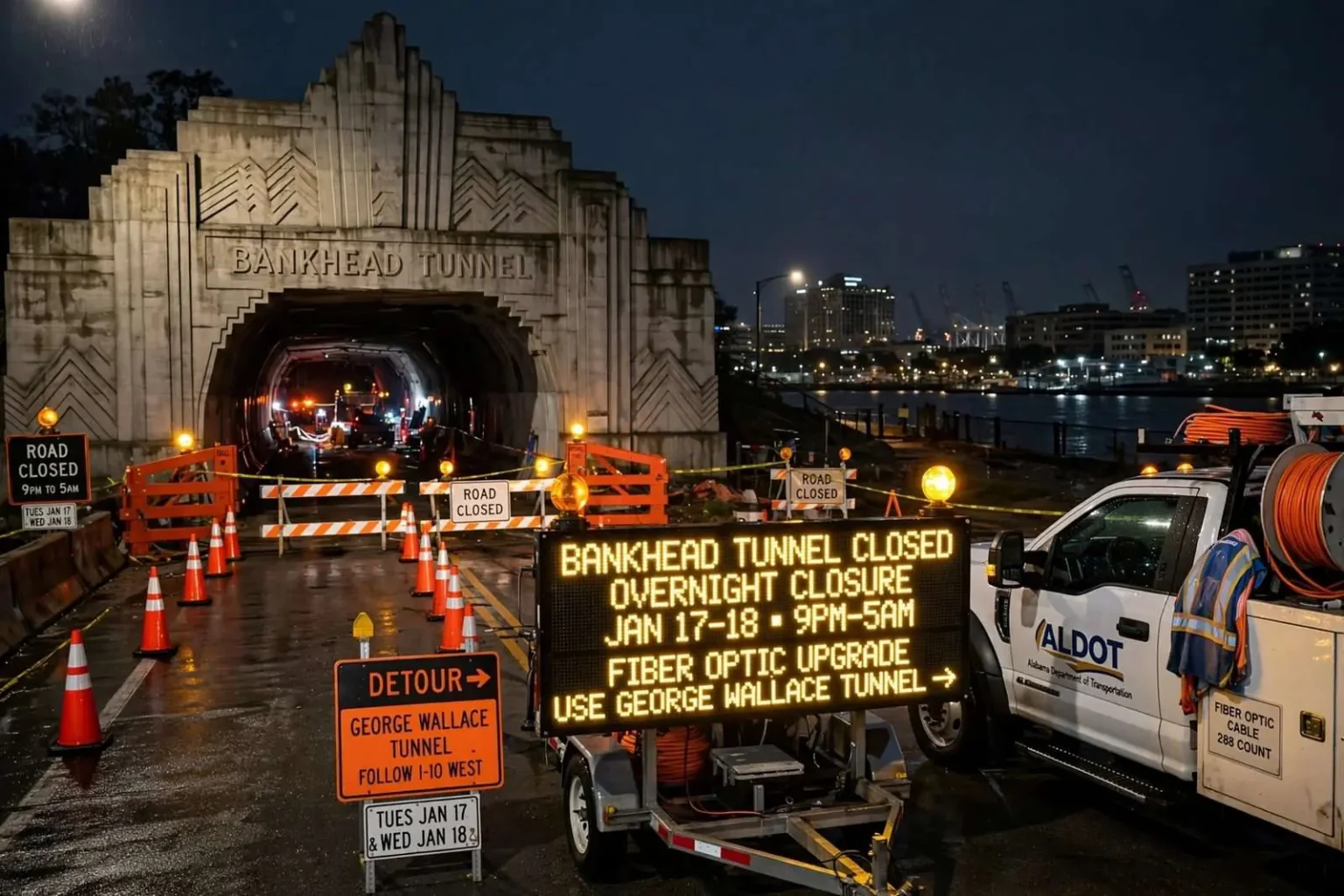
The Alabama Department of Transportation will close the Bankhead Tunnel for two consecutive nights next week while crews upgrade fiber optic lines running through the crossing, adding another disruption to an already busy construction season around Mobile.
According to ALDOT, the tunnel will be shut to traffic from 9 p.m. to 5 a.m. on both Tuesday, Jan. 17, and Wednesday, Jan. 18. The overnight window keeps the work out of the peak commuting hours, when the tunnel and its companion crossing carry steady volumes of downtown traffic beneath the Mobile River.
Drivers who cross the Mobile River on those nights will need to use the George Wallace Tunnel or another route. The two crossings sit close together near the downtown waterfront, and motorists accustomed to one can usually divert to the other with only a modest detour, though overnight closure signs and the mix of truck and commuter traffic can still slow the shift.
The fiber optic upgrade is the kind of infrastructure work that rarely draws attention until it interrupts a commute. Modern fiber lines carry communications for state transportation systems, including the signals, cameras and message boards that ALDOT uses to monitor and manage traffic across the Mobile area, and keeping those lines current is part of maintaining the region’s growing intelligent transportation network.
A crossing with deep roots
The Bankhead Tunnel, which opened in the early 1940s, carries Government Street traffic beneath the Mobile River and ranks among the oldest crossings of its kind on the Gulf Coast. Named for Alabama’s William B. Bankhead, who served as Speaker of the U.S. House of Representatives, the tunnel was a landmark of its era and remains a distinctive drive for anyone heading through downtown Mobile, with its low clearance and art deco portals marking the entrance and exit.
Decades of daily traffic, salt air and river water take a toll on any underwater crossing, and maintenance at the tunnel is a recurring item on ALDOT’s calendar. Crews periodically close the tunnel overnight for cleaning, inspections, drainage work and now communications upgrades, typically choosing weeknight windows when traffic volumes dip and the George Wallace Tunnel on Interstate 10 can absorb the diverted vehicles.
The George Wallace Tunnel, which opened in the early 1970s as part of the interstate system, carries I-10 traffic in twin tubes beneath the river and handles the heavy through-freight volumes that pass through Mobile on the Gulf Coast’s main east-west corridor. During closures like next week’s, it becomes the default crossing for drivers who would otherwise use the Bankhead.
One busy construction season
The tunnel work fits into a busy stretch of construction around Mobile that reaches well beyond the downtown riverfront. Across the city and its western suburbs, multiple projects are underway at once, each adding its own detours and delays to the daily map.
McGregor Avenue remains closed for roughly 12 months for sidewalk, lighting, and curb-and-gutter improvements. The lengthy closure on one of west Mobile’s principal thoroughfares has pushed traffic onto parallel routes for months at a time, a burden local drivers have felt on every trip through the corridor while the streetscape work progresses.
Lott Road closed Thursday for what the state described as a bridge replacement project, taking another piece of the western Mobile grid out of service while crews replace the aging structure. Bridge replacements of this kind typically require full closures for the duration of construction, since the work cannot safely proceed with live traffic over the site.
Starting Monday, Jan. 16, crews also begin replacing railroad tracks along Springhill Avenue, a project expected to last at least 10 days. That work gets underway at 5:30 a.m. each day, meaning the morning commute will encounter it from the very start, with crews and equipment occupying the roadway during the hours when traffic is still building.
Railroad track replacement along an active corridor requires coordination between the railroad and the state, and the 10-day estimate can stretch if weather or unexpected conditions intervene. Drivers who use Springhill Avenue regularly were advised to plan alternates rather than expect to thread through the work zone on their usual schedule.
Taken together, the projects sketch a picture of a city whose transportation network is being worked on from several directions at once — a tunnel communications upgrade downtown, a year-long corridor rebuild in the west, a bridge replacement on a north-south route and a rail maintenance push along another. Each is routine on its own; stacked together, they create the kind of week where a driver’s usual route may be closed without warning.
What drivers should do
Motorists traveling through downtown Mobile and west Mobile should build in extra time and watch for changing traffic patterns over the coming weeks. The overnight tunnel closure is the shortest of the current projects, but the surrounding work will shape commutes for months, and the state has encouraged drivers to treat posted detours and message boards as the best source of current guidance.
For the tunnel closure specifically, the practical advice is simple: if a trip crosses the Mobile River between 9 p.m. and 5 a.m. on Tuesday or Wednesday night, take the George Wallace Tunnel or another crossing, and expect police officers or signs at the approaches to funnel traffic toward the detour.
ALDOT reminds drivers that work schedules can shift with weather, equipment availability and emergency repairs, and that closure times listed in advance are subject to change. Checking conditions before an overnight or early-morning trip remains the surest way to avoid an unexpected detour.
Why the fiber work matters
Beneath the scheduling headaches, the fiber optic upgrade reflects a broader shift in how transportation departments operate. Modern road networks rely on continuous data connections: cameras feed traffic management centers, sensors track congestion, and coordinated signals adjust timing in real time. When those connections run through aging copper lines, reliability suffers and capacity limits how much monitoring a corridor can support.
Fiber provides the bandwidth and durability those systems require, and running new lines through an existing tunnel takes advantage of a protected route that already crosses the river. The overnight closure is the price of working safely in a confined underground space where crews need room for equipment and cannot work alongside live traffic.
Once the upgrade is complete, drivers are unlikely to notice any single change — but the improved connections support the day-to-day systems that shorten commutes, warn of crashes ahead and keep traffic moving through one of the Gulf Coast’s busiest interchange and tunnel complexes.
The bigger picture for Mobile’s network
Mobile occupies a cramped spot on the national map for freight. Interstate 10 funnels Gulf Coast commerce through the city, the Port of Mobile feeds trucks and rail cars in every direction, and the river tunnels represent the only direct paths for the interstate beneath the waterway that splits the city. Any maintenance on those tunnels ripples across the region’s logistics, which is why ALDOT schedules such work in overnight windows and publicizes it days ahead.
The same arithmetic applies downtown. Government Street and the roads feeding the Bankhead Tunnel connect the central business district to the waterfront neighborhoods, and even a two-night closure reshapes where drivers go. Business owners along the affected routes generally benefit when the state announces work in advance, since regulars can plan around it rather than discovering a closed tunnel at the last moment.
Longer projects demand more patience. A year-long closure like McGregor Avenue’s changes school runs, delivery routes and errand patterns for the neighborhoods it serves, and businesses along the corridor typically spend the construction period asking customers to keep coming despite the detours. States pair such closures with phased access plans where possible, but full closure remains the fastest way to complete sidewalk, lighting and drainage work on a busy street.
Bridge and rail projects, meanwhile, tend to arrive with less fanfare even though they carry equally high stakes. Replacing a bridge deck extends the life of a crossing by decades; renewing railroad track keeps freight moving without slow orders that delay trains and the businesses that depend on them.
For residents, the advice from transportation officials is consistent across all of these projects: allow extra time, follow posted detours, and expect the map of road closures around Mobile to keep shifting as each project moves through its phases over the coming weeks and months.
Staying current on closures
With four separate projects active around Mobile at the same time, transportation officials encourage drivers to rely on official channels for updates rather than word of mouth. ALDOT posts closure notices and schedule changes through its district office, and local media routinely flag overnight closures that affect river crossings, since even experienced commuters can be caught out by a tunnel that is dark at 10 p.m. but open at 8 the next morning.
Commercial drivers have the most at stake in the details. Weight limits, clearance heights and restricted routes shape where trucks can legally travel, and a closed tunnel or bridge can add meaningful miles to a delivery run through the city. Carriers that move freight through the Port of Mobile and the industrial districts on both sides of the river track closure notices closely for exactly that reason.
For everyday drivers, the next two weeks will test habits built around familiar routes. The safest approach is the simplest one: check before traveling through downtown or west Mobile, expect crews near Springhill Avenue in the early mornings, and remember that the George Wallace Tunnel stands in for the Bankhead during the overnight upgrade work on Tuesday and Wednesday.