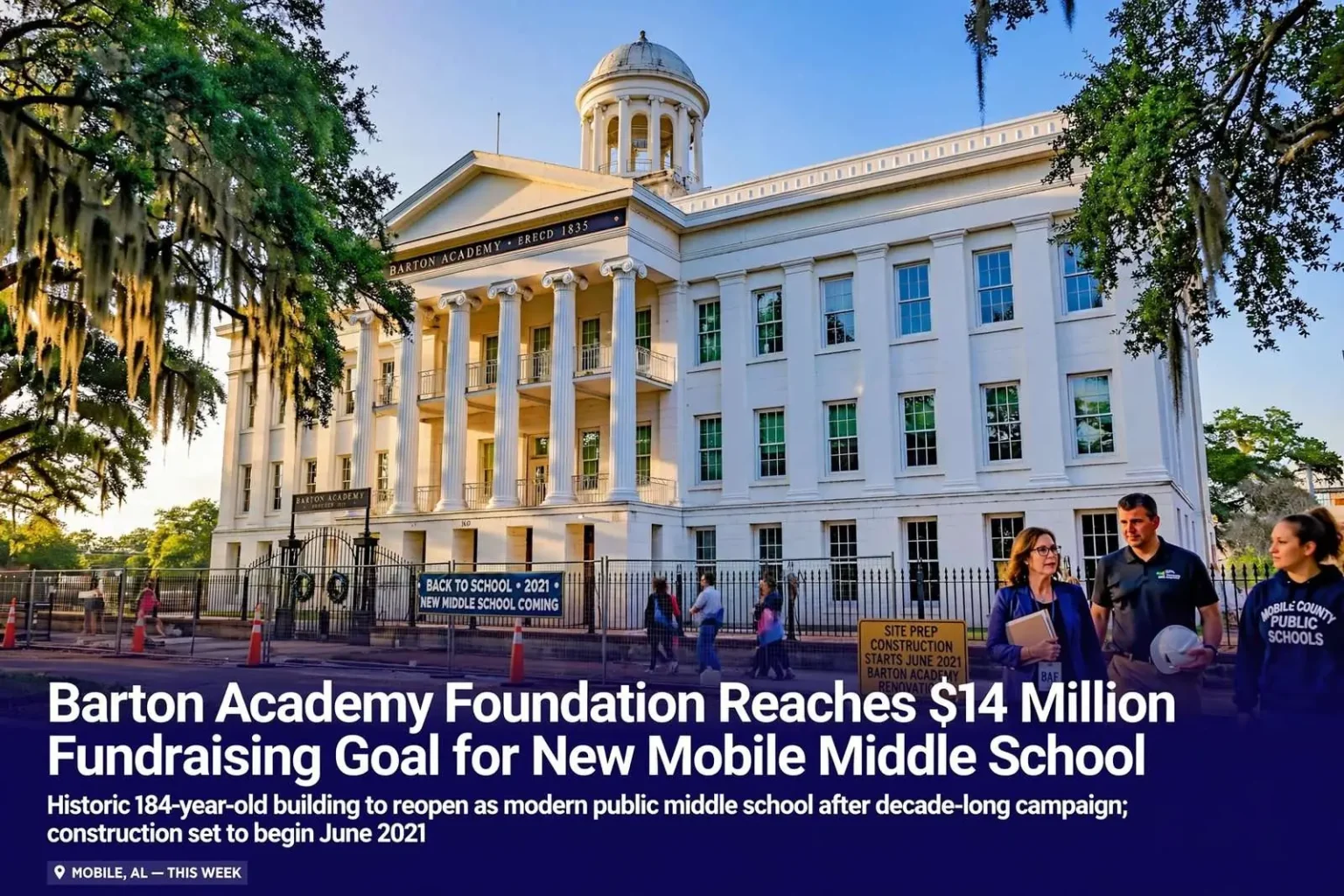
The Barton Academy Foundation announced this week it has reached its $14 million fundraising goal to renovate the interior of the historic Barton Academy building in downtown Mobile, clearing the way for it to reopen as a modern public middle school.
“This has been a long road, and we couldn’t be happier to reach this milestone,” said Elizabeth Stevens, president of the foundation, a nonprofit that has worked alongside Mobile County Public Schools since 2012 to fund the renovation. “For 10 years the BAF board, our donors and Mobile County Public Schools focused on the end goal of returning students to Barton Academy for the first time in more than 50 years. That will soon be a reality.”
Construction on the 184-year-old building, located in Mobile’s Central Business District, is set to begin in June.
The announcement capped a decade of advocacy and fundraising for a building that many Mobilians regarded as the single most symbolic piece of unused real estate in the city. Barton Academy is the building from which public education in Alabama grew, and its emptiness for the better part of two decades had become a standing rebuke — a marble-and-dome reminder of both the city’s proudest educational legacy and its habit of letting historic assets sit idle.
A building with a history of firsts
Barton Academy, completed in 1836 and named for local attorney Willoughby Barton, was designed by architects James Gallier and James Dakin and is widely regarded as one of the finest Greek Revival public buildings in the South. Its significance runs deeper than its architecture: Barton served as the first headquarters of the Board of School Commissioners of Mobile County, the body created in 1826 to oversee what was among the earliest publicly funded school systems in the United States — years before the state of Alabama itself established a system of public education. From its classrooms and offices, the commissioners ran the schools that made Mobile, for generations, the statewide standard-bearer for public education.
The building served for more than a century as an educational facility — as academy, as school headquarters, and as classroom space — until changing times emptied it. The Board of School Commissioners for Mobile County Public Schools previously completed a $4.2 million exterior renovation of the Barton Academy and adjoining Yerby buildings in 2015, but the interior, most recently used as MCPSS administrative office space, required a far larger investment to convert into a modern academic facility.
That exterior work stabilized the dome and the historic fabric, but without a funded plan for the interior, the building remained what it had been since MCPSS moved its administrative offices to west Mobile in 2007: a beautifully restored shell with no purpose. The foundation, formed to close that gap, spent its early years building the case for the school system’s return, commissioning feasibility studies, lining up early gifts, and persuading school officials that Barton’s future should once again be students rather than filing cabinets.
How the $14 million came together
The campaign’s largest single gift, $1.27 million, came from the Ben May Charitable Trust. The J.L. Bedsole Foundation and the Hearin-Chandler Foundation each contributed $500,000, and additional gifts of $200,000 or more came from the Crampton Trust, the Daniel Foundation of Alabama, the Mobile City Council, the Mobile County Commission, the Dr. Monte L. Moorer Foundation and the Wayne D. McRae Fund of the Community Foundation of South Alabama.
In total, nearly 450 foundations, businesses and individuals contributed to the effort, which had raised about $5.2 million in cash and pledges before the foundation turned to a more complex financing structure to close the remaining gap.
The donor list traced the full breadth of Mobile’s civic geography — established philanthropies with generations of giving history behind them, the city council and county commission on the public side, and hundreds of individual gifts large and small from graduates of Mobile County schools for whom Barton’s name still carried weight. Foundation leaders said the breadth of the campaign mattered as much as its total, because a project pitched as the community’s restoration of its own birthplace of public education needed to be visibly supported by the community itself.
The foundation reached its goal with help from AMCREF Community Capital, which served as tax credit advisor, and $8 million in combined equity from the federal New Markets Tax Credit program, Federal Historic Tax Credits and State Historic Tax Credits.
AMCREF brought in United Bank, U.S. Bank and Brownfield Revitalization as tax credit funders, with United Bank providing bridge funding that allowed the foundation to leverage the historic tax credit equity and multi-year pledges and begin construction on schedule.
The structure was the piece that turned a decade of pledges into an actual construction start. Historic tax credit equity — essentially, the value of federal and state credits earned by rehabilitating a certified historic structure — is claimed over years, not up front, and without bridge financing a nonprofit can find itself with a fully “funded” project it cannot yet pay contractors for. United Bank’s bridge commitment untangled that knot, converting paper pledges and future credits into cash on a timeline the school system’s construction calendar could use.
A separate $2 million came through the AlabamaSAVES Program, run by the Alabama Department of Economic and Community Affairs’ Energy Division, to cover energy conservation upgrades including LED lighting, energy-efficient HVAC systems and energy-efficient water heaters for the school’s cafeteria.
“Financing this historic effort was clearly one of Mobile’s most complicated preservation and education projects ever,” Stevens said. “As with some other important development projects boosting downtown’s economy, we turned to state and federal tax credits to make Barton’s comeback possible.”
The financing stack — private philanthropy, public appropriations, three tax credit programs, a bank bridge loan and a state energy grant — reflected the realities of reviving large historic buildings in the 21st century. Preservation projects of Barton’s scale are rarely financed the way new construction is, and the Barton Academy Foundation’s assembly of partners became, by Stevens’ description, a case study in its own right: proof that a nonprofit, a school system and a set of public and private lenders could jointly fund a project neither could have carried alone.
From filing cabinets to classrooms
School commissioners recently approved a construction bid with Ben M. Radcliff Contractor Inc., and Barton Academy for Advanced World Studies is slated to open in August 2021.
The school is expected to enroll roughly 300 students in grades six through nine, with a curriculum built around real-world problem solving, multiple foreign languages, advanced fine arts, entrepreneurial learning and dedicated collaboration and STEM labs.
Admission will work similarly to a magnet school application process, with academic criteria and application details expected to be announced in fall or winter 2020.
The academic plan marks a deliberate departure from the building’s last educational life. Barton Academy for Advanced World Studies is designed as a school of consequence for downtown’s revival — a program meant to draw students from across Mobile County into a landmark building, pairing the magnet-style admissions model with a curriculum aimed at the skills schools elsewhere in the state have struggled to fund: languages, fine arts, entrepreneurship and laboratory-based STEM work. The renovation itself has been shaped around that program, with the historic classrooms, corridors and assembly spaces adapted to collaboration labs and modern instructional technology rather than converted into generic office space.
For Mobile County Public Schools, the return of students to Barton carries a symbolic weight beyond enrollment figures. The system that was born in the building in the 1820s and 1830s will once again be headquartered there in the most literal sense — a functioning school rather than an administrative address — closing a gap of more than half a century during which Barton educated no one.
An anchor for a bypassed corner of downtown
Barton Academy has sat largely vacant since MCPSS moved its administrative offices to west Mobile in 2007, and the building landed on Alabama’s most endangered historic properties list twice during that time.
Those listings, issued by the Alabama Trust for Historic Preservation and the Alabama Historical Commission, were more than symbolic warnings. A vacant landmark in a city’s core depresses the blocks around it, and the stretch of Government Street around Barton — between the Civic Center and the Gov. George Wallace Tunnel approaches — had watched the spillover of downtown’s investment stop short. The foundation’s argument, repeated for a decade, was that the fastest way to save the building was to fill it, and that the only use commensurate with its history was the use it was built for.
Stevens said reopening it as a school is expected to spur redevelopment in the surrounding area of downtown Mobile, which has been largely bypassed by revitalization transforming other parts of the city center.
“A new school at Barton will spark redevelopment in the area immediately surrounding it, largely bypassed by the revitalization transforming other downtown areas,” Stevens said.
That theory of urban reinvestment — anchor institutions drawing daily foot traffic, families and spending into a stagnant district — is the same one downtown leaders have applied around hospitals, courthouses and universities in cities across the country. A 300-student school means hundreds of arrivals and departures every day, faculty and staff on site year-round, and a stream of events and activities that put the blocks around Barton back into the daily map of downtown life. The foundation’s bet is that the investment already remaking Mobile’s waterfront, entertainment district and historic neighborhoods will finally round the corner onto Government Street — with the state’s oldest public school building, once again full of students, leading the way.