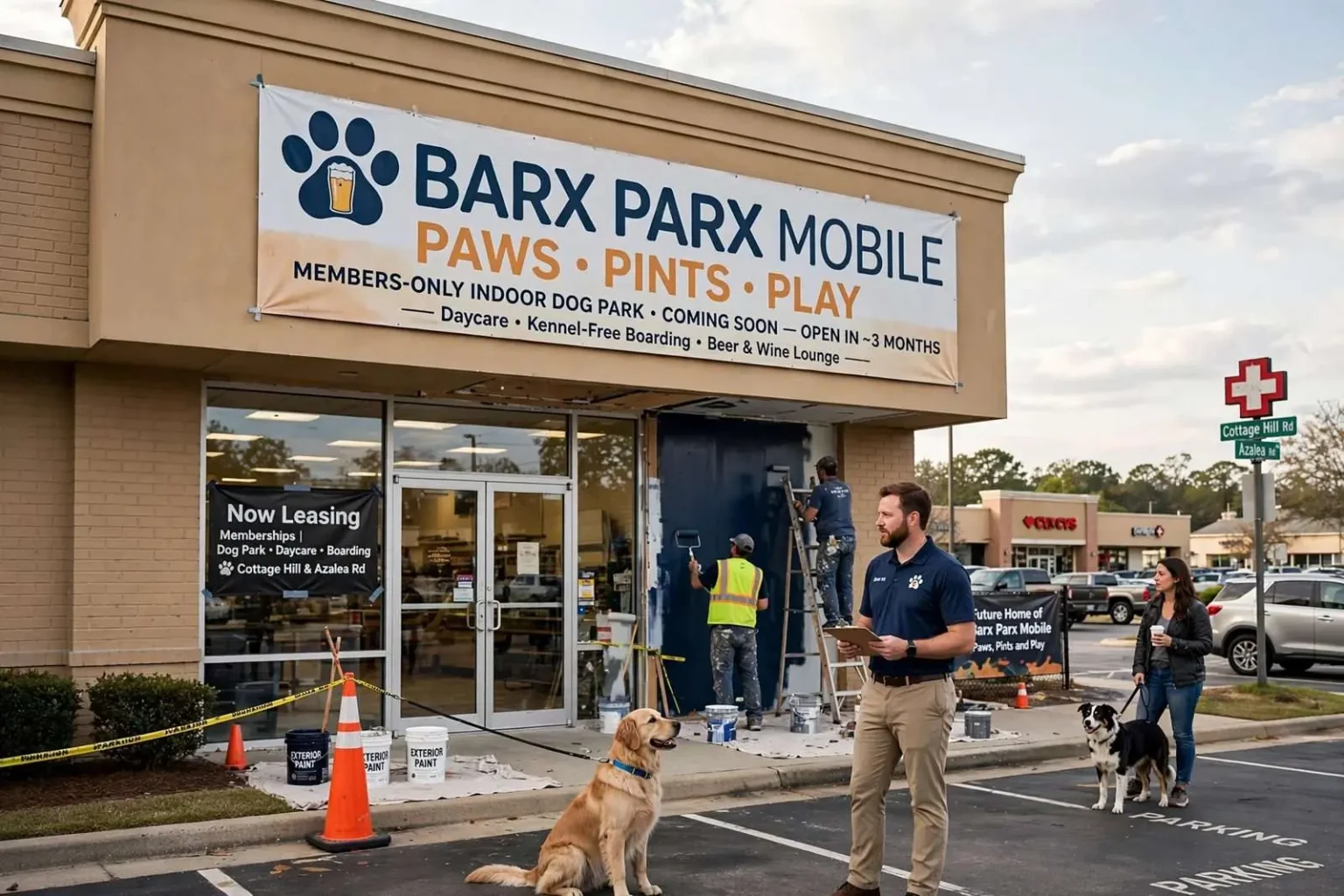
MOBILE, Ala. — A familiar building at one of Mobile’s busiest intersections is headed for a very different second life. The former CVS at Cottage Hill and Azalea roads is being converted into Barx Parx Mobile, a members-only indoor dog park where dogs play off-leash while their owners relax with a beer or a glass of wine.
Franchise owner Jonathan Rayner said he hopes to open in roughly three months, with the timeline depending in part on the city’s permitting process.
“It’s an indoor dog park,” Rayner said. “You can come hang out, have fun with the dogs, enjoy a cold beverage.”
More than a play space, Barx Parx Mobile plans to offer daycare and kennel-free boarding, with the possibility of adding training and grooming services later.
Barx Parx began in Las Vegas around 2018 and only started offering franchise opportunities about a year ago. Rayner said he and his son are the first franchisees, making Mobile the company’s first franchise location.
Finding the Right Building Took a Year
“It’s been about a year trying to find an appropriate location,” Rayner said. He eventually connected with local businessman Don Henry, who purchased the former CVS building, allowing Rayner to sign a lease.
Converting a pharmacy into a dog park sounds like a substantial undertaking, but Rayner said the existing structure suits the purpose well.
“We’re still in the initial stages of getting all the plans and whatnot put together, and we’ve got to get permits,” he said. “The nice thing is there’s not a lot of build-out that’s required.” Painters were already at work at the property as the transformation began.
A former drugstore’s second act
The building at Cottage Hill and Azalea roads sits at the heart of one of west Mobile’s busiest commercial crossroads, a corridor of shopping centers, medical offices and restaurants that serves the neighborhoods between Airport Boulevard and the Tudor area. Chain pharmacies have consolidated across the country in recent years, leaving communities with empty big-box drugstore buildings, and the conversion of one into an entertainment-and-pet venue is the kind of adaptive reuse that keeps those corridors alive.
The building’s layout is part of why the conversion is relatively light. A modern pharmacy box offers the square footage, open floor plate, climate control, restrooms and parking field that an indoor dog park needs — precisely the assets that make redundant drugstores attractive to unusual tenants. Rayner’s plan puts the play space, the boarding area and the owners’ lounge inside a single controlled environment, a combination outdoor dog parks cannot offer on a Gulf Coast afternoon in July or during one of the region’s frequent storms.
The Indoor Dog Park Model
The members-only structure is central to the concept. Off-leash play works only when every dog in the room is known, vaccinated and screened, which is why indoor parks of this type operate on membership rather than drop-in traffic. Members pay for ongoing access, the business maintains health and behavior records for each animal, and staff can manage play groups by size and temperament — the fundamentals of safe group dog socialization that any reputable daycare already follows.
The addition of alcohol service for owners turns the model into something closer to a social club than a kennel. Rather than dropping a dog off and leaving, owners stay, watch their pets play, and socialize with other dog owners — creating the repeat-visit habit that drives membership-based businesses. It is the same logic that made dog-and-beer venues a fast-growing category in Sun Belt cities, and Mobile’s climate, where summer heat and afternoon thunderstorms limit outdoor dog park use for months at a time, gives the indoor version a particular advantage here.
Daycare and kennel-free boarding extend the same philosophy. Traditional boarding places dogs in runs or cages for the length of an owner’s trip; kennel-free boarding instead lets boarded dogs play and rest in supervised groups, which many owners prefer for social, well-exercised pets. Adding daycare builds weekday recurring revenue from the same membership base, and training and grooming — the services Rayner said may come later — would let the business capture the full spending a dog owner does in a year.
From Microbiology to Dog Parks
Running an indoor dog park represents a career change for Rayner, though not as sharp a turn as it might appear. His undergraduate degree is in animal science and he holds a Ph.D. in microbiology. He spent about nine years as a professor at the University of South Alabama before that appointment, and the scientific training shows up in how the business has to operate.
An indoor facility where dozens of unfamiliar dogs share space is, at bottom, an animal health environment. Vaccination verification, sanitation protocols, airflow, disease surveillance for the canine illnesses that circulate through group settings — these are the operational details that separate a professionally run indoor park from a liability. A founder who understands microbiology from the inside is unusually well positioned to design them, and Rayner’s academic background at South Alabama also roots the business in the city’s own institutions.
The franchise side of the story is equally telling. Barx Parx operated in Las Vegas for years before opening franchising only about a year ago, and Rayner and his son became the company’s first franchisees — meaning Mobile is the proving ground for whether the concept travels beyond its original market. First franchisees typically work closely with the franchisor on everything from build-out standards to operating playbooks, and the outcome in Mobile will shape how quickly the brand expands across the region.
What it means for the neighborhood
For west Mobile, the project lands at a familiar intersection with a new draw. Cottage Hill and Azalea roads carry heavy daily traffic between residential neighborhoods, schools and the commercial strip, and the conversion of a vacant pharmacy box into an active venue restores both a storefront and a reason for repeated visits. Pet spending has been one of the most resilient categories of consumer spending nationally, and the Gulf Coast’s growing population of dog owners — including the many households in the corridor’s subdivisions — is the market the membership model is built to capture.
The permitting timeline Rayner described — hoping for an opening in roughly three months, dependent on the city’s process — is the standard path for a change-of-use conversion in Mobile: plans, permits, inspections. The light build-out he reported means the critical path runs mostly through approval rather than construction, and the painters already at work suggest the cosmetic side of the transformation is underway while the paperwork proceeds.
If the concept performs as its Las Vegas parent has, Barx Parx Mobile gives the city something it does not currently have: a climate-proof place where dogs can play off-leash year-round, owners can stay for the evening, and a vacant drugstore becomes a neighborhood gathering spot. The three-month target puts that test on the calendar, and the corridor at Cottage Hill and Azalea is about to find out what a members-only dog park does to its foot traffic.
The economics of the model reward the multi-service approach Rayner outlined. A membership alone rarely covers the fixed costs of a large indoor facility; layered revenue — daycare subscriptions, boarding nights, and eventually training classes and grooming appointments — lets one building earn across every service a dog owner buys. Businesses that bundle these services also retain members longer, because each added service raises the cost and inconvenience of switching to a competitor.
Staffing is the other decisive variable. Supervised off-leash play requires people who can read dog behavior — recognizing when play escalates toward conflict, when a dog needs a break, and when a group composition has to change. Professional dog daycares train staff in exactly these skills, and an operation combining play, boarding and future training will need a team comfortable managing dozens of animals at once. It is skilled work, and it is also the kind of employment a west Mobile venue of this size adds to the local service economy.
Safety and health protocols will be the public-facing measure of quality. Members will want to see vaccination requirements enforced at the door, cleaning routines that keep kennel cough and other contagious conditions out of the play floor, and separation policies by dog size and energy level. Indoor parks that get these right build the trust that keeps memberships renewing; those that do not quickly develop reputations that spread through the same dog-owner networks that feed them.
The building’s location gives the business its natural catchment. The neighborhoods fanning out from Cottage Hill and Azalea roads — some of Mobile’s most established middle-class areas — hold exactly the dual-income, pet-owning households that sustain membership clubs, and the intersection’s access from Airport Boulevard and Schillinger Road puts the facility within a short drive of much of west Mobile. For owners who currently drive their dogs to scattered outdoor parks or rely on in-home sitters, a single venue combining play, daycare and boarding fills a gap the market has not yet served.
Rayner’s path from University of South Alabama professor to first-time franchisee also reflects a broader pattern of academics and professionals building second careers in the pet economy, which has grown into one of the country’s most durable consumer sectors. Whether Mobile becomes the template for Barx Parx’s next round of franchises will depend on what happens at the former CVS in the months ahead — and the painters already on site are the first sign that the answer is being built.