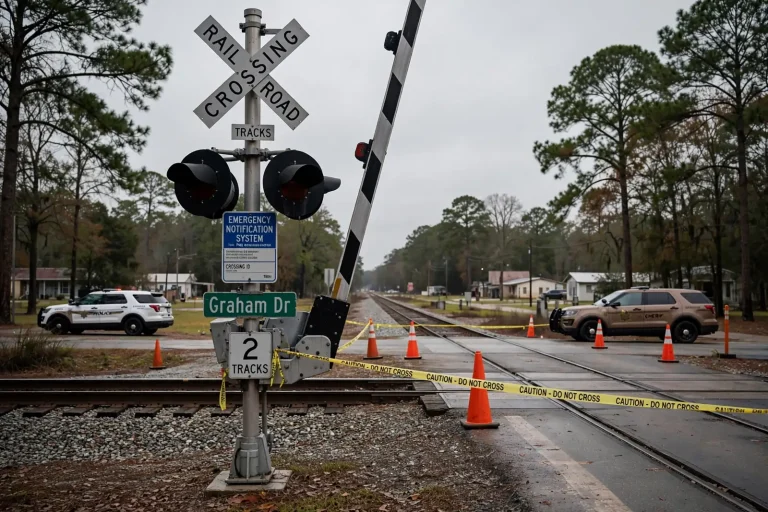
Bay Minette police pursuit ends in fatal Florida crash after suspect rams patrol cars
A Bay Minette police pursuit ended in a fatal Florida crash after a stolen-vehicle suspect repeatedly rammed patrol cars, authorities said.
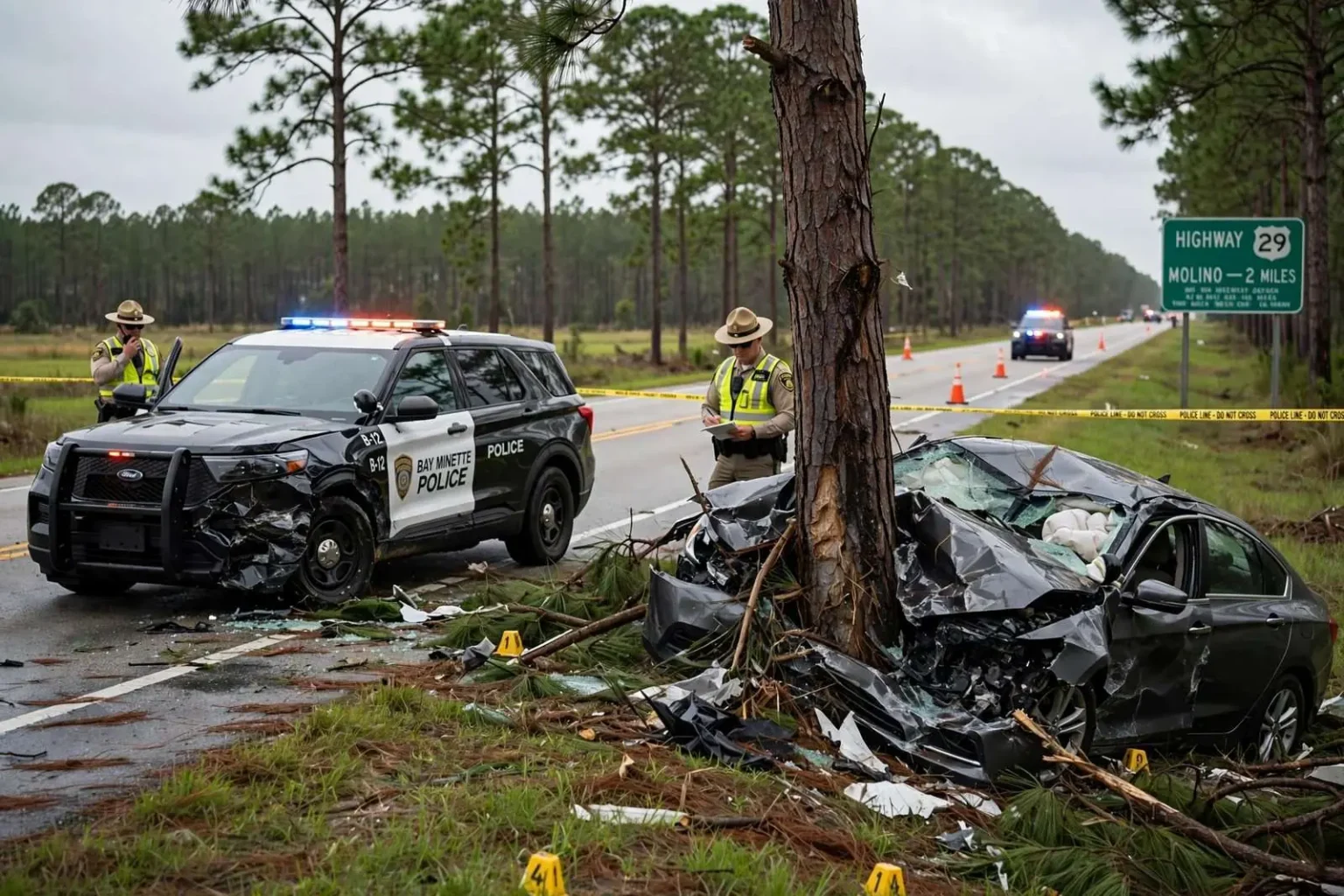
MOLINO, Fla. — A police pursuit that began in Bay Minette, Alabama, ended in a fatal crash in Florida’s Escambia County after the suspect repeatedly rammed police vehicles, according to the Bay Minette Police Department. The driver, the only person in the stolen car, was pronounced dead at the scene, and the Florida Highway Patrol is investigating the crash.
The chain of events began on Aug. 1, 2020, when Bay Minette officers responded to a report that a vehicle had been stolen from the Jet Pep gas station on Highway 31 South. An officer spotted the suspected stolen vehicle a short time later and attempted a traffic stop, but the driver refused to pull over. What followed was a chase that moved through North Baldwin County and into Escambia County, Alabama, before crossing the state line into Florida — a route that covered dozens of miles of highway and drew in assisting agencies along the way.
According to Bay Minette police, the suspect struck two patrol cars multiple times on purpose during the pursuit, ramming marked units as officers attempted to bring the chase to an end. The pursuit ended when, in Escambia County, Florida, the stolen vehicle struck a Bay Minette patrol car a final time, lost control and hit a tree on Highway 29 near Molino. The driver was pronounced dead at the scene. Bay Minette police confirmed that their officers were involved in the events leading up to the crash and said the Florida Highway Patrol, which has jurisdiction over crash investigations on Florida roadways, took over the investigation of the fatal collision.
A Chase Across Two States
Pursuits that cross county and state lines are among the most complicated events in policing. Bay Minette sits in the heart of North Baldwin County, positioned along Highway 31 and U.S. 31 corridors that connect the city to the Interstate 65 interchange and to the farm communities stretching toward the Alabama River. From Bay Minette, a northbound driver can reach the Florida line in less than 30 minutes on rural highways, and Escambia County, Alabama, directly north of Baldwin, is among the state’s most sparsely populated counties, with long stretches of two-lane road where traffic is light and speeds run high. That geography is what allowed a theft reported at a Bay Minette gas station to become a multistate chase within minutes.
Highway 29, where the pursuit ended, is the main north-south road through the western Florida Panhandle’s rural communities, running from Pensacola up through Molino, Century and across the Alabama line. On an ordinary day it carries commuters, farm traffic and long-haul vehicles; on the afternoon of Aug. 1, 2020, it became the final leg of a pursuit that had already crossed two counties and two states. When the stolen vehicle struck the patrol car and spun into the tree, the crash brought the chase to an end no officer wanted, and it handed the investigation to the Florida Highway Patrol, which by protocol conducts an independent review of any pursuit that ends in a fatality on its roads.
The ramming of police vehicles — described by Bay Minette police as deliberate, and repeated against two different units — marks the pursuit as an unusually dangerous one. Pit maneuvers, rolling roadblocks and the decision to break off a chase are all judgment calls officers must make in real time, and a driver who actively rams patrol cars eliminates some of the safer options. Each collision between a fleeing vehicle and a police unit risks injuries to officers and turns the pursuit into an escalating contest of force, which is one reason multistate pursuits are reviewed so closely afterward.
How the Investigation Works
With a fatality at the end of a pursuit, the investigative timeline belongs to the Florida Highway Patrol. FHP traffic homicide investigators document the crash scene — skid marks, vehicle damage, point of impact, the condition of the roadway — and reconstruct the sequence of collisions. Their findings will address not only how the crash occurred but the broader circumstances of the pursuit, including speeds, distances and the actions of the pursuing officers. Bay Minette police, as the agency that initiated the stop, would compile its own records: the theft report from the Jet Pep station, radio traffic from the pursuit, dash and body camera footage, and statements from the officers whose cars were struck.
Two separate inquiries effectively run in parallel. The first is the crash investigation by FHP, which determines the cause of the fatal collision and issues its findings as a traffic homicide report. The second is an administrative review by the pursuing agency, standard practice when a chase ends in death or serious injury, examining whether the pursuit followed department policy and state law on when to initiate, continue or terminate a vehicle chase. Neither review is criminal in nature against the officers, but both can shape policy, training and, in some cases, civil claims filed afterward.
The vehicle theft itself remains part of the record even though the suspect died. A stolen vehicle report from a gas station on Highway 31 South in Bay Minette set the entire sequence in motion, and the fact that the driver refused to stop for a marked patrol unit is what transformed a property crime into a multistate pursuit. Gulf Coast gas stations, with cars left running or unattended during quick stops, are recurring targets for opportunistic vehicle thefts, and agencies across Baldwin County regularly remind motorists not to leave vehicles unattended with keys inside.
What This Means Locally
For Bay Minette residents, the episode underscored the reach of a small city’s police department and the risks its officers absorbed during the chase. Two patrol cars damaged in deliberate ramming attacks represent not just property loss but the potential for officer injury or death, and the fact that no Bay Minette officers were reported killed or seriously hurt was the incident’s one piece of unambiguous good news. Damaged units are repaired, but the operational cost of a pursuit — multiple agencies coordinating by radio, roads closed at the crash scene, investigators working for days afterward — lands on a department of modest size.
For the communities along the route — from the Jet Pep on Highway 31 South, through the crossroads of North Baldwin and Escambia County, Alabama, and up Highway 29 through Molino — the aftermath was a reminder of how quickly a routine police call can turn into something far larger. Fatal pursuits that end in trees instead of traffic stops generate grief that extends to the suspect’s family and lingering questions among the residents who witnessed pieces of the chase as it passed.
Those questions will be answered, to the extent they can be, by the paperwork of two states: the Florida Highway Patrol’s crash reconstruction and Bay Minette’s internal review. What is already established is the basic and tragic outline — a stolen car, a driver who refused to stop, two patrol cars rammed repeatedly on purpose, and a fatal end against a tree on Highway 29, with the Florida Highway Patrol now responsible for explaining how it all came to rest there.
Pursuit Policy and the Roads Involved
Police pursuit policy has become a subject of active debate across Alabama and the nation, and cases like this one are the reason. Departments generally authorize pursuits for violent crimes and require supervisors to weigh continuing a chase against the danger it poses to the public. Factors officers must judge in seconds include traffic volume, road conditions, the seriousness of the underlying offense and whether the driver’s behavior — such as deliberately ramming police units — shows escalating recklessness. A driver who attacks patrol cars with his vehicle changes the calculation entirely, because breaking off the chase no longer removes the danger; it simply leaves an actively aggressive driver at large on the same roads.
The route of the pursuit itself tells residents something about North Baldwin County’s geography. Highway 31 South, where the Jet Pep station sits, feeds directly into Bay Minette’s commercial core, and from there the road network fans north toward Escambia County, Alabama, through thinly populated land where patrol coverage comes from the Baldwin County Sheriff’s Office. Escambia County, Alabama, has no traffic light in its county seat of Brewton’s more rural stretches, and its two-lane highways are known locally for long sight lines and high speeds. Crossing into Florida near Century, the driver entered a jurisdiction where Bay Minette officers were far from home, relying on Florida agencies for backup as the chase continued up Highway 29.
After the Wreckers Leave
In the days after a fatal pursuit, the visible signs — the wrecked vehicles, the troopers at the roadside, the law enforcement presence at the station where the car was stolen — give way to slower work. FHP’s reconstruction can take weeks, and the report that results becomes the public account of speeds, impacts and decisions. Bay Minette’s internal review proceeds on a parallel track, examining radio logs and camera footage against the department’s pursuit policy. Where the findings land will determine what the public learns about the final moments of a chase that began over a stolen car at a Bay Minette gas pump and ended against a tree 60-some miles away, and they will shape how the department, and agencies like it across the state line, train for the next refusal to stop.