Bay Minette Woman Faces Year-Long Recovery After Tree Crushed Her Car in June Storm
Bay Minette resident Robin Burcham faces up to a year of recovery after a tree crushed her car during a June 30 thunderstorm, leaving her with multiple broken bones.
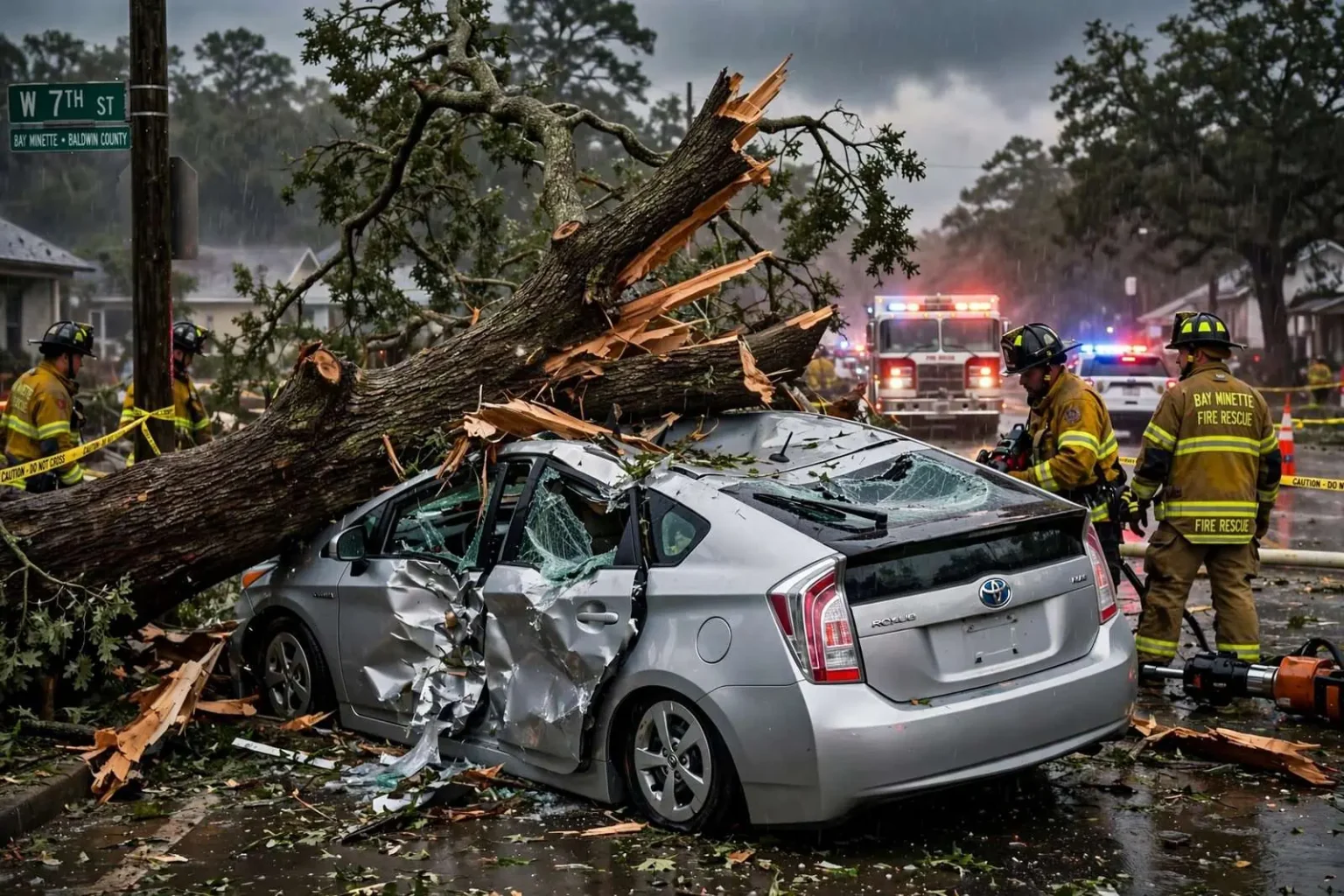
A Bay Minette woman is recovering from severe injuries after a tree fell on her car during a thunderstorm on June 30, according to police and a close friend — a crash that turned a routine drive home from work into a fight for her life on one of the city’s main streets.
Robin Burcham was driving home from work along West Seventh Street when the tree came down on her vehicle. Police found her trapped inside the car, and first responders airlifted her to a hospital in Mobile. What should have been a minutes-long commute became an hours-long rescue, then a hospital stay that doctors say will stretch into a rehabilitation measured in months.
A rescue measured in hours
Alicia Bailey, a longtime friend of Burcham’s, said the rescue took hours. Because Burcham was driving a Toyota Prius, firefighters had to take extra precautions specific to hybrid vehicles before they could free her. “She was driving a Prius, so there are certain steps that have to be taken with an electric vehicle or a hybrid vehicle because of the risk of electrical fire. And electrical fire and water — it was raining — don’t mix,” Bailey said.
Bailey said firefighters used foam to suppress the fire risk, dismantled part of the car’s interior, removed the steering wheel and cut through the vehicle to reach Burcham. The precautions were not unusual for a hybrid rescue: a Prius carries a high-voltage battery system, and crews trained in extrication are taught to isolate that system before applying the hydraulic cutters and spreaders that modern rescue work relies on. Rain added another layer of caution, since energized components and standing water are a combination rescuers are trained to treat as dangerous until proven otherwise.
The airlift that followed reflected the severity of what rescuers found. A helicopter transport from the scene of a Baldwin County crash to a Mobile hospital is a decision rescuers make when the injuries on site exceed what a ground ambulance run can safely manage with time to spare — and in this case, the injuries proved to be as extensive as the response suggested.
West Seventh Street runs through the heart of Bay Minette, the Baldwin County seat, threading past homes, churches and the mature trees that line the older parts of the city. Streets like it are exactly where tree-fall crashes happen: canopy roads that predate the vehicles beneath them, where a storm-toppled trunk can close a lane or, as on June 30, land squarely on a car. City and county crews clear storm debris as a matter of routine each summer, but no public works schedule can remove the risk of a tree falling at the moment a driver is passing.
Injuries measured in fractures
Burcham suffered multiple broken bones. “Both arms and both hands were broken, her right leg and right ankle, eight ribs, and a degloving injury on her thigh, which means that the tree took off the skin down to the muscle,” Bailey said. Bailey said Burcham coded twice after arriving at the hospital. “None of the EMTs thought she was going to survive,” Bailey said.
A degloving injury — skin and tissue torn away from underlying structures — is among the most serious soft-tissue wounds trauma surgeons treat, typically requiring multiple surgeries and skin grafts to close, and it was the thigh injury that drove the early surgical schedule. Ten days after the crash, Burcham had already undergone 10 procedures on her left leg and received skin grafts.
A recovery measured in months
Doctors expect a long rehabilitation. Bailey said it could take up to a year for Burcham’s left leg to fully heal, though Burcham could begin regaining function from her broken bones within three to six months. The two timelines tell the story of the injury pattern: bones knit on a predictable clock, while the soft-tissue damage on the thigh heals through repeated procedures, wound care and grafting that cannot be compressed into a few weeks.
For a patient who coded twice on arrival, simply reaching the rehabilitation stage marks substantial progress. Trauma teams measure early recovery in stages — out of the most acute danger, then out of the surgical cycle, then into the physical therapy that determines how much of the original function returns. Burcham has moved through the first two stages in a matter of days, with the third still ahead of her.
A friend organizing support
Burcham lives alone with her cats and has no immediate family nearby. Bailey said relatives have been traveling from Birmingham to help care for her. The logistics of a long hospitalization and an even longer recovery fall heavily on a patient without family in town — someone has to manage the house, the pets, the insurance paperwork and the steady stream of decisions that trauma care generates.
Bailey, who also lives in the Birmingham area, said she and Burcham met as sophomores at the University of South Alabama in 1987 — a friendship now entering its fourth decade, mobilized overnight. Bailey has started a GoFundMe campaign to help cover Burcham’s medical and recovery expenses, the kind of fundraising effort that has become a common bridge for trauma patients whose treatment, transport and aftercare outpace what insurance covers.
The campaign’s expenses go beyond hospital bills. An airlift, a surgical schedule that reached 10 procedures in 10 days, extended rehabilitation and the cost of family members shuttling from Birmingham all accumulate for a patient facing a year-long recovery. For Bailey, the fundraiser is also a way to let friends, coworkers and strangers contribute to a recovery they cannot visit.
When trees come down on Baldwin County roads
The crash on West Seventh Street is a reminder of a seasonal hazard familiar across Baldwin County and south Alabama: summer thunderstorms that bring down mature trees over roads in minutes. Communities thick with oaks and pines — and Bay Minette is one of them — see limb and tree falls every storm season, and when one drops across a roadway at the moment a car passes, the vehicle offers little protection against thousands of pounds of wood.
What first responders faced
The June 30 rescue drew on the full sequence of modern crash response. Police arrived to find a driver pinned under a fallen tree; fire crews assessed the hybrid’s electrical system and applied foam as a precaution; and the extrication that followed required dismantling part of the interior and cutting through the vehicle itself. Each step is standard for a wreck of this kind, but the combination — a pinned patient, a high-voltage vehicle, active rain and a multi-hour operation — made it an unusually demanding one for the crews involved.
Hybrid extrication training has become a fixture of fire service preparation as vehicles like the Prius have filled the roads. Crews are taught to identify disconnect points, treat undeployed systems as live, and keep water away from exposed high-voltage components — procedures that add minutes to a rescue but prevent the secondary emergencies that can turn a survivable crash into a fatal one. The foam Bailey described is part of that protocol, suppressing fire risk around the vehicle’s electrical systems while rescuers work.
The road ahead
For Burcham, the immediate milestone is the end of the surgical phase and the start of sustained rehabilitation. Regaining function in broken arms and hands is a precondition for nearly everything else — transfers from bed to wheelchair, grip strength, the everyday movements most patients relearn first. The thigh injury’s year-long healing timeline runs in parallel, with follow-up procedures likely as the grafts and repaired tissue mature.
Her support system, meanwhile, has reorganized around the recovery. Relatives rotating in from Birmingham, a friend of nearly 40 years coordinating care from the same city, and a GoFundMe campaign covering the costs give the recovery a structure that hospital discharge plans alone cannot. Bailey’s updates since the crash have documented the progress — the procedures completed, the grafts placed, the hours of rescue now behind her.
The crash itself remains the simplest part of the story: a tree, a thunderstorm and a driver in the wrong place on West Seventh Street. Everything since — the hybrid protocols, the airlift, the coded heart that restarted twice, ten procedures in ten days — is the work of first responders, trauma surgeons, family and friends turning a freak accident into a survivable one. What remains is the recovery, measured in months and, for the left leg, close to a year.
Residents who knew Burcham — and many in Bay Minette did, once the crash was reported — have followed the campaign and the updates as the recovery unfolds. The GoFundMe remains the central way to help, and Bailey has said contributions of any size go toward the medical and recovery expenses of a woman who, by every account from the hospital and her friend, is fighting her way back one procedure at a time.