Political Notebook: A Redneck Woman for BayFest and a New Fire Chief for Bayou La Batre
Country star Gretchen Wilson was headed to BayFest, a longtime Mobile firefighter was poised to lead Bayou La Batre's department, and a former sheriff was at work on a book.
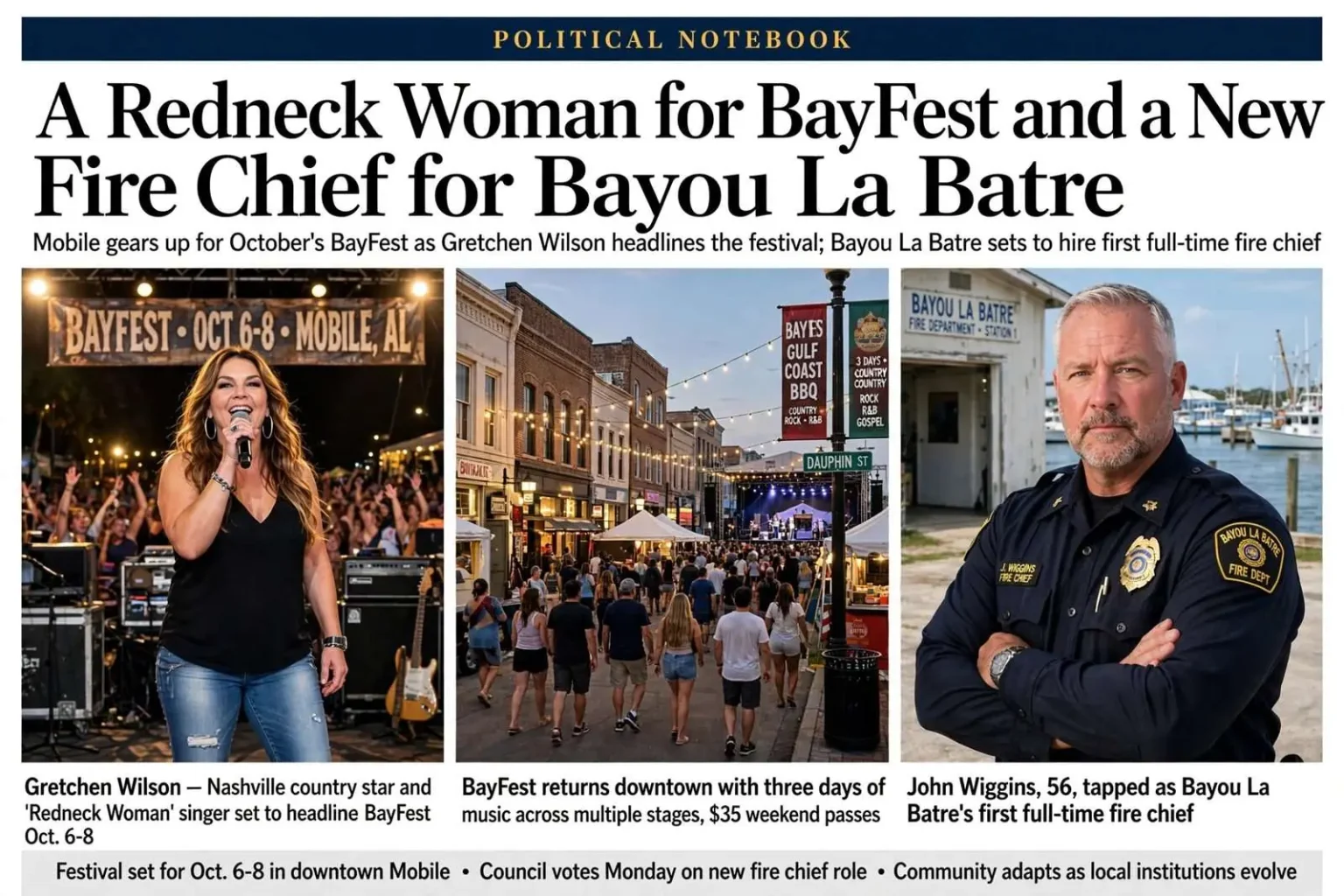
Mobile was getting ready for a loud October. Sources close to BayFest, the downtown music festival set for Oct. 6-8 across a variety of stages, said Nashville’s Gretchen Wilson — whose hits included “Redneck Woman,” “Here for the Party” and “All Jacked Up” — ranked among the top touring country acts booked for the weekend. The question making the rounds along Dauphin Street was whether Mobile was ready for a redneck woman. Ready or not, she was coming.
Wilson’s own concert tickets typically sold in the $50-to-$80 range on her national tours. A BayFest weekend pass ran $35 — less than $12 a day for all the shows — a pricing gap that has long been part of the festival’s pitch. Organizers budgeted more than $2 million for the event, a figure that could approach $2.2 million once cash, in-kind support and city services were factored in. For that money, ticket buyers got access to multiple stages spread across the downtown core, where acts rotate through evening slots and crowds drift on foot from one venue to the next.
A Festival Woven Into Downtown
BayFest has grown into one of the largest music festivals on the Gulf Coast, and its footprint says a great deal about how Mobile uses its downtown. Stages dot the blocks of the central business district, and the layout turns the weekend into a walking festival: attendees park once and spend the evening moving between country, rock, R&B and gospel lineups. Restaurants and bars in the surrounding blocks count on the surge of visitors, and the city’s contribution of police, fire and public-works services is a big part of why the true cost of the event runs well past the published budget.
Booking a headliner of Wilson’s stature fit the pattern organizers have pursued: name country acts with strong radio followings, paired with regional and local bands across the other stages. Wilson broke through in 2004 with “Redneck Woman,” a chart-topping country single that introduced her to a national audience, and she followed it with a string of hits that kept her on festival circuits for years afterward. For Mobile audiences, the chance to see an act of that profile for the price of a weekend pass was the draw.
American Idol winner and Alabama native Taylor Hicks had reportedly been invited to drop in as well, though his commitments with the show through the following year prevented any formal booking. Hicks, a Birmingham native with deep ties to the state’s music scene, had become one of the most visible Alabama performers on national television, and his name continued to circulate in festival conversations even without a contract in place.
A Professional Chief for Bayou La Batre
Down the bay, the municipal news centered on the fire station. John Wiggins, president of the Mobile firefighters union, was poised to become fire chief in Bayou La Batre, with the City Council expected to act on his hiring Monday night. Wiggins, 56, would be the first full-time professional firefighter to lead the volunteer department in the south Mobile County fishing and boat-building community.
The hire marked a meaningful shift for a department that has long depended on volunteers. Bayou La Batre, known for its shrimp fleet and shipyards along the Mississippi Sound, covers a compact area but faces hazards typical of a working waterfront — seafood processing plants, fuel docks and wooden boat-building operations among them. A small volunteer roster can strain quickly when calls come in during working hours, and bringing in a career firefighter as chief gives the city a full-time professional presence at the top of the organization.
Wiggins is a Mobile native who grew up in Crichton, one of the city’s historic neighborhoods north of downtown. He retired two years earlier as a lieutenant driver after 34 years with the Mobile Fire Department, an organization whose ladder trucks, pumpers and rescue units respond to tens of thousands of calls a year across the city. Three decades and a half of that kind of service leaves a veteran with strong opinions about how a department should be staffed, and Wiggins wasted little time sharing his.
He was expected to sign a one-year contract, and he said an immediate goal was hiring three certified drivers, one per shift. The drivers-first plan reflects the arithmetic of small-department staffing: an engine or tanker cannot roll until someone qualified is at the wheel, and in a volunteer outfit the difference between having a certified driver on duty and waiting for one to arrive can be measured in minutes that matter. Spreading one across each of the three shifts would guarantee the department could move apparatus at any hour.
Wiggins would succeed Gary Johnson, who had resigned. For a council governing a town of roughly 2,500 residents, the decision was less about ceremony than about continuity — a professional hand to build rosters, maintain equipment and set training standards that volunteers can hold onto over time. Communities along the Alabama coast, from Coden to Grand Bay to the island towns, have wrestled for years with the same challenge of keeping volunteer emergency services staffed as work and family obligations pull residents in a dozen directions.
Book ‘Em
Former Mobile County Sheriff Jack Tillman, who had stepped down under pressure about three months earlier after nearly 12 years in office, was at work on a book. Tillman said the as-yet-untitled volume would cover his 20-year career as a resource officer in the Mobile County Public School System, recounting investigations that ranged from streaking to steroids. The onetime professional boxer promised the book would be a bestseller.
The memoir premise tracks with a career that was unusual even by the standards of Alabama law enforcement. School resource officers occupy a strange middle ground in public life: they carry badges and make arrests, but their daily work happens in hallways, cafeterias and parking lots, where the caseload runs from truancy and theft to the kind of drug investigations that periodically convulse a high school. Tillman spent two decades in that world before winning the sheriff’s office, and he evidently found the material durable enough to fill a manuscript.
Tillman’s departure from office had come under pressure after nearly 12 years as the county’s top lawman, an office whose responsibilities include operating the metro jail, serving civil papers and patrolling unincorporated Mobile County. Whether the book lands on bestseller lists or not, it adds one more chapter — literally — to the story of a figure who spent decades at the center of county politics.
Watching the Calendar
Taken together, the items sketch a civic landscape in motion. A festival economy downtown that now budgets in the millions; a small waterfront town reaching outside its borders for professional leadership; and a former sheriff turning two decades of schoolhouse policing into prose. Each, in its own way, is a story about institutions adapting to the people they serve.
For residents, the practical takeaways are concrete. BayFest’s weekend pass remains one of the region’s cheapest entertainment values, with downtown parking and street closures to plan around during the October run. In Bayou La Batre, a council vote Monday night will determine whether the volunteer fire department gets its first career chief and, with him, a push toward certified drivers on every shift. And in Mobile’s bookstores, whenever Tillman’s title finally appears, readers can expect a lawman’s-eye view of the county’s schools from a man who never lacked for confidence about its commercial prospects.
The Money Behind the Music
The festival’s budget tells its own story about the scale of the undertaking. Staging a three-day, multi-venue event in a downtown setting means equipment rentals, security, lighting and sound crews, artist guarantees and travel, insurance, fencing and sanitation — line items that accumulate fast even before a single ticket is scanned. The reported budget of more than $2 million, potentially $2.2 million with city services included, puts BayFest in the company of regional festivals across the Southeast that treat live music as serious civic infrastructure rather than a weekend amusement.
That spending lands in local pockets. Hotels across the city fill for the weekend, downtown restaurants run their busiest stretches of the fall, and service workers log overtime hours across the hospitality sector. For a city that has invested heavily in its downtown revitalization over the past two decades, the festival doubles as an annual showcase for the results — loft conversions, new restaurants and restored storefronts all on display for visitors who might not otherwise have reason to come downtown after dark.
Wilson’s arrival also underscores how the country music business has come to regard the Gulf Coast. Tour routing between New Orleans, Pensacola and the Florida panhandle puts Mobile squarely on the map, and festivals like BayFest give national acts a stop that pays while offering fans prices the arena circuit cannot match. A weekend pass at $35 — the price of a single ticket, before fees, for many touring shows — remains the kind of value that keeps families coming back year after year.
What Comes Next
Between now and the October opening weekend, the remaining lineup announcements will fill in the undercard around the headliners, and downtown property owners will brace for the usual run of street closures and detours. The city services folded into the festival’s bottom line — police details, fire standby and public works crews — will be scheduled accordingly, the same way they are every year.
In Bayou La Batre, meanwhile, all eyes shift to Monday night’s council meeting. If the hiring goes through as expected, Wiggins will take over a department with a clear first assignment: three certified drivers, one for each shift, so that no call for help ever waits on a wheelman. It is a modest goal on paper and a consequential one in practice — the difference, in an emergency, between a truck that rolls now and one that rolls late.
And somewhere in Mobile County, a former sheriff is typing. Whether Jack Tillman’s schoolhouse memoir turns out to be the bestseller he promises or simply a colorful footnote to twelve years of county history, it guarantees that one of the region’s most familiar law enforcement figures will keep telling his stories a while longer — this time on his own terms, in his own book, with the streakers and the steroid cases getting chapter and verse at last.