BBB Warns Mobile County Residents About Overpayment Scam Targeting Online Sellers
BBB warns Mobile County sellers of overpayment scams on Facebook Marketplace. Learn how buyers trick sellers with fake payments and how to protect yourself.
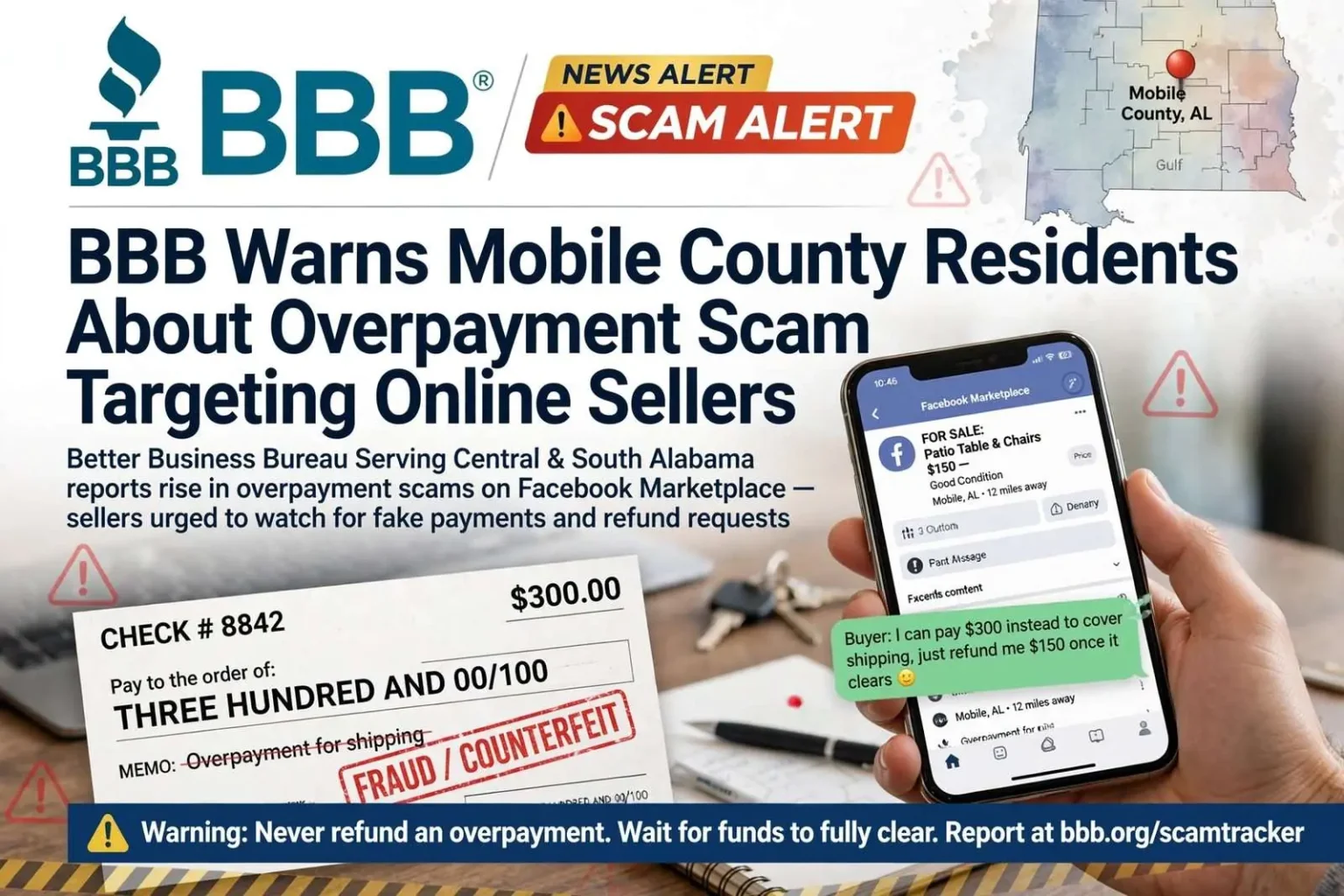
The Better Business Bureau Serving Central & South Alabama is warning residents about a growing overpayment scam that targets people who sell used items through online marketplaces such as Facebook Marketplace. The scheme is not new — variations of it have circulated since the days of classified newspaper ads — but consumer officials say the combination of widespread digital payment tools and the popularity of local selling platforms has given it fresh momentum across the Gulf Coast region.
The warning comes as the organization reports a noticeable uptick in complaints involving the scheme, particularly transactions arranged through Facebook Marketplace, where sellers of furniture, electronics, vehicles, children’s items, and household goods regularly interact with strangers they have never met. For many residents, an online sale is one of the easiest ways to turn unused belongings into cash, and that convenience is precisely what the scam is built to exploit.
How the Scam Works
Fraudsters pose as interested buyers and reach out to sellers who have listed items ranging from clothing to electronics to vehicles. At first, the contact looks completely ordinary: the supposed buyer expresses enthusiasm for the item, asks a few reasonable questions, and agrees to the price or something close to it. The red flag appears at the payment stage, when the “buyer” offers to pay more than the asking price.
These seemingly legitimate buyers offer a variety of explanations for the excess amount. Some claim they want to cover shipping costs in advance. Others say the overpayment is simply a policy of the digital wallet service or payment app they are using. Whatever the explanation, the effect is the same: the seller suddenly has a payment that appears larger than expected, along with a polite request to refund the difference.
In some cases, the scammer goes a step further and mails a physical check for more than the agreed-upon amount, then claims the overpayment was an honest mistake and asks the seller to send back the difference before the check finishes clearing. Because modern banking apps often show a pending deposit as available funds within a day or two, the check can look legitimate long before the bank discovers it is counterfeit.
Once the seller returns the extra money, the trap springs shut. The initial payment turns out to be fraudulent — the check bounces, or the online payment gets reversed after the buyer disputes it or the account funding it proves to be stolen. The seller is left with nothing but a loss, and in some cases may also face overdraft fees from their own bank on top of the money returned to the scammer.
What Sellers Stand to Lose
The damage from an overpayment scam is twofold. Victims lose both the money they voluntarily sent back and the item they shipped or handed over to the buyer. Because the original payment was never real, there is nothing to offset the refund, and recovering either the cash or the merchandise after the fact is rarely possible once the fraudster has moved on.
The Better Business Bureau reports a noticeable increase in complaints involving this scheme, with Facebook Marketplace transactions appearing especially frequently in the reports it receives. The pattern is consistent across complaints: a generous stranger, a plausible-sounding reason for the extra funds, and a time pressure that pushes the seller to refund the difference before the original payment has had a chance to fail.
Consumer officials stress that the loss often goes beyond dollars. Sellers who hand over vehicles or electronics may lose items worth hundreds or thousands of dollars in a single transaction, and the emotional toll of realizing they were targeted can make people hesitant to report the crime at all — which in turn keeps the scheme circulating.
Why Marketplace Sales Are Fertile Ground
Facebook Marketplace and similar platforms have become fixtures of secondhand commerce across Alabama because they make it simple to reach a large local audience without listing fees. That openness cuts both ways: anyone can browse a listing, and sellers have no reliable way to verify who is on the other end of a message. A scammer can operate from anywhere, copy photos from legitimate listings, and run the same overpayment script against dozens of sellers in a single day.
The structure of a typical marketplace deal also works in the fraudster’s favor. Many sales happen quickly, with both parties eager to close the transaction, and payment apps have trained people to accept electronic transfers as routine. When a stranger volunteers extra money, it can feel like good luck rather than a setup — especially for first-time sellers who have never encountered the trick before.
Scammers frequently build trust with small talk about the item, references to a family member who needs it, or claims that they are deployed out of town or otherwise unable to meet in person. Each detail is designed to make the seller comfortable shipping the item and refunding the difference without ever meeting the buyer face to face.
The BBB’s Role and Its Scam Tracker
The Better Business Bureau Serving Central & South Alabama is part of the international BBB network, a nonprofit organization focused on advancing marketplace trust through business accreditation, dispute resolution, and consumer education. Its coverage area includes Mobile and communities across the southern and central portions of the state, and its staff regularly issues alerts when a particular fraud pattern shows a spike in local reports.
One of the organization’s most useful tools for consumers is the BBB Scam Tracker, an online reporting system at bbb.org/scamtracker. Anyone who encounters suspicious purchasing behavior — or any other suspected scam — can file a report detailing what happened. The reports are mapped and analyzed, allowing the BBB to spot emerging schemes early and warn others in the community before they become victims.
Reporting serves a second purpose as well. Scam Tracker data is shared with law enforcement agencies and consumer protection partners, so each report adds to the record investigators can draw on when patterns of fraud cross jurisdictions. Even when an individual loss is small, the accumulated reports can help establish that a scheme is active in the region.
How to Protect Yourself
BBB spokesperson Monde Donaldson advises Mobile County residents to never accept overpayment for online sales. If a buyer offers more than the listed price, treat it as a red flag and end the transaction. There is no legitimate reason for a buyer to send extra money, and no payment policy or shipping service requires the seller to refund a difference.
Never return funds from a payment that has not fully cleared. A pending deposit in a banking app is not a guarantee that the money is real, and a check can bounce days or even weeks after it first appears to hit the account. When meeting local buyers, consider using only cash or payment methods that settle instantly and cannot be reversed after the fact.
Sellers should also stay on the platform where the listing was posted whenever possible, be wary of buyers who push to move the conversation to text or email immediately, and never ship an item before payment has truly cleared. If something seems too good to be true, it almost certainly is — a lesson that applies as much to online selling as to any other corner of the marketplace.
Red Flags to Watch For
The overpayment scam has a handful of telltale markers that repeat from one report to the next. A buyer who offers more than the asking price is the clearest one, but sellers should also note buyers who ask to pay with a check for a far larger amount, insist on refunding a difference immediately, or claim that their payment app requires the extra funds for technical reasons. Buyers who cannot or will not meet in person, who show no real interest in the condition of the item, and who create urgency by saying a courier or moving company will pick it up are also running a familiar script.
Sellers should be equally cautious when a supposed buyer sends a payment before asking where to send it, then follows up with a request to change the delivery plan after the money appears. Reversals and counterfeit checks are not discovered until after the refund has been sent, so any request that involves sending money back is the point at which the transaction should end.
What To Do If You Are Targeted
Anyone who receives an overpayment offer should stop communicating with the buyer and keep the messages, payment notices, and any tracking information as records. Report the account to the platform where the listing appeared so moderators can take action, and if a check has already been deposited, contact the bank immediately to explain the situation — in some cases, notifying the bank before the counterfeit check finishes processing can limit the damage.
Victims and near-misses alike can file a report through the BBB Scam Tracker at bbb.org/scamtracker, which helps the organization warn other residents in the region. Residents who have suffered a financial loss may also want to notify local law enforcement, since a documented report can support any broader investigation into a repeating scheme.
The BBB’s message to sellers across Mobile County is straightforward: honest buyers pay the asking price and expect nothing back. The moment a stranger’s generosity enters the picture, the sale has stopped being a sale and started being a setup, and the safest move is to walk away.