Beach Volleyball on Sand Island Kills Hundreds of Unhatched Shorebirds
Beach volleyball players on Sand Island damaged hundreds of least tern and black skimmer eggs after setting up a court in an active nesting colony.
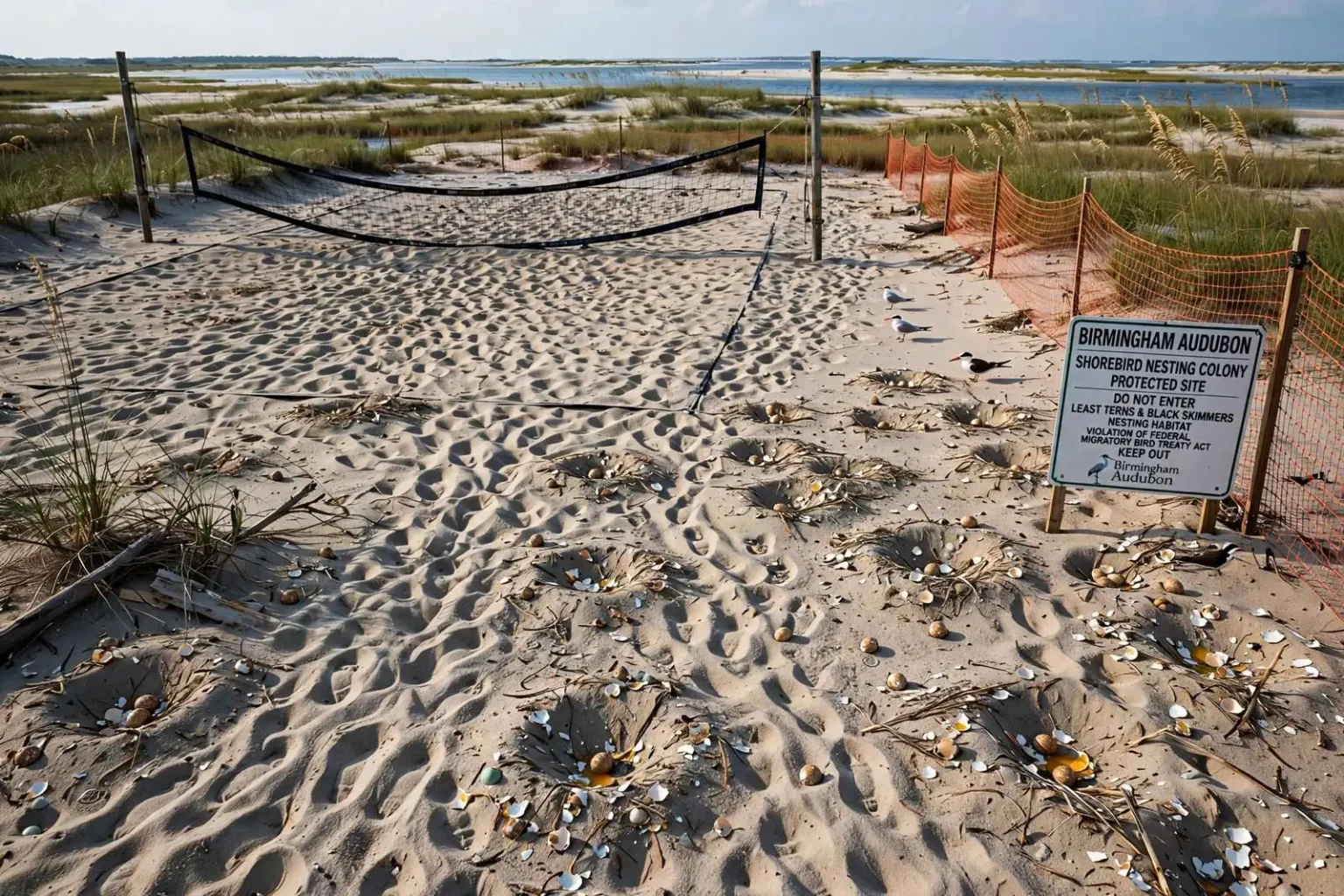
An outing to Sand Island, a small barrier island off the Alabama Gulf Coast near Dauphin Island, turned deadly for hundreds of shorebird eggs when beach volleyball players apparently set up a court in the middle of an active bird nesting colony — without realizing they were doing it. The incident, discovered over the Fourth of July holiday weekend, has become a stark illustration of how easily coastal recreation and coastal wildlife collide on Alabama’s beaches, where the most vulnerable nesting sites look to the untrained eye like nothing more than empty sand.
Unlike sea turtle nests, which are marked with stakes and warning tape along Gulf beaches each summer, shorebird nests offer almost no visual cue. Least terns and black skimmers lay camouflaged eggs in shallow scrapes on open sand, and the birds themselves blend into the beach so completely that visitors can walk through a colony without ever seeing a nest. The result, biologists say, is a recurring conflict that intensifies every July as beach crowds peak at exactly the moment late-season clutches are due to hatch.
What Happened
A Birmingham Audubon surveyor, Andrew Haffenden, was conducting a bird survey on Sand Island over the Fourth of July weekend when he discovered the damage. The birds — least terns and black skimmers, both protected species — make their nests directly in the sand and depend on the eggs and chicks being left undisturbed. When beachgoers established a volleyball court within the nesting area, they either displaced eggs or chased parent birds from their nests, exposing the eggs to the brutal summer sun and killing the unhatched chicks.
Based on the size of the nesting colony and the area disturbed, biologists believe the total number of lost eggs likely numbered in the hundreds. The loss was not concentrated in a single corner of the colony but spread across the disturbed zone, where nets, boundary lines and foot traffic had compressed an area that had held dozens of active scrapes. A volleyball court occupies a deceptively large footprint once players pace out serving lines and chasing space, and every square foot of it overlapped ground the birds had claimed for breeding.
Understanding the Impact
Least terns and black skimmers are ground-nesting shorebirds that rely on open Gulf Coast beaches to raise their young. Parent birds sit on eggs during the day to provide shade and regulate temperature. When adults are flushed from nests — either by activity or physical disruption — temperatures on a July afternoon in Alabama can destroy an entire clutch in a matter of minutes. Sand surfaces exposed to full summer sun routinely reach temperatures far hotter than the surrounding air, and an egg without its parents’ shade effectively becomes an incubator running in reverse.
Biologist Katie Barnes of Birmingham Audubon noted that the damage was significant and that the full toll may never be known, because once eggs overheat in the direct sun, the embryos inside die quickly. The uncertainty is itself part of the injury: without a precise count of active scrapes before the disturbance, the colony’s losses can only be estimated from the colony’s size and the footprint of the court. Chicks that had already hatched faced their own peril, since young shorebirds leave the nest within days and depend on open beach to forage along the waterline under their parents’ protection.
The stakes extend beyond a single weekend. Both species are protected under federal migratory bird law, and their Gulf Coast nesting populations have contracted for decades as beaches have been developed, renourished and opened to ever-heavier recreation. A colony the size of the one on Sand Island represents a meaningful share of the regional breeding effort for the year, which is why coastal bird conservation groups invest so heavily in monitoring these sites each summer.
Why Sand Island Matters to Birds
Sand Island sits at the mouth of Mobile Bay near Dauphin Island, at the western edge of a barrier island chain that shelters the bay and the Alabama port district. Its remoteness is its value: the island receives a fraction of the foot traffic of the public beaches at Dauphin Island or Gulf Shores, making it one of the few places in the region where colonial waterbirds can nest with minimal disturbance. Dauphin Island itself is celebrated among birders as one of the premier migration observation points on the Gulf, and the sandbars and islands around it function as essential waystations for species moving between the Americas.
Colonial nesting is a survival strategy that depends on numbers. By nesting in dense groups, least terns and skimmers multiply the eyes watching for predators and overwhelm gulls and crows with coordinated defense. But the same density makes a colony catastrophically sensitive to a single disturbance: one misplaced volleyball game, one off-leash dog or one drone flight can scatter hundreds of birds at once. Conservation groups post symbolic fencing and signs at colonies across the Gulf each summer precisely because the birds cannot be trained to avoid people — the burden of avoidance falls entirely on beachgoers.
For the region’s birding economy, healthy colonies are part of the attraction. Coastal Alabama draws birders from across the country during spring and fall migration, and local tourism organizations have spent years promoting the area’s birding trails and festivals. Nesting colonies that fledge young successfully each summer are the foundation of those migrations, linking the sandbars off Mobile Bay to birding economies hundreds of miles away.
A Swift Response
After the discovery, Birmingham Audubon worked quickly to rope off the nesting area, posted signage alerting visitors to the active rookery, and coordinated with local authorities to manage public access to the site. The fencing and signs serve a dual purpose: they keep feet and nets out of the colony’s core, and they explain to curious visitors exactly why the area is closed, converting a potential conflict into a recurring educational moment.
Since the barriers and signs went up, the nesting birds have been left alone and some colonies have continued to breed successfully. Late-season nests still had time to hatch before the summer’s end, and monitoring surveys have continued to track which pairs fledged young. The episode has also sharpened the conversation among coastal conservation groups about how such sites are marked and how clearly the closures communicate with the public.
Volunteers and staff with bird conservation organizations walk these colonies through the summer to document nests, count chicks and repair storm-damaged fencing, often in brutal heat. Their surveys feed state and regional databases used to evaluate shorebird population trends, which in turn guide decisions about beach management, renourishment projects and public access. The Sand Island damage was caught because a trained surveyor happened to be on the island; the episode underlines how thin the monitoring net is stretched across Alabama’s remote coastal habitats.
The incident highlights a broader challenge for the Alabama Gulf Coast: balancing recreation and protected wildlife on the same strips of sand. Conservation groups urging caution during nesting season offer a simple rule of thumb for beachgoers — watch where you walk above the high-tide line, keep pets leashed where colonies are posted, respect rope and sign boundaries, and give any cluster of small birds on open sand a wide berth. The birds nesting on Sand Island cannot read a sign or recognize a boundary line; whether the colony’s next generation survives depends almost entirely on the choices of the people who share its beach.
How Beachgoers Can Help
Conservation groups stress that most shorebird losses are unintentional, and that a few simple habits prevent nearly all of them. Nested areas that are posted with rope and signs are closed for a reason, and crossing the line — even briefly, even for a photograph — can flush hundreds of adult birds in seconds. Beachgoers who spot chicks on the sand are asked to walk around them rather than toward them, since chicks crouch motionless when approached and are nearly invisible to anyone not looking for them. Fireworks, kites and drones carry their own risks during nesting season, because the sudden noise and overhead shadows register to a colony as aerial predators.
Pet owners hold an outsized share of the responsibility. Dogs, even leashed ones, read to ground-nesting birds as predators, and an off-leash dog can destroy a colony’s season in a single visit. Local ordinances on most Alabama public beaches already restrict pets during the busy season, and conservation groups ask visitors to apply the same discipline on undeveloped islands, where the rules exist mainly on paper and enforcement depends on boaters policing themselves.
Anglers and boaters landing on remote sandbars can help by scanning the upper beach for posted boundaries before setting up gear, and by launching and beaching watercraft away from any visible cluster of birds. Left-behind fishing line and trash attract predators that prey on eggs and chicks, so packing out everything carried in is part of sharing the habitat. None of these measures requires more than attention and a few extra minutes of walking.
The birds, for their part, have shown they can recover when given the chance. Colonies along the Gulf Coast re-nest after storms, predator losses and other setbacks as long as the season leaves them time, and the Sand Island colony’s continued breeding after the fencing went up shows exactly that resilience. The difference between a bad July and a lost season is often nothing more than whether the disturbance comes early or late — and whether the people on the beach notice the birds at all.