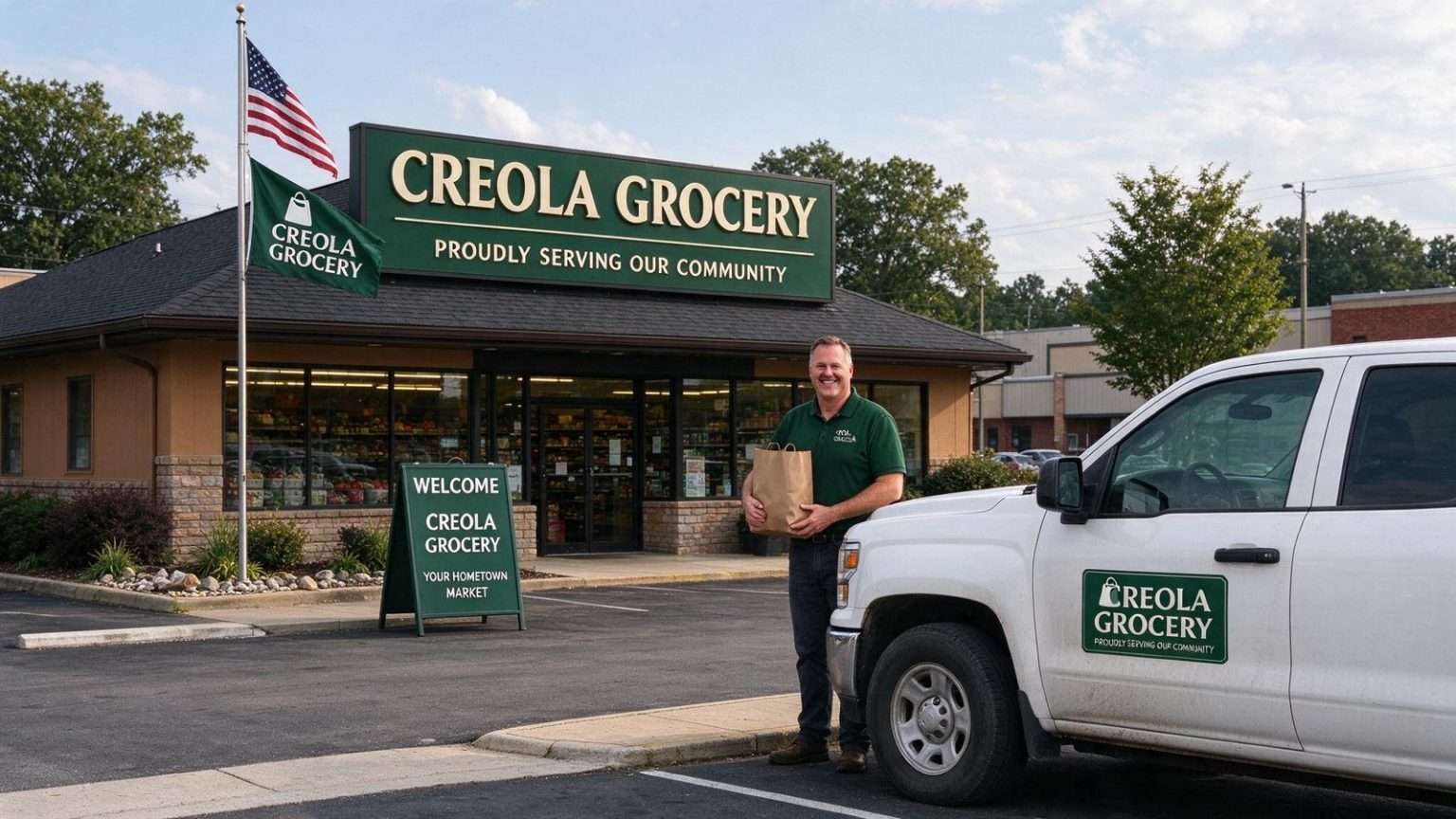
CREOLA, Ala. — Residents of this small Mobile County city will not have to lose their hometown grocery store after all. Just weeks after announcing it would close following nearly half a century in business, Platt’s Food Store has been taken over by new owners and will keep serving the community under a new name: Creola Grocery.
The announcement, shared on the store’s Facebook page earlier in the week, came as welcome relief to shoppers in Creola, a city of roughly 4,000 people north of Mobile that would otherwise have been left without a grocery option inside its city limits.
The stakes of the announcement were bigger than one storefront. Creola sits along U.S. 43 between Saraland and Mount Vernon, a small city whose residents otherwise drive to Saraland’s supermarkets or farther into Mobile for their weekly shopping. Losing Platt’s would have meant the nearest milk, bread or prescription-adjacent errand becoming a twenty-minute round trip for residents on either side of the tracks — and for older residents without easy transportation, something closer to a hardship.
A Half-Century Institution Gets a Fresh Start
Platt’s had told customers in early July that it planned to shut its doors after nearly 50 years of operation, a prospect that left many in the close-knit community disappointed. Independent groceries of that vintage are rare survivors — businesses that outlasted the supermarket chains, the discounters and the economic cycles that closed so many of their peers — and their closures are felt as civic losses, not just commercial ones.
Instead, the transition to new ownership means the store will stay open, and the incoming owners say they intend to bring back many of the products regulars have relied on for years. That promise — continuity of stock, not just continuity of doors — speaks to what the store’s shoppers actually depend on: the specific shelf mix of a hometown market, stocked the way the neighborhood has always expected.
“The store is going through some amazing changes and we ask for your patience during these changes and look forward to your business,” the store’s Facebook page told customers.
For now, shoppers can expect some disruption as shelves are restocked and operations settle in, but the message from Creola Grocery is clear: the city’s grocery story is not ending — it is starting a second chapter.
Why a Town Needs Its Grocery
When a small town loses its grocery store, the loss compounds quickly. Food-access researchers treat the closing of a town’s last full-service supermarket as a defining event — the moment a community becomes a food desert in the technical sense, regardless of how many fast-food options remain. In Creola’s case, the store’s survival preserves more than convenience; it preserves the daily errand economy that keeps residents — particularly older ones — shopping, socializing and living independently in their own town.
Grocery stores also anchor local commerce in ways chains headquartered elsewhere do not. An independent market buys from local suppliers, supports local jobs, and keeps its margins in the community. Platt’s nearly 50 years in Creola spanned the city’s incorporation in the 1950s, its growth along the U.S. 43 and I-65 corridors, and its evolution into a bedroom community for Mobile’s workforce — the store growing up alongside the families it fed.
That history explains the reaction to the closing announcement. In a city of 4,000, a store’s shutdown is not a line item; it is a civic event, and the community’s response — relief, loyalty, patience with the transition — reflects how much identity residents attach to the place where they have shopped for decades.
The Transition Under Way
An ownership change at a small grocery is a delicate operation, and the store’s message acknowledged as much. Restocking shelves under new ownership means renegotiating supplier relationships, reworking inventory, and keeping the registers running while the operation behind them changes hands. Customers will see empty rows before they see full ones, and the new owners’ appeal for patience was an acknowledgment that the short term will feel different from the long-term plan.
The commitment to bring back familiar products is also a hedge against the standard fate of transitioned stores. New owners often arrive with a plan to modernize — new point-of-sale systems, new layouts, new product lines — and lose the regulars whose daily purchases kept the old store alive. Creola Grocery’s messaging points the other way: the changes will be visible, but the essentials customers have relied on for years will return, and the business asks only for patience while it gets there.
The Facebook announcement itself reflects how such businesses now communicate. A store that has served Creola since the era of print grocery ads now reaches its customers through a social media page, where the closing news broke and where the reopening reassurance spread. For a small city’s commerce, the page functions as the store’s newspaper — and its loyalty program.
Creola and the Corridor
Creola’s position in Mobile County’s northern tier explains both the store’s importance and its precarious economics. The city fronts U.S. 43, the historic corridor that parallel-runs Interstate 65 north from Mobile, and its population of roughly 4,000 supports a modest commercial base rather than the retail density of Saraland or Prichard to its south. Grocery economics are unforgiving at that scale: a small market needs enough daily volume to cover margins that big-box chains sustain with regional distribution, and independent owners in towns Creola’s size have struggled for decades.
The store’s near-closure and rescue fit a national pattern of small-town grocery attrition — and, more recently, of rescue. Across rural America, community groups, local entrepreneurs and returning families have stepped in to take over closing stores, recognizing that a grocery’s survival and a town’s viability travel together. Creola’s transition follows that pattern: new owners, a new name, and the old customer base asked for patience while the fixtures restock.
The new name itself is a statement. Dropping the Platt’s identity for Creola Grocery ties the store to the city rather than the founding family — a signal that the business intends to be the town’s market for another generation, the way Platt’s was for the last one.
What Shoppers Will See
In the immediate term, the transition is visible in the shelves. As inventory is rebuilt and operations settle, some familiar products will be temporarily missing, some sections rearranged, and the store’s rhythm slightly off its long-established pace. The owners’ message asks regulars to ride through that period, with the promise that the staples will return as the restocking proceeds.
The deeper test will come after the transition, when the question becomes whether the new Creola Grocery can do what Platt’s did for nearly fifty years: run a profitable independent market in a town of 4,000, on a corridor where shoppers are twenty minutes from the big chains. The answer depends on exactly what the announcement appealed to — the loyalty of customers who would rather not drive to Saraland, and who understand that keeping a hometown store open requires shopping at it.
For now, Creola’s residents have what they feared losing: a grocery store inside their city limits, with a new name on the sign and the same mission it has carried since the Platt family opened its doors half a century ago. The second chapter has begun, and the community that filled the store’s parking lot for decades now holds the rest of the story in its own shopping baskets.
The July Announcement and the Rescue
The closing announcement in early July set the community’s week into motion. Customers who had shopped at Platt’s for decades — some since the store’s earliest days — faced the prospect of a city with nowhere to buy a gallon of milk, and the disappointment registered quickly across local social media and the counter conversations the store hosted daily. Independent groceries close for reasons that are rarely dramatic: thin margins, rising supplier costs, an owner’s retirement with no successor in line. Platt’s message to customers gave no detailed reasons, only the plan to shut its doors after nearly 50 years.
What followed was the rescue. New owners stepped in within weeks, and the store that was set to close instead changed names and kept its doors open. The speed of the transition suggests that the closing decision and the takeover conversations ran in parallel — a business nearing its end and a buyer waiting to catch it — but the outcome mattered more than the mechanics: Creola kept its grocery.
The Facebook announcement that delivered the news doubled as the new operation’s founding document. “The store is going through some amazing changes and we ask for your patience during these changes and look forward to your business,” the page told customers — a sentence that promised transformation, asked for grace, and courted the loyalty that would determine the store’s success.
Independent Grocers and Their Long Odds
Running an independent grocery in a town of 4,000 means competing on terms the big chains wrote. Regional supermarkets leverage distribution networks that move products at costs no single-store operator can match, and they absorb loss-leader pricing that small markets cannot. The independents that survive do it on service, proximity and specialty — the short line at the register, the owner behind the counter, the cut of meat ordered because a regular asked for it.
Platt’s survived those odds for nearly half a century, which puts it among the durable minority of Alabama’s small-town markets. The stores that close typically do so after decades of gradual erosion, and the communities around them spend years trying to replace them — through cooperatives, city incentives, or new entrepreneurs who inherit the same arithmetic that closed the last store. Creola’s new owners take on those odds knowing the community has already demonstrated its answer once: when the store announced it would close, the town treated it as unacceptable.
The transition period will be the new operation’s first argument for that loyalty. Shoppers judging by the next few weeks will see a store in motion — restocked shelves arriving unevenly, operations settling, the occasional familiar product missing while suppliers come back online. The owners’ request for patience during “some amazing changes” is the honest version of what every store transition looks like from the checkout line: slightly worse for a few weeks, with the promise of better after.
A Small City’s Second Chapter
The new name, Creola Grocery, puts the city’s name above the door in a way Platt’s never did — a deliberate tie between the store’s fate and the town’s. For a municipality that grew up along U.S. 43 while the interstate carried travelers past its exit, the grocery store is one of the few remaining pieces of a town-center economy, and keeping it open preserves more than a shopping option. It preserves a place where residents run into each other, where the community’s daily life has a physical address.
The store’s nearly 50 years under the Platt name spanned the careers of clerks who knew every order, the rise of the interstate that bypassed the town’s main street, and the growth of Mobile’s northern suburbs around it. The second chapter inherits all of that history plus the goodwill the closing announcement revealed — the relief of a town that almost lost something it did not realize it could not replace.
Creola Grocery’s opening message closed with what amounts to a partnership proposal: patience during the changes, business in return. For a city that nearly watched its last grocery store close, it is an easy bargain — the town keeps its market, and the market, restocked and renamed, keeps its town.