Bernie Dittman, the Man Who Made WABB the Sound of Mobile, Dies at 79
For nearly 50 years Bernie Dittman ran WABB as an independent family station, turning down offers from the giants of corporate radio. Colleagues remembered a fierce competitor and a loyal boss.
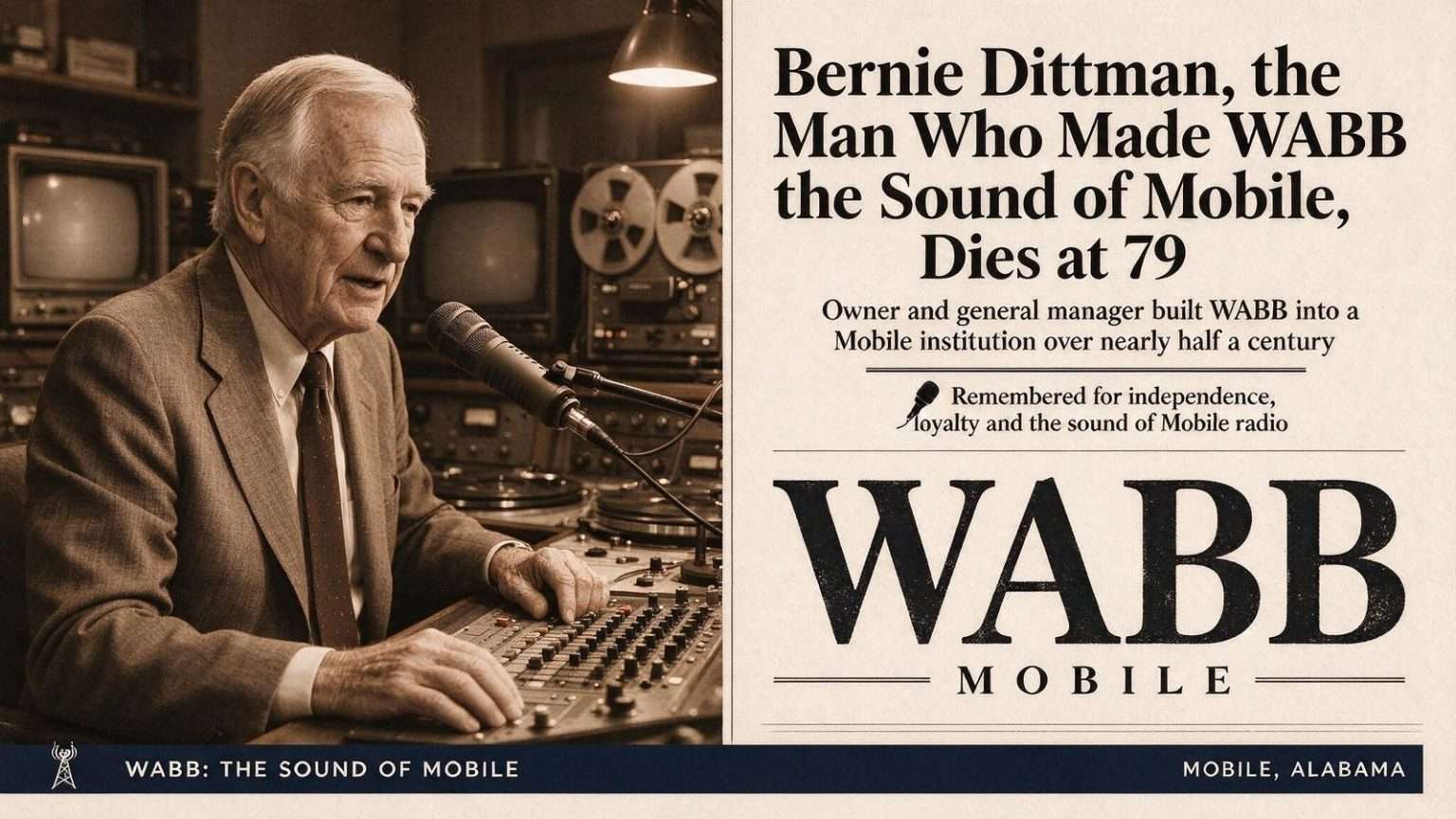
Bernie Dittman, who for nearly half a century was the one constant in the ever-changing world of Mobile radio, died Wednesday morning at the age of 79. Dittman was the owner and general manager of WABB in Mobile, a station he ran with a hands-on grip that grew rarer every year as the industry around him consolidated. He bought WABB-AM in 1959 and put WABB-FM on the air in 1973, starting it as a rock station and turning it into one of the great Top 40 stations in the Southeast.
For generations of Mobilians, WABB was the station they grew up with. Teenagers of the 1960s and 1970s caught the British Invasion and the disco years on its signal; the children of the 1980s and 1990s knew the FM side as the dominant hit-music outlet on the central Gulf Coast, the station that broke new records, ran the big promotions and sent its disc jockeys to remote broadcasts at car dealerships, burger stands and school events from Saraland to Tillman’s Corner. In a market within easy reach of New Orleans and Pensacola signals, WABB held its own for decades against owners many times Dittman’s size.
Three Rules and a High Striker
Colleagues remembered a broadcaster who was frugal by instinct and bold when he saw an opening. He gambled on Top 40 in the early 1960s and on album rock in the 1970s, and he beat back better-funded competition for decades.
“I went to the Bernie Dittman school of business and broadcasting,” said Lee Stamp, a Mobile attorney and radio veteran. “There were three rules for a successful station. Watch the budget. Play the hits. Remember rules one and two.”
That discipline showed up in the smallest details of how the station did business. Dittman’s operations ran lean, with promotions that cost little but lodged in the public memory, and with a reluctance to spend on anything that did not put the station’s name in front of listeners. Rivals with corporate budgets spent heavily on research and image campaigns; Dittman spent on ratings that could be measured and kept the rest.
He was a fixture at the Greater Gulf State Fair, where for 40 years he worked the high striker at the entrance to the midway, a simple promotion that outlasted nearly every marketing fashion the business produced. Each October, as the fairgrounds filled along Sage Avenue, fairgoers found the station’s owner himself ringing the bell, an annual bit of showmanship that connected WABB to the calendar of Mobile life the way an anchor store connects to a downtown. The fair itself was one of the Southeast’s larger traditional expositions, and for four decades the station and the event grew up together.
A Salesman First
Before radio there were televisions. Dittman told colleagues that he and his father sold TV sets in Cleveland, and that when the sets were still a novelty he would push one down the sidewalk in a baby carriage, asking passersby whether they wanted to take one of these babies home. The image — a salesman literally hauling the product into the street — was the one he carried into broadcasting, and it explained much of what he did afterward.
He talked with the biggest names in broadcasting but trusted the opinion of the average Mobilian more than the consultants. During the country boom of the 1990s, one former employee recalled, Dittman came in one day and announced: “The guy down at the Shell Station says we need to play Garth Brooks.” And so they played Garth Brooks.
The anecdote captured the method behind a career of correct instincts. While competitors subscribed to audience research firms that told them what listeners had liked last quarter, Dittman treated the gas station counter and the grocery line as his focus group, reasoning that the person pumping gas in west Mobile was telling him what the market wanted that week. In a business that increasingly managed by spreadsheet, he managed by conversation, and his stations’ longevity suggested the conversation was worth having.
Loyalty, and Second Chances
Those who worked for him described a boss who gave people second chances, and third and fourth ones. Talented broadcasters with personal troubles left in a huff and returned humbled years later, and he would hire them again when most businessmen would not.
He was also the first to integrate a white radio station in the region, according to a former disc jockey, and kept an open mind about promoting people regardless of race or gender at a time when neither was common in the business. In the segregated Gulf South of the early 1960s, that decision put WABB ahead of employers across the region, and the station’s staff became a launching pad for broadcasters whom other owners had declined to consider.
“He was a tough, tough competitor. At the end of the day, he was very professional,” said David Coppock, vice president and market manager for Clear Channel Radio in Mobile and Pensacola. “He was a true icon. He touched a lot of people who went on to significant careers.”
Coppock’s tribute carried weight precisely because it came from the other side of the consolidation Dittman had resisted. Clear Channel, the largest radio operator in the country after the deregulation of the mid-1990s, owned a block of Mobile stations and competed with WABB for audiences and advertisers every ratings period. For the manager of a corporate cluster to call the independent across town an icon was a measure of the respect his operation commanded even among those who had outspent it.
Tim Camp, who left WABB to start WNSP sports radio, recalled being told years later, “I should have listened to you,” which everyone who knew Dittman understood to be his way of admitting he had been wrong without ever quite saying so. Former employees traded such stories the way alumni trade campus legends: the apology that never quite arrived, the hire that made no business sense, the young announcer given a shift he had not earned and kept it by performing. The station functioned for decades as an informal academy, and its graduates could be heard on air in markets across the country.
That loyalty ran both directions, people who knew him said. Longtime employees stayed through format changes and ownership-era uncertainties because the boss had stayed loyal to them first, and several of the market’s best-known voices spent their whole careers in Mobile rather than move on, content to work for an owner who knew their names and their families.
An Independent to the End
Dittman was unwavering in his commitment to keep his company independently owned, turning down large offers from national broadcasting groups over the years. The offers grew larger after the Telecommunications Act of 1996 lifted the national caps on station ownership and set off a wave of consolidation in which group buyers rolled up family-owned stations across the South. Nearly every independent operator of Dittman’s generation eventually sold; he became one of the last in the market who did not, keeping Dittman Broadcasting a family company in an industry of corporate clusters.
He was instrumental in the early careers of a long list of broadcasters who went on to national reputations, and in 2005 the Alabama Broadcasters Association named him Broadcaster of the Year, an honor he accepted only reluctantly, having never cared for a spotlight he had spent 50 years pointing at other people. The association’s award, given annually to a figure whose work shaped broadcasting across the state, read as a lifetime-achievement recognition of a career spent almost entirely in one market — an increasingly rare distinction in an industry where careers and ownership alike had become national.
Survivors and Services
Dittman is survived by his wife, Judy, and three daughters, Betsey, Stephanie and Marsha.
Funeral services were set for Friday, Oct. 27, at Radney Funeral Home, 3155 Dauphin St., with visitation from 11 a.m. to 1 p.m. and a graveside service at 2 p.m. The Dauphin Street address placed the funeral home along the same west Mobile corridor where many of the market’s longtime institutions made their homes, and friends from the industry expected to fill the visitation hours alongside the listeners who had grown up with the station.
Dittman Broadcasting will continue. His daughter Betsey planned to relocate from Chicago to Mobile to take over operations of the company.
The succession promise answered the question that had hung over the market for years: what would happen to WABB when its owner finally stepped away. In an era when the death of an independent owner almost always meant a sale to a group broadcaster, the plan to keep the company in the family was the final expression of the independence that had defined his career — the last “no” to consolidation, delivered by succession rather than negotiation.
For Mobile radio, the passing marked the end of an era in the most literal sense. The market Dittman entered in 1959 was a landscape of local owners, local personalities and formats decided by judgment rather than research; the market he left was dominated by companies headquartered hundreds of miles away, running playlists assembled elsewhere. Between those two worlds he had built and kept a station that outlasted nearly everyone who had ever competed with it, run to the end on three rules — watch the budget, play the hits, and remember rules one and two.
Tributes from former employees and listeners began circulating within a day of his death, many of them recounting the same themes in different words: the second chances, the fairness across race and gender decades before it was standard, the fair each fall, and the owner who rang the bell himself. It was, colleagues said, the kind of career that could only have happened in a city the size of Mobile — big enough to sustain a great station for half a century, small enough for one man to run it by walking the halls and knowing everyone’s name.