
Bikers for Trump Group Plans Flag Drop Event on Highway 90 in Pensacola
The Bikers for Trump Northwest Florida group planned a flag drop event Saturday at 10 a.m. on Highway 90 at the I-10 overpass in Pensacola.
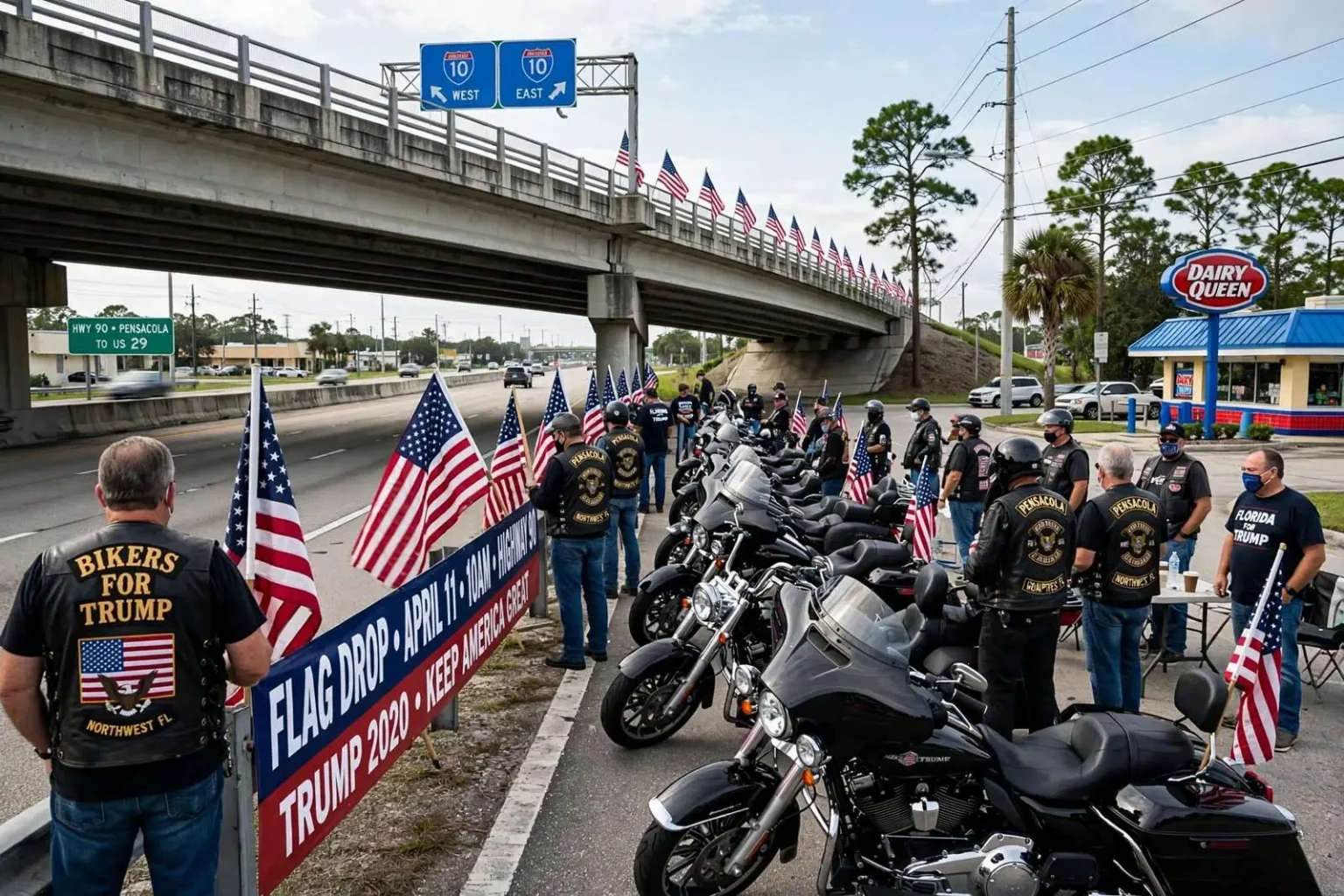
A Northwest Florida chapter of the Bikers for Trump group scheduled a flag drop event for Saturday morning in Pensacola, and organizers expected candidates and officeholders from around the state to attend. The gathering was set for 10 a.m. Saturday along Highway 90 at the Interstate 10 overpass, near the Pensacola Dairy Queen, a spot chosen for the steady stream of traffic it draws on one of the Panhandle’s busiest corridors.
According to the group, state representatives and other people running for office throughout Florida were expected to be on hand for the display. Flag drop events became a signature gathering for Bikers for Trump chapters across the country, with members lining roadways and overpasses with American flags and campaign banners to show support for President Donald Trump — a rolling, roadside rally that traded a stadium or a fairground for a highway shoulder and the constant audience of passing cars.
The Flag Drop Format
The appeal of a flag drop is its visibility and its informality. Instead of renting a venue and drawing a seated crowd, riders station themselves along an overpass and highway frontage with flags and banners, turning commuter traffic into their audience for hours at a time. Passersby respond in kind — honks of support, waves, sometimes counter-protests — and the event generates its own photographs and social media posts as travelers pull out phones from the highway below.
For the riders themselves, the format fits the culture. Motorcycle groups have long organized around visibility rides and charity runs along Florida’s highways, and the flag drop merges that tradition with political expression. Chapters schedule the events on weekend mornings when traffic is heavy, often choosing overpasses that carry interstate traffic above the older highway routes so the display is seen by both local drivers and long-distance travelers.
The Route and the Spot
Highway 90 through Pensacola is one of the Panhandle’s historic corridors — part of the old coast-to-coast route that predates the interstate system — and it remains a commercial spine lined with businesses, including the Dairy Queen near the I-10 overpass that served as the landmark for Saturday’s gathering. The overpass carries Interstate 10, the region’s main east-west artery, above Highway 90, putting any display there in view of tens of thousands of vehicles on a typical weekend morning.
That intersection of old road and new made the spot a practical stage. Riders could gather along Highway 90 with room to line up, while the flags and banners stood out against the interstate overpass where drivers entering and leaving Pensacola could hardly miss them. For an event built entirely on being seen, the location did most of the work.
Organizers expected the event to double as a political meet-and-greet, with candidates and officeholders working the crowd of riders alongside the roadway. In an election year, flag drops frequently attract politicians looking to reach the group’s engaged, energetic membership, and the Pensacola gathering was expected to feature appearances from state representatives and hopefuls from around Florida.
A Gathering in the Pandemic’s Early Weeks
The Pensacola event came during the early weeks of the coronavirus pandemic in April 2020, when many large gatherings across the Gulf Coast had been canceled or scaled back. Florida and Alabama had both declared emergencies, spring festivals along the coast had been postponed, churches had moved to online services, and public health guidance urged residents to avoid crowds and keep their distance from one another.
Against that backdrop, the flag drop’s roadside format occupied unusual ground. An outdoor event spread along a highway shoulder, with participants mostly arriving on motorcycles and remaining in the open air, differed from the packed indoor gatherings that had been canceled across the region. Organizers proceeded with the Saturday schedule while much of the region’s spring event calendar sat empty, and the group’s members — many of them veterans and older riders — weighed the same questions of caution and community that every organization faced that April.
The pandemic context also shaped what the event meant to participants. With ordinary rallies called off and daily life upended by closures, a morning on the overpass offered the kind of public gathering that had all but disappeared, and the flag display doubled as a show of continuity — a familiar event, in a familiar spot, in a spring when familiar things were scarce.
The Riders and Their Community
The people behind events like Saturday’s flag drop are, in most cases, local riders first and political volunteers second. Northwest Florida’s motorcycle community is anchored by veterans’ groups, charity-riding organizations and weekend clubs whose calendars are normally filled with benefit runs, memorial rides and fundraisers for local causes. Many of the same riders who lined the Highway 90 overpass spend other weekends riding for children’s charities or escorting the funerals of fallen service members.
That dual identity shapes how the group’s political events run. Flag drops tend to be orderly and self-policing, organized by riders accustomed to coordinating large groups on the road, with staging plans, marshals and an eye toward keeping the roadway safe for both participants and drivers. Candidates who attend learn quickly that the audience is not a passive crowd but a network — riders who communicate through chapter pages and word of mouth, and whose turnout at a roadside event is a reliable signal of the energy a campaign can expect at the polls.
Northwest Florida’s Political Ground
Northwest Florida has long been one of the most reliably conservative regions of Florida, and Pensacola-area rallies and flag displays drew steady participation from riders across Escambia and Santa Rosa counties during the 2020 election cycle. The Panhandle’s political culture — shaped by its military installations, its veterans’ community and its small-town social fabric — has made it a frequent stop for statewide and national candidates, and grassroots groups there have a reputation for turning out in numbers that belie the region’s population.
Pensacola itself sits amid that landscape as the region’s largest city, home to Naval Air Station Pensacola and a deep military tradition that runs through its economy and its politics. Events supporting the president found receptive audiences across the area, and the Bikers for Trump chapter’s event was part of a broader pattern of visible, roadside political expression that dotted the Panhandle throughout 2020 — overpass vigils, flag lines and motorcycle convoys that kept the election season in public view even as the pandemic canceled the traditional campaign trail.
Bikers for Trump as a Movement
Bikers for Trump grew from an informal collection of motorcycle enthusiasts into one of the most recognizable volunteer groups of the Trump era. Chapters formed across the country, organizing not only flag drops but ride escorts for campaign events, counter-presences at protests and charitable rides in their home regions. The group’s identity drew heavily on veterans and working riders, and its roadside events became a fixture of the 2020 campaign landscape from interstates in Florida to overpasses in the Midwest.
The flag drop was the group’s signature contribution to that landscape. Unlike a rally with speakers and a stage, a flag drop asked nothing of its audience but a glance from the road — and, in its way, delivered its message to far more people than a ticketed event could. A well-placed overpass display in a high-traffic corridor could reach tens of thousands of drivers in a single morning, which is why chapters kept returning to the format even as the pandemic reshaped every other kind of political gathering.
What Saturday Meant
For the riders gathering near the Pensacola Dairy Queen, Saturday’s event carried the layered meanings of its moment: support for a president in an election year, a community of riders maintaining its traditions through a pandemic, and a visible statement on one of the Panhandle’s busiest corridors at a time when most of the region’s public life had gone quiet. Candidates expected at the event would find an audience of committed activists whose energy — on display, honking, waving flags along the highway — was exactly what campaigns sought in the spring of a presidential year.
The event also fit the rhythm of the 2020 cycle to come. As the election year unfolded, Northwest Florida’s riders would repeat the format across Escambia and Santa Rosa counties, and the April flag drop at the Highway 90 overpass would stand as an early marker of the region’s engagement — a morning when motorcycles, American flags and campaign banners lined one of the Panhandle’s most traveled roads, and passing drivers got an unmistakable preview of the election season ahead.
Whether measured in flags hung, candidates greeted or honks answered, the Pensacola flag drop did what the format was designed to do: put its message where the traffic was, on a Saturday morning, in the heart of one of Florida’s most reliably conservative regions.


