
Biloxi Police Accused of Forcibly Relocating Homeless People to Mobile
Mobile Chief of Staff James Barber accuses Biloxi police of a pattern of transporting homeless people to Mobile and leaving them there.
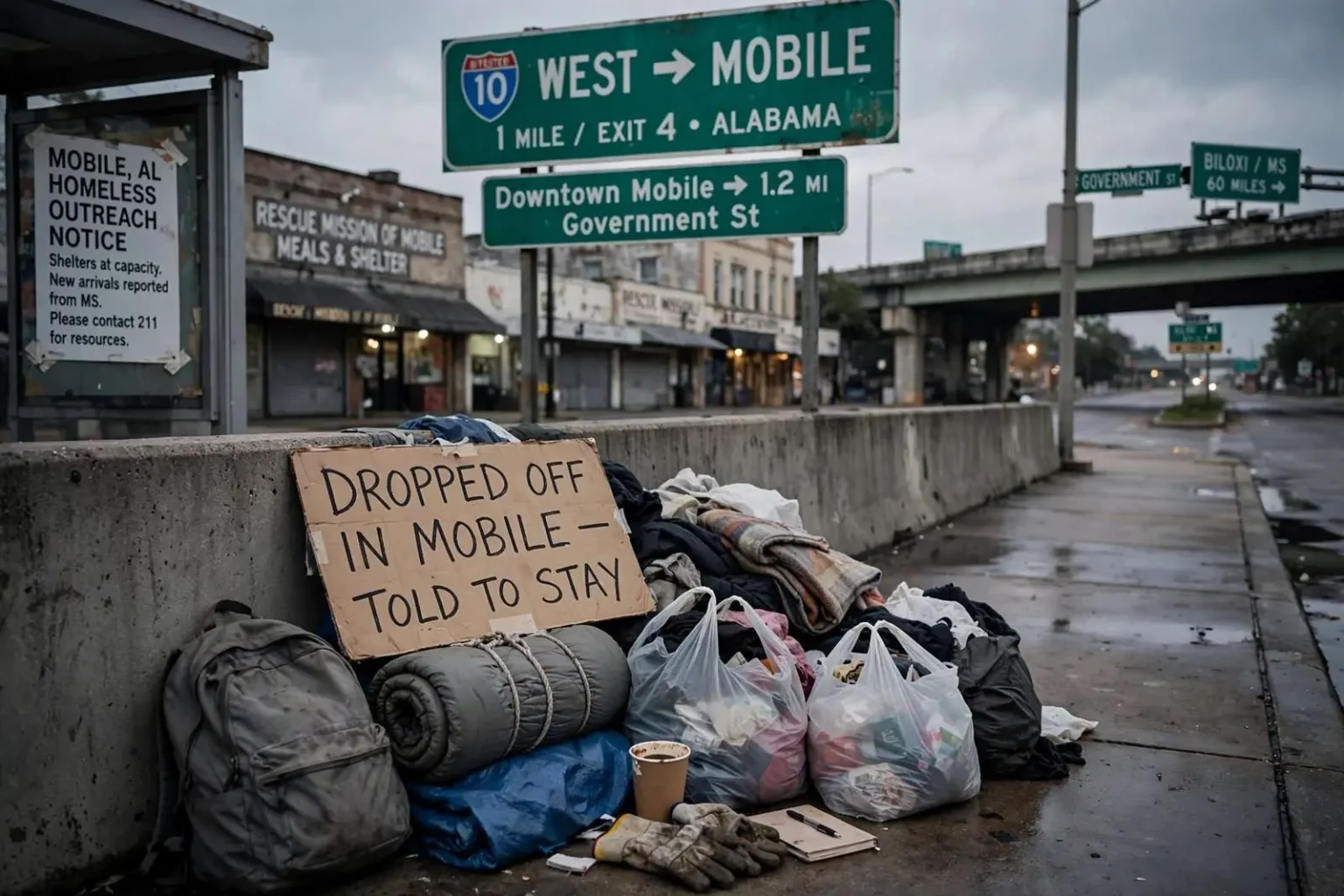
Mobile’s chief of staff has accused the Biloxi Police Department of a troubling pattern: driving homeless people across state lines and abandoning them in Mobile.
James Barber, Mobile’s chief of staff, issued an open letter to both the mayor of Biloxi and that city’s police chief addressing what he described as an apparent pattern of Biloxi police transporting people to Mobile and leaving them here.
A Cross-Border Dispute
The letter, submitted directly to Biloxi’s top elected official and its police leadership, puts the Mississippi Gulf Coast city on notice about the alleged practice. Cities along the Gulf Coast have wrestled for years with how to manage homeless populations, and the accusation raises questions about whether one municipality is simply exporting the problem to a neighboring state.
The distance involved is short — Biloxi sits roughly an hour east of Mobile along Interstate 10 — which makes the alleged practice logistically simple and, for the same reason, easy to detect. People do not vanish across a state line without leaving traces: they show up at the same missions, the same soup kitchens, the same downtown sidewalks, and the case managers who serve them hear the same story again and again. That repetition is what turns individual anecdotes into a pattern, and patterns into formal complaints between city halls.
Barber’s letter did not detail how many individuals are alleged to have been transported or when the practice began. Any response from Biloxi officials had not been made public at the time of the letter.
Mobile’s Homeless Services Under Strain
The accusation lands in a city that has built an extensive — and strained — network of homeless services. Mobile’s downtown and Midtown corridors hold the region’s largest concentration of shelters and service providers: rescue missions that operate beds and meals daily, salvation army facilities, and a coordinated network of nonprofit agencies that manage outreach, case management, and housing placement under the regional continuum-of-care structure. Those organizations serve people from across southwest Alabama, and their capacity is finite; every additional person dropped into the system without advance coordination consumes beds, vouchers, and staff time that were budgeted for the people already here.
City officials have spent years working on a strategy that pairs enforcement of ordinances against obstruction and camping with genuine pathways off the street — outreach teams that connect people to services rather than simply moving them along. The frustration behind Barber’s letter is the product of that approach: a city that invests in services watches another city’s police department, in effect, make use of them without asking.
The ethics of transporting homeless people between jurisdictions is a national issue. Across the country, agencies and cities have been accused of handing homeless individuals a bus ticket, a ride, or a nudge toward the next city over — a practice critics call homeless dumping. Defenders sometimes frame relocations as humanitarian, connecting people with family or services elsewhere, but when the destination city receives no notice and the individual receives no support on arrival, the practice amounts to shifting a problem down the road.
Biloxi’s Side of the Street
Biloxi, like Mobile, is a Gulf Coast city with a visible homeless population and its own debates about what to do about it. The city’s economy is built on casinos, tourism, and the service industries that support them, and its police department patrols a waterfront district where panhandling and public camping draw regular complaints. Mississippi Gulf Coast cities have cooperated — and feuded — for years over how to share the burden of social problems that do not respect municipal lines, and this dispute fits squarely into that history.
The silence from Biloxi at the time of the letter left the accusations unanswered. A police department accused of systematically transporting people out of its jurisdiction would face several obvious questions: what policy authorized the transports, who approved them, and whether anyone at Biloxi City Hall knew. The answers matter not only for the two cities but for every municipality along the Coast, because a practice one department adopts quietly can become an expectation the next department follows.
What an Open Letter Can Do
Barber’s choice of format — an open letter to the mayor and police chief — is itself significant. An internal phone call keeps a dispute private; a public letter makes it a matter of record, forcing a response and inviting the press to keep asking. Cities generally prefer to resolve inter-municipal disputes quietly, which suggests Mobile officials believed quieter channels had already been tried, or that the pattern had gone on long enough that the public needed to know.
The letter also serves the people at the center of it. Homeless individuals transported across a state line lose whatever fragile connections they had — a case manager who knew their history, a clinic that held their records, a bed they could return to. Arriving in a new city, they start from zero, and the receiving community’s providers often have no idea who they are or what services they qualify for. Mississippi and Alabama operate separate systems, so even benefits and identification documents can complicate a fresh start.
The Regional Stakes
Mobile, Biloxi, Gulfport, and Pascagoula form a chain of cities along 100 miles of Interstate 10, and their homeless populations have always moved among them — for work, for family, for shelter availability. The region’s providers know this, and the better ones coordinate informally across the line. What the letter alleges is different: not movement by choice, but movement by police transport, with Mobile as the destination of record.
The practical question the two cities must answer is simple: if Biloxi police transported people to Mobile, did they do so under any policy, and if not, will they stop? The longer answer involves whether the Gulf Coast’s cities can build the kind of coordination their providers already practice — shared intake information, honest communication between city halls, and an agreement that no city solves its homelessness numbers by making another city’s numbers worse.
Until Biloxi responds, the letter stands as Mobile’s position on the record: the city will serve people in need, but it will not quietly accept becoming the Gulf Coast’s dumping ground. How Biloxi’s leadership answers — whether with denial, explanation, or a policy change — will determine whether this becomes a settled dispute or a continuing sore point between two cities that share a coastline, a highway, and more problems than either can handle alone.
Who James Barber Is and Why the Messenger Matters
The weight of the accusation comes in part from who delivered it. Barber serves as chief of staff in Mobile’s mayor’s office — the administration’s chief operating officer and one of the few officials with standing to speak for the city on intergovernmental matters. A complaint from an advocate can be dismissed as opinion; a letter from the chief of staff to a peer city’s mayor and police chief reads as the city of Mobile’s official position. That is precisely why the format was chosen, and why the letter’s public release signaled that Mobile considers the matter unresolved at the staff level.
Mobile’s city administration has made downtown redevelopment a signature priority, and visible homelessness intersects with that work daily. City leaders have consistently argued that the answer is more housing and services, not less visibility — a position that makes an allegation of interstate dumping all the more galling, because it means the city’s investment in beds and case management is being quietly drawn on by a jurisdiction that contributes nothing to it.
The Legal Line Between Relocation and Dumping
There is a legal and ethical line between helping someone relocate and transporting them to be someone else’s problem. Police agencies across the country have, at times, driven homeless individuals to the edge of their jurisdictions or bought them bus tickets out of town, and courts and civil rights groups have repeatedly challenged the practice. Transporting a person across state lines without their genuine consent, without notice to the receiving community, and without any plan for their arrival can implicate a range of concerns — from false imprisonment questions to the basic due-process problem of a government agency making decisions about where a person may live.
Nobody in Mobile has alleged criminal conduct in the letter, and none of the reporting on it suggests charges are contemplated. The remedy being sought is diplomatic, not legal: acknowledgment, communication, and an end to the practice. Inter-city disputes of this kind are usually settled exactly this way — a public letter, a private conversation, and a new understanding about what will and will not happen on the highway between two city limits signs.
What Comes Next on the Gulf Coast
The episode will likely end up as a footnote in the long-running conversation about regional homelessness — or a turning point, depending on what Biloxi does next. Gulf Coast providers have suggested for years that the real solution is regional: shared funding for shelters and services, coordinated intake so people are not shuffled between systems, and honest data about where people come from and where they end up. Mobile County’s continuum of care already tracks that data for the people it serves, and adding the Mississippi Coast’s systems to that conversation would give both states a clearer picture than either has now.
For the individuals caught in the middle, none of the municipal politics changes their situation much. A person dropped on a Mobile sidewalk still needs a bed that night, a meal, and someone to help untangle the paperwork of starting over. Mobile’s missions and outreach teams will do what they always do, regardless of where the person started the day. The letter’s promise, in effect, is that Mobile will keep doing that work — and that Biloxi will not be permitted to pretend otherwise.
The cities share more than a highway. They share an economy, a hurricane history, and a population that moves freely between them. Homelessness is not one city’s problem, and the letter from Mobile’s chief of staff is, at bottom, an invitation for Biloxi to treat it that way. The next move belongs across the state line.


