Biloxi police seek help identifying credit card fraud suspect
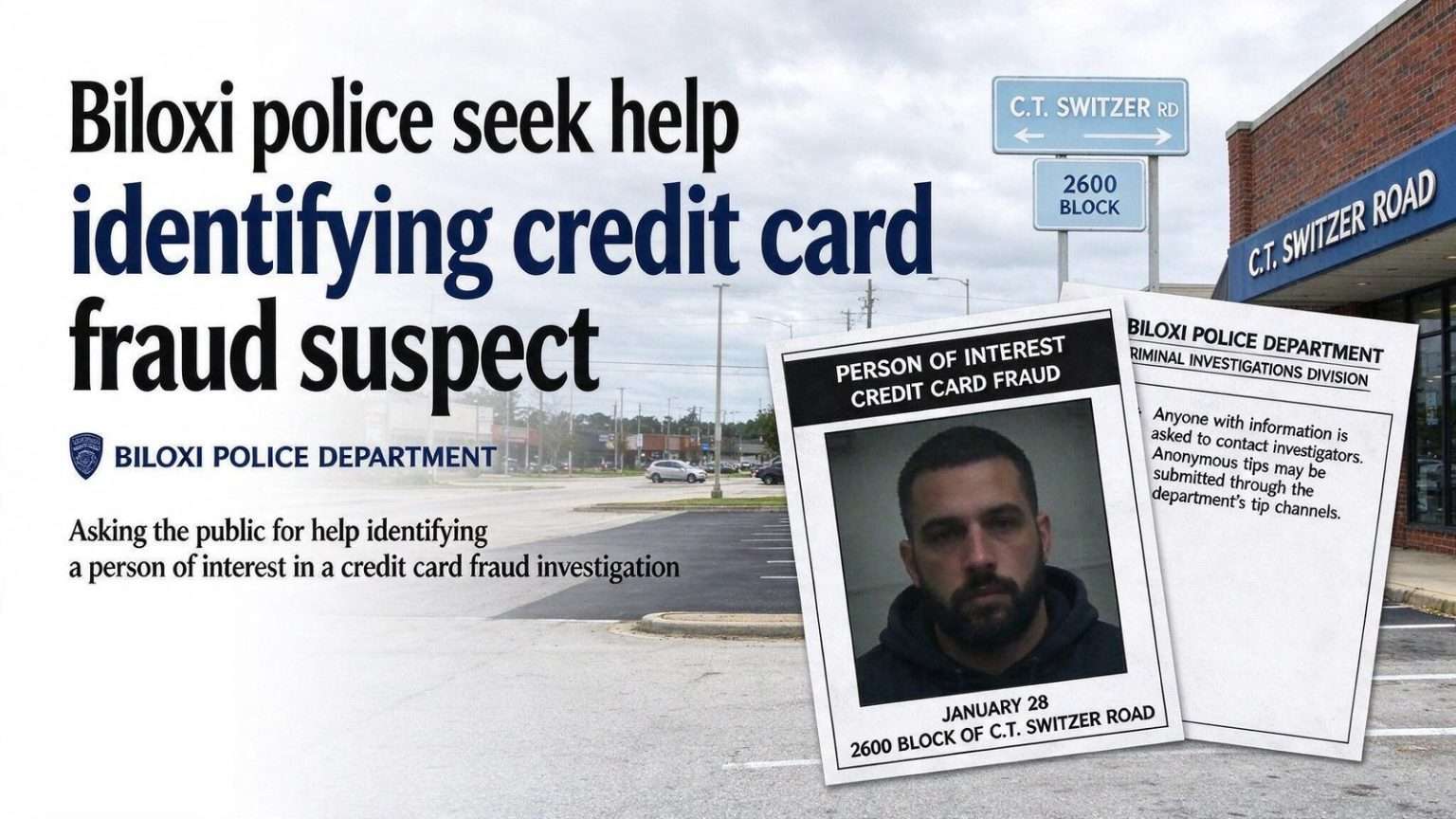
Biloxi police are asking for the public's help identifying a man wanted for questioning in a credit card fraud case on C.T. Switzer Road.
Biloxi Police Ask Public to Help Identify Fraud Suspect
Biloxi police are asking the public for help identifying a man they want to question in connection with a credit card fraud case. Investigators said the fraud occurred Jan. 28 in the 2600 block of C.T. Switzer Road. The Biloxi Police Department’s Criminal Investigations Division is asking anyone with information to come forward. Police emphasized the man is wanted for questioning only.
The case is a familiar one for Gulf Coast police departments: a fraud caught on camera, a suspect whose name investigators do not yet know, and a public appeal built on the hope that someone in the community will recognize the face. Credit card fraud moves fast — a stolen card or stolen card number is used quickly, often within hours — so the department’s appeal came with a specific date and location attached, the two anchors investigators need the public to think against.
The 2600 block of C.T. Switzer Road sits in west Biloxi, an area of retail shops, service businesses and commercial strips that serve the neighborhoods well back from the beachfront highway. Businesses there handle card transactions by the hundreds every day, which makes them both efficient and vulnerable: a single stolen card or skimmed account can pass through a register in seconds, and the fraud is often discovered only when the cardholder reviews a statement or the bank flags unusual activity. When that discovery points to a transaction on C.T. Switzer Road on Jan. 28, investigators start working backward from the receipt.
The phrase police used — wanted for questioning only — carries specific meaning. No warrant has been announced, and no formal charge; investigators want to talk with the man in the images, not accuse him. The distinction protects the process: identification is not conviction, and departments phrase their appeals carefully so that a mistaken identity does not become an accusation. Members of the public who recognize the man are asked to contact investigators rather than confront anyone themselves.
How Credit Card Fraud Investigations Unfold
A credit card fraud case typically begins with a report from the victim or the bank, and it advances through a chain of records: where the card was used, at what time, for how much, and who appeared on any camera at the counter. Every transaction leaves a timestamp, and businesses along commercial corridors like C.T. Switzer Road generally maintain surveillance systems that give investigators still images worth publishing. From there, the work is identification — someone must recognize the face, the clothing, the vehicle or the routine.
Investigators from the Criminal Investigations Division handle that work. The division’s detectives carry caseloads that run from property crimes to person crimes, and fraud cases occupy a large share of the volume: they are common, they cross jurisdictional lines easily, and they succeed or fail on the quality of the documentation. In a case like this one, a detective will pull transaction records from the bank, request the merchant’s video, check whether the same card or the same suspect appears in other reports, and build a timeline that can support charges once a name is attached.
The public’s part in that process is decisive in ways that modern databases have not replaced. Facial recognition and records checks help when a suspect is already known to the system, but a first-time offender — or a visitor passing through the city — is identified the old way: someone who knows him sees the image and makes the call. Biloxi’s population swells and shifts with tourism and the casino economy, which makes community recognition both harder and more valuable, and the department’s appeal was aimed at the residents most likely to know the faces in their own commercial corridors.
The Jan. 28 date also serves the public. People who were in the 2600 block of C.T. Switzer Road that day — shopping, working, delivering — hold fragments of the picture investigators want: who was in the lot, what vehicles were parked there, what they might have seen. Appeals with a date and a place generate better tips than appeals with a description alone, which is why detectives construct them that way.
The wider context of financial crime on the Mississippi Gulf Coast shapes how detectives work these cases. Fraud rarely stays within one city’s limits: a suspect who uses a stolen card in Biloxi may have taken it in Gulfport, live in D’Iberville, or run the account dry in Pascagoula, and the same face can turn up in another agency’s case file. Detective divisions along the coast compare notes through regional channels for exactly this reason, and a published image from a Biloxi case sometimes produces a call from a neighboring jurisdiction that recognizes the man from its own investigation. Every identification, wherever it starts, has a way of unraveling a larger pattern.
Biloxi’s Fraud Landscape
Biloxi’s economy makes the city a recurring setting for financial crimes of every description. The casino resorts, the restaurants and shops that serve them, and the steady movement of visitors along the coast create an environment where cards change hands constantly and fraudulent transactions can hide in the volume. Police investigate fraud cases ranging from counterfeit cards to account takeovers to the classic stolen wallet used at a retail counter, and the department’s public appeals — like this one — are the standard tool for the cases where cameras caught a face but records produced no name.
C.T. Switzer Road itself is part of the west Biloxi commercial grid, a corridor of businesses that serve the residential neighborhoods between the Back Bay and the highway. For the businesses there, a fraud incident is more than a loss on one transaction: chargebacks cost merchants money, repeated incidents raise processing scrutiny, and staff time goes to responding to investigators. Merchants along corridors like this one generally cooperate closely with police, preserving video and transaction records the moment a case touches their register.
Employees are often the most overlooked witnesses in a case like this one. The clerk who ran the transaction, the stocker who noticed a man lingering near the registers, the driver who saw a car idling oddly in the lot — each holds a detail that no camera caught, and each may not realize its value until an appeal like the department’s makes clear what investigators are looking for. Retail workers on corridors like C.T. Switzer Road process hundreds of faces a day, but memory sharpens when a date is supplied, and the police department’s appeal is calculated to jog exactly those memories.
For cardholders, the case is a reminder of the habits that limit fraud’s damage. Reviewing statements promptly, reporting unfamiliar charges to the bank immediately, and filing a police report when a card is stolen all shorten the window in which a thief can use the account. Federal protections cap cardholder losses on fraudulent credit card charges when they are reported, but the report still has to be made — and the faster the bank and police hear about it, the better the record they can build.
How to Help
The Biloxi Police Department’s Criminal Investigations Division is asking anyone with information about the man in the case, or about the Jan. 28 fraud in the 2600 block of C.T. Switzer Road, to come forward. Callers can reach the department directly, and those who prefer to remain anonymous can use the department’s tip channels. Investigators ask for specifics — where the person was seen, when, and any vehicle involved — because a tip with a detail attached is the one that closes a case.
The emphasis on questioning only remains the operative fact of the appeal. The man investigators want to talk to may be a suspect, a witness, or a victim of identity theft whose own information was used — fraud cases sometimes reveal a second victim behind the first. Until investigators have spoken with him, the department describes the case as an identification effort, not a manhunt, and the public’s role is to help put a name to a face.
Fraud cases of this kind rarely stay open long once images are published. Someone along the coast knows the man in the photographs — a coworker, a neighbor, a relative — and the department’s request is that that person, or anyone else with information, make the call. The transaction on C.T. Switzer Road on Jan. 28 left a paper trail; what it needs now is a name, and the Biloxi Police Department is asking the community to supply it.
Until that call comes, the case remains open on a detective’s desk, and the window the department hopes to close is the one that matters most to victims: the sooner a fraud actor is identified, the sooner the pattern of activity stops and the sooner cardholders see restitution move through the process. The Criminal Investigations Division’s appeal stands open, the images remain available through the department, and the residents of Biloxi — who have helped close countless cases like this one — are once again the detectives’ most important resource.