Blount High Extends Opening-Day Shutdown Another Day as AC Repairs Drag On
Blount High School in Prichard remained closed Wednesday after air conditioning trouble sent students home on the first day of school.
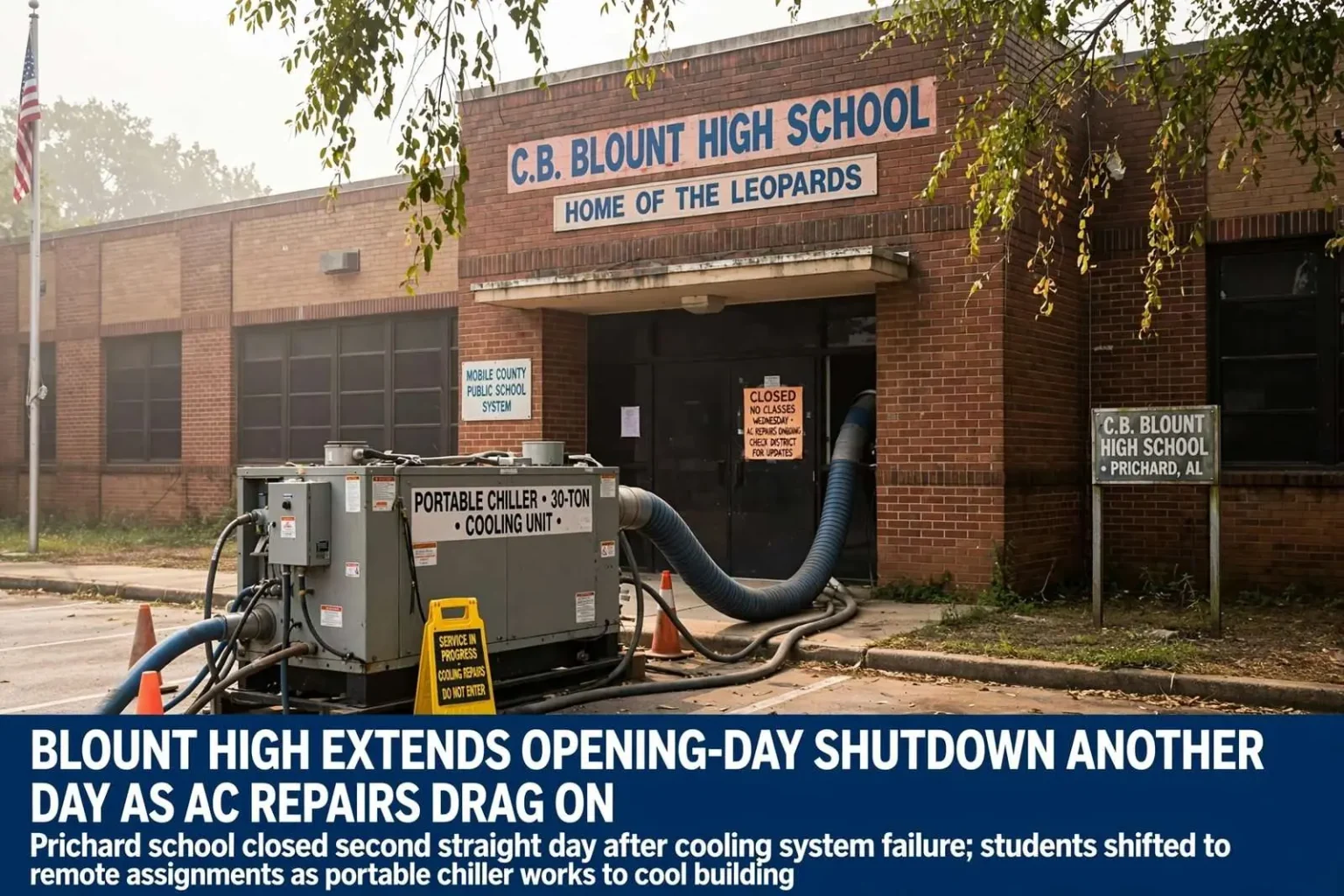
Blount High School in Prichard kept its doors closed for a second straight day Wednesday after an air conditioning failure cut short the school’s first day of classes. Students were sent home Tuesday, the opening day of the school year, because of technical difficulties with the cooling system, and the building remained too warm for classes to resume on time.
A Tuesday afternoon post from the school suggested classes would resume Wednesday, but the Mobile County Public School System confirmed that morning that the building would remain closed another day. The reversal left families scrambling for child care and transportation with little notice, a familiar frustration in districts where aging buildings and late-summer heat combine to make cooling failures a recurring back-to-school hazard.
According to the district, a portable chiller had been installed at the school, but the building remained warm. Officials expected temperatures inside to drop through the day, setting up a Thursday return to class. In the meantime, students were given ACT workbooks and other assignments to complete before classes resume, keeping the interrupted start of the semester from becoming two entirely lost days of instruction.
An aging building in an Alabama summer
C.B. Blount High School serves students in Prichard, one of Mobile County’s older cities, as part of the Mobile County Public School System, the largest school district in Alabama. Late August in southwest Alabama brings heat indexes that regularly push past 100 degrees, and a school without functioning air conditioning is not merely uncomfortable, it is untenable. Brick-and-block buildings built decades ago hold heat like ovens once their cooling systems fail, and classroom temperatures can climb into the 90s within hours of a shutdown.
Mobile County’s school buildings include some of the oldest continuously operating campuses in the state, and HVAC failures spike predictably in August, when systems that idled or struggled through summer maintenance are suddenly asked to cool full buildings in peak heat. Districts across the Gulf Coast have faced the same pattern in recent years, opening schools in August heat and then sending students home when chillers, rooftop units or aging ductwork give out. Portable chillers, like the one installed at Blount, are the standard stopgap: industrial cooling units rolled into place to supplement or replace a failed central system while permanent repairs are made.
Those stopgaps take time to move the needle in a large building. A portable chiller does not simply flip a switch and restore comfort; it has to be connected to the building’s airflow, and a structure that has already absorbed days of August heat cools slowly from the outside in. District officials monitoring temperatures through the day made the call Wednesday morning to extend the closure rather than bring students back into a building that had not yet recovered.
Keeping students on track during the shutdown
With the building closed, the school moved to keep the lost days from becoming lost learning. Students were sent home with ACT workbooks and other assignments, and additional work was posted to the school’s Facebook page and to Schoology, the learning management system the district uses to distribute materials and collect completed work. The approach reflects how ordinary the remote-assignment playbook has become for schools since the pandemic normalized digital distribution of coursework.
The ACT emphasis is not incidental. Alabama has historically administered the ACT to high school juniors statewide as part of its college-and-career readiness framework, and performance on the college entrance exam is a factor in school accountability ratings and in students’ scholarship prospects. Blount students losing classroom time at the start of the year miss foundational review, and the workbooks sent home are a way to keep test preparation moving while the building is offline. For juniors and seniors, early-year ACT preparation carries real consequences for the spring testing calendar.
Schoology, the platform hosting additional assignments, allows teachers to post readings, videos and problem sets that students can complete from home and submit electronically. Families without home internet access, a persistent gap in parts of Mobile County, can pick up printed materials or use assignments distributed through the school’s social media channels. The layered approach, paper workbooks, Facebook posts and online coursework, is designed to reach students regardless of connectivity.
What the closure means for the school calendar
A two-day instructional loss at the start of a school year is more than an inconvenience. Districts build a small number of contingency days into their calendars for exactly this kind of disruption, and Alabama law requires a minimum number of instructional hours for a school year. Whether the Blount closure requires make-up time depends on decisions by the Mobile County Public School System, which has historically evaluated each closure individually rather than automatically scheduling make-up days for short weather or facility-related shutdowns.
The timing compounds the disruption. The first days of school set classroom routines, distribute schedules and materials, and establish the relationships between teachers and students that carry a semester. Two days of closure mean those routines start late, and high school students in particular lose early momentum in courses that move quickly toward graduation requirements. Extracurricular schedules, athletic practices and orientation activities tied to the first week also shuffle as officials await a confirmed reopening date.
For families, the closure forced rapid adjustments. Working parents in Prichard and the surrounding communities had to arrange supervision for teenagers on short notice, and students who depend on school breakfast and lunch programs lost access to those meals while the building was closed. Districts in Mobile County have historically worked with community partners to provide meals during extended closures, though a two-day facility shutdown is typically managed by families themselves with little formal support.
The broader infrastructure question
The Blount closure lands in the middle of a long-running conversation about school facility funding in Alabama. School systems across the state have cataloged hundreds of millions of dollars in deferred maintenance needs, and cooling systems sit near the top of the list in the Gulf Coast climate, where equipment runs nearly year-round. Capital funding for school construction and renovation in Alabama flows from a mix of local property taxes, state bond issues and Public School and College Authority appropriations, and districts the size of Mobile County’s face a constant triage between new construction and keeping existing buildings operational.
Until permanent repairs are complete at Blount, the portable chiller and the repair timeline will determine whether students return Thursday as expected. School officials have indicated that updates will continue to come through the district and the school’s Facebook page, and families were urged to watch both channels Wednesday evening for confirmation of the Thursday reopening. Students, meanwhile, have workbooks to finish and online assignments to submit, making sure that whenever the doors reopen, the semester picks up where it left off rather than starting over.
How the district communicates closure decisions
The back-and-forth between Tuesday afternoon and Wednesday morning illustrated the communication challenge districts face during facility emergencies. A school-level social media post signaling a Wednesday return was superseded by the district’s confirmation that the building would stay closed, a sequence that underscores why Mobile County Public School System officials generally ask families to treat district-level announcements as the authoritative source. The school’s Facebook page remains the fastest channel for assignment updates, but reopening decisions flow through the district’s central administration and are announced through its official channels.
That structure exists because closure decisions involve more than one building’s conditions. District facilities staff assess repair progress, transportation officials confirm whether buses can run normal routes, and administrators weigh the instructional and operational consequences of reopening a building that might need to close again midweek. A premature reopening that fails, sending students home a second time after families have rearranged their days, is worse in practice than one extra day of caution, which is the calculus that produced the Wednesday morning announcement.
Prichard and its high school
Blount High School anchors public education in Prichard, a city just north of Mobile that has weathered decades of economic change. The school draws students from the city’s neighborhoods and surrounding communities in northern Mobile County, and its programs include career and technical education pathways alongside its college-preparatory coursework. Generations of families in Prichard have sent children through the school, and its football games and graduation ceremonies remain among the city’s signature community gatherings.
The school’s place in the community raises the stakes of disruptions like this week’s closure. In cities where the high school functions as a civic hub, a building that cannot open is not just a classroom problem, it is a neighborhood event that parents discuss at work, at church and online. Social media channels associated with the school carry that civic weight, which is why assignment posts and closure updates circulate rapidly through the community within hours of going up.
For now, the district’s message to Blount families is straightforward: the building is expected to be ready for students Thursday, assignments are available through the workbook, the school’s Facebook page and Schoology, and officials will confirm the reopening through the same channels families have been watching all week. The first days of the school year will start late at Blount, but they will start, and the work students complete at home in the meantime will count toward the semester that finally gets underway.