Blue Marlin Grand Championship Brings Elite Sportfishing Fleet Back to Orange Beach
The Blue Marlin Grand Championship set a tournament record with a $2.1 million purse in 2026, as 75 teams launched from Orange Beach chasing the biggest blue marlin in the Gulf.
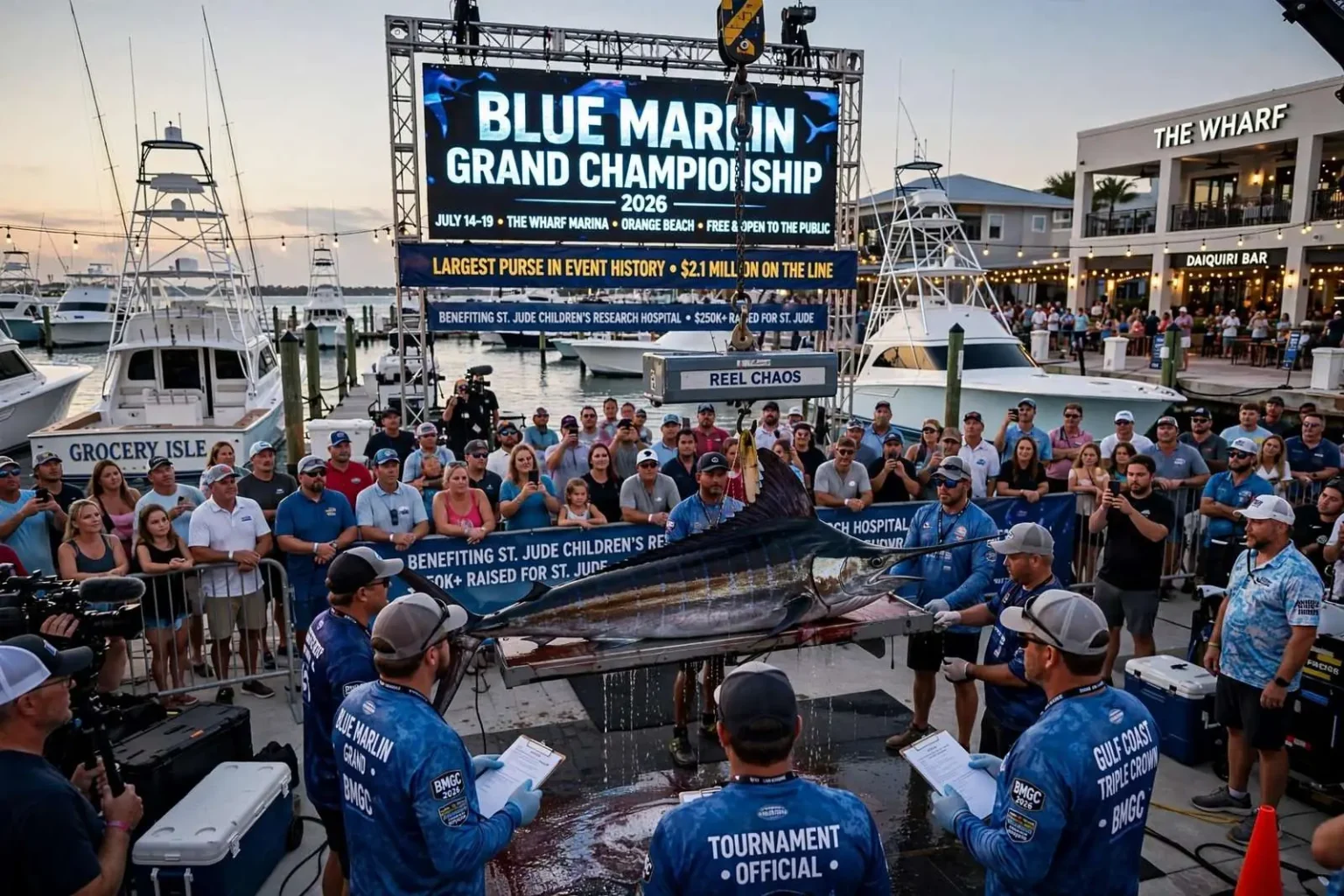
For one week each July, the docks at The Wharf Marina in Orange Beach become the most closely watched stretch of waterfront on the Alabama coast. The Blue Marlin Grand Championship returns July 14 through 19, 2026, bringing with it the largest big-game fishing tournament on the Gulf Coast and, unusually for an event of this caliber, admission that costs spectators nothing at all.
2026 Tournament Update
This year’s tournament launched with a shotgun start as 75 teams from across the country headed out through Perdido Pass chasing the largest payout in the event’s history. Tournament host Jim Cox said $2.1 million was on the line this year, the biggest purse the tournament has offered. “It’s going to be a huge Happy Gilmore check that they’re going to have hanging up in their tackle room or their house or somewhere for the rest of their life,” Cox said of the winning team’s prize.
Cox said the heaviest blue marlin brought to the scale wins the tournament, and recent history shows it takes a serious fish to do it. “Over the past 13 years, the average winning weight is about 668 pounds,” Cox said. “So you’re going to need a big fish to win the tournament.” Catches began hitting the scales Friday evening at The Wharf, with the tournament concluding Saturday evening as all 75 teams returned for a final weigh-in.
The Schedule
The tournament is headquartered at The Wharf Marina, 4673 Wharf Parkway, Orange Beach. Fishing days run July 16 through 18. Each morning the fleet departs through Perdido Pass, with a shotgun start at 10 a.m.
That departure is worth seeing in its own right. Alabama Point and the Perdido Pass Seawall both offer solid public vantage points to watch a procession of multi-million-dollar sportfishing boats run the pass in sequence. It is free, it happens in daylight, and it requires nothing more than showing up.
The weigh-ins are the main event for spectators. Friday and Saturday nights draw the biggest crowds, and they are open to the public at no charge.
The Scale of It
Since its debut in 2012, the BMGC has grown into the Gulf’s premier big-game tournament. The 2025 edition set a record with 15,770 spectators packed in for the Saturday night weigh-in, where 66 elite teams competed for a $1.8 million purse.
The winning boat, Grocery Isle, brought a 746.2-pound blue marlin to the scale. Angler Donny Rouse collected $405,977.80 in prize money for the effort. Those are the numbers that explain why crews travel from across the Gulf and beyond to be here.
The Triple Crown Stakes
The BMGC is the final leg of the Gulf Coast Triple Crown, and that status transforms it. Teams that have fished the series all summer arrive in Orange Beach knowing the championship will be settled on these docks. A team must compete in the BMGC to be eligible for the Triple Crown title at all, which means the entire summer converges here.
Competition categories include:
- Blue marlin (weighed) — the headline division and the one that fills the seawall.
- Catch-and-release — points accumulate without a fish ever reaching the dock.
- Tuna
- Dolphin
- Wahoo
The release division introduces genuine strategic tension. Because points can be accumulated without weighing a fish, a team could conceivably win the Triple Crown without ever bringing a marlin to the scale. Standings stay unpredictable until the final night, which is precisely what organizers want.
The Billfish Arena
Organizers have leaned hard into spectacle. During weigh-in nights The Wharf is converted into what they call a Billfish Arena, outfitted with giant LED screens, a concert-grade sound system and live coverage of the scale. Captains have compared the walk to the weigh station to stepping onto a rock concert stage.
It is a deliberate choice. Sportfishing is, for most of its duration, an activity that happens far offshore and out of sight. The weigh-in is the only moment the public can share, and the BMGC has built its entire spectator experience around maximizing it.
Making a Night of It
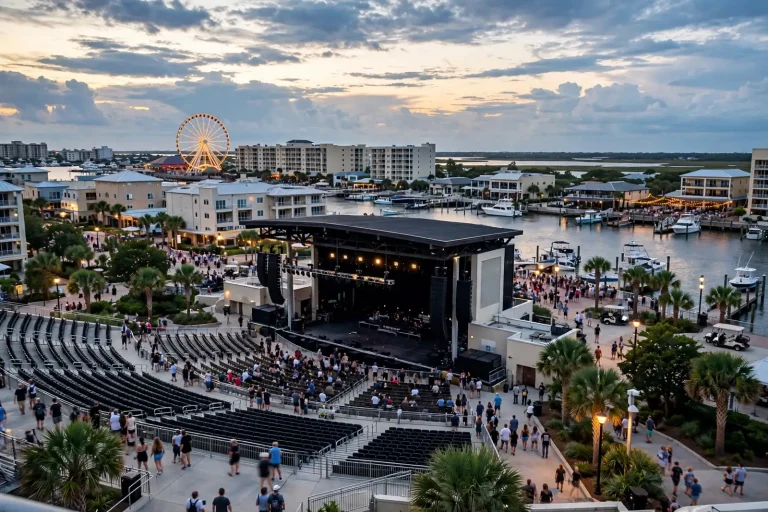
The Wharf is a full entertainment complex, which makes the tournament unusually accessible for families who have no particular interest in billfish. Valigios, Tee Off at the Wharf, Gulf Babe and The Daiquiri Bar all sit within easy walking distance of the marina, and the complex’s retail shops and attractions fill the hours before the scales open.
Crowds on Friday and Saturday nights are substantial. Arriving early is advisable, both for parking and for any hope of a clear view of the scale.
Charity Component
The tournament has raised more than $250,000 to date for St. Jude Children’s Research Hospital. That charitable dimension has become a fixture of the event and part of how the BMGC positions itself within the broader Orange Beach community rather than as a closed competition among a wealthy fleet.
Economic Weight for Orange Beach
A week that draws tens of thousands of spectators and dozens of large sportfishing vessels lands squarely in the middle of the summer season. Marina slips, fuel, provisions, lodging, restaurants and retail all absorb the surge. For a city whose economy is built on visitors, the BMGC is both a marquee event and a reliable revenue week. A full schedule of events is available through the tournament’s official website.