Boat Catches Fire Near Baldwin Beach Express in Orange Beach
A boat caught fire near the Baldwin Beach Express in Orange Beach around 1 p.m. Wednesday. No injuries were confirmed and no cause was determined.
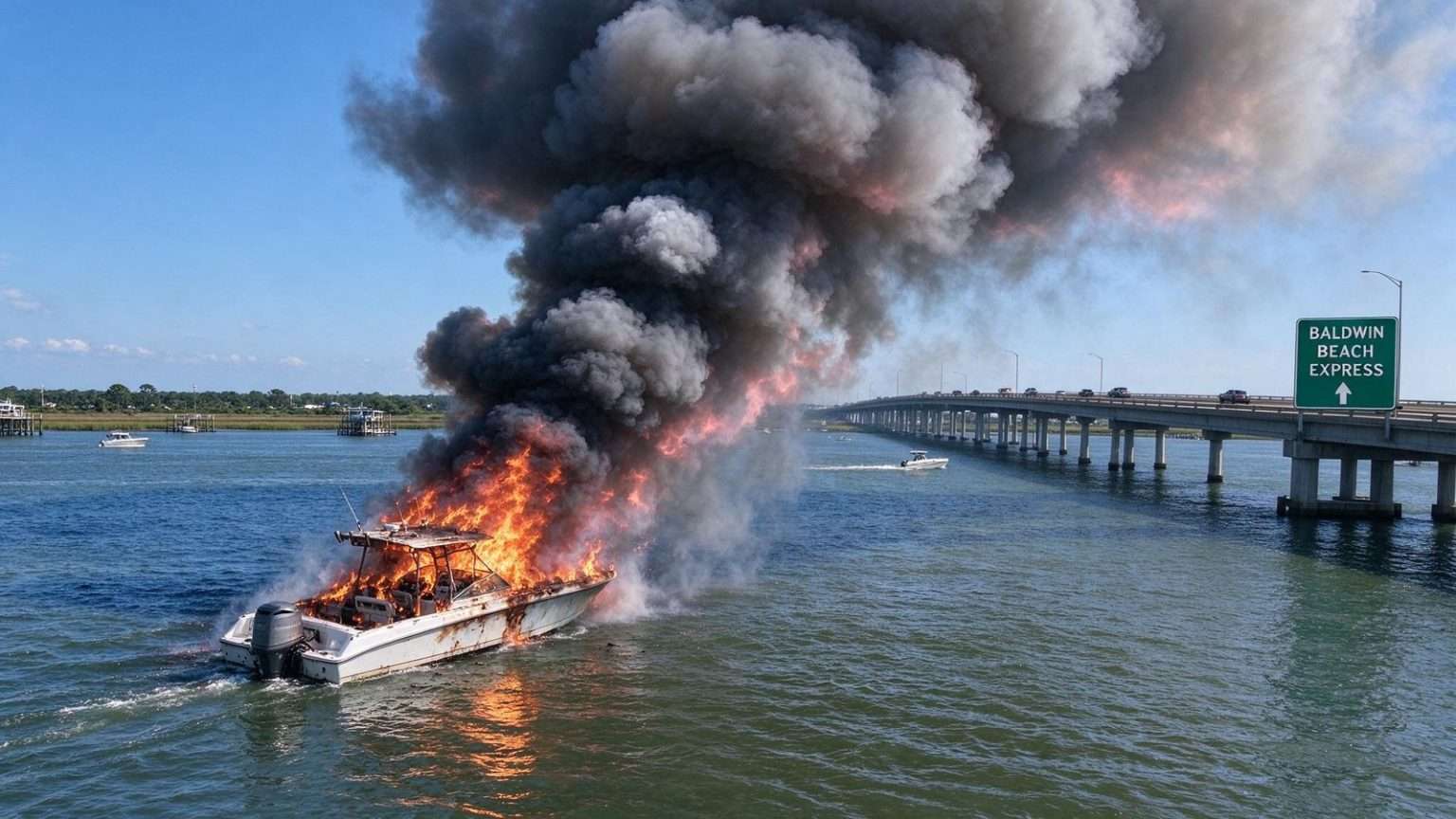
A boat caught fire near the Baldwin Beach Express in Orange Beach on Wednesday afternoon, drawing attention from passersby who watched smoke rise from the vessel. The fire was reported around 1 p.m., and the sight of a burning boat on the water just off one of the area’s busiest highway corridors quickly drew onlookers and questions from travelers along the roadway.
Video of the burning boat circulated after the fact, showing the vessel alight on the water near the roadway. The footage captured the kind of scene that is rare on land but familiar to anyone who has spent time around busy coastal waterways: thick black smoke, visible from a distance, pouring off a fiberglass hull as fire worked through the boat’s compartments. Motorists crossing the bridge and residents along the adjacent canals were among those who spotted the smoke and shared images and clips online within minutes.
No information was released on whether anyone aboard was hurt, and no cause of the fire had been determined at the time. It was not stated how many people were on the boat or whether anyone had to be pulled from the water. Authorities had not said which agency led the response, and details such as the vessel’s size, ownership, and condition after the fire were not immediately available. Investigations of boat fires typically take time, since investigators must examine fuel systems, wiring, and engine compartments before reaching conclusions about ignition sources.
A Busy Stretch of Coastal Water
The Baldwin Beach Express is a major north-south route carrying traffic toward the Alabama beaches, and the waterways it crosses see heavy recreational boat traffic in the summer months, particularly around the Fourth of July holiday. The roadway’s bridge spans put drivers close to the water, which is why incidents on the waterway there so quickly become visible to the traveling public. On a summer afternoon, the channels around Orange Beach carry a dense mix of fishing boats, pontoon rentals, personal watercraft, and larger cruisers heading between the Intracoastal Waterway, Perdido Bay, and the Gulf.
That traffic density raises the stakes whenever something goes wrong on the water. A disabled or burning vessel can drift into the path of other boats, and rescuers must account for both the people on the stricken craft and the vessels crowding around to look. Boaters are generally urged to keep their distance from an emergency scene, both to give responders room to work and to avoid adding to the hazards from fuel, debris, or smoke drifting downwind.
Boat fires are among the harder incidents for responders to handle, because fuel and fiberglass burn fast, the vessel cannot simply be walked away from, and crews often have to reach the scene by water. Unlike a structure fire with a fixed address, a fire on a boat in a channel or canal requires responders to stage equipment on vessels or along the shoreline, and water access limits what apparatus can be brought alongside. Burning fiberglass produces dense, toxic smoke, and a hull filled with gasoline vapors can flash or explode, forcing crews to attack from a distance and letting the boat burn rather than risking lives to save it.
Marine fire response in the Orange Beach area typically draws on the city’s fire and police marine units, with mutual aid from neighboring departments and, in serious cases, state and federal partners. The Intracoastal Waterway and the back bays are laced with canals and marinas where vessels are moored close together, so responders also weigh the risk of a fire spreading to nearby boats or docks when deciding how aggressively to approach. Environmental considerations follow as well, since fuel and oil released from a burned vessel require containment to protect the sensitive estuary waters.
What Boaters Can Do to Prevent and Survive a Fire
Boating safety guidance generally urges operators to keep a marine-rated fire extinguisher aboard, wear life jackets, and get everyone off a burning vessel and clear of it as quickly as possible rather than trying to fight a spreading fire. Coast Guard-approved extinguishers are required equipment on most powered vessels, and boaters are advised to check charge indicators and mounting locations before every outing. Fueling practices matter too: running blowers after fueling, sniffing for fumes in the bilge, and never refueling with engines running are among the habits that prevent most fuel-related ignitions.
Electrical faults are the other leading cause of boat fires, particularly on older vessels where wiring has been patched over the years or where aftermarket electronics have been added without proper protection. Corroded connections, chafed wiring runs, and overloaded circuits can heat silently in a compartment no one opens during a routine day on the water, which is why inspections and early-season maintenance checks pay for themselves. Battery charging systems and shore power connections deserve particular attention in a boating community where many vessels sit plugged in at dock for days at a time.
If a fire does start, the priority order is simple: stop the boat, position it so smoke blows away from others, shut off fuel lines if it can be done safely, use the extinguisher only if the fire is small and contained, and otherwise get everyone into life jackets and into the water or a rescue craft at a safe distance. A burning boat can be replaced; the people who were on it cannot. Wednesday’s incident near the Baldwin Beach Express ended without reported injuries, and it stands as a visual reminder of why the boring safety checklist, extinguisher checks, blower runs, and clear-headed abandon-ship decisions, is the one that matters most on the water.
The stretch of water where Wednesday’s fire occurred sits within one of the most heavily used boating regions on the northern Gulf Coast. Orange Beach and neighboring Gulf Shores anchor a fleet that swells each summer as visitors launch at public ramps, rent from marinas, and run the channels between the Intracoastal Waterway, Wolf Bay, Perdido Bay, and the passes that reach the Gulf of Mexico. On peak weekends, marine officers and the Coast Guard auxiliary spend as much time on navigation and courtesy patrols as they do on enforcement, and incidents anywhere near the main channels are visible to dozens of boats within a mile.
The Baldwin Beach Express itself, opened to carry beach traffic off the crowded Highway 161 and Canal Road corridors, was designed with those waterways in mind. Its spans cross the canal and connecting waters at a height and alignment that keep vehicles moving while passing over the boat traffic below, and the bridge has become a landmark that locals use when describing locations on the water. An incident visible from the bridge, as Wednesday’s fire was, is effectively visible to all of Baldwin County’s beach-bound traffic in real time, which explains how quickly photos and video spread.
How Marine Fire Investigations Work
When authorities begin piecing together what caused a boat fire, the work looks quite different from a vehicle or building investigation. The vessel itself is often the only evidence, and it may be partially sunk, towed to a lift, or burned to the waterline by the time investigators can safely board. Investigators document the engine compartment, fuel system, electrical panels, and any portable fuel containers, looking for the origin point and whether flammable liquids, wiring, or mechanical failure started the sequence. Interviews with the operator, passengers, and witnesses who saw the fire begin fill in the timeline.
Insurance carriers are closely involved in that process, since the vessel is typically a significant covered loss and the cause determination affects how a claim is handled. Marine surveyors photograph and examine the hull, and salvage crews manage any pollution risk from remaining fuel and oil. In cases like Wednesday’s, where no injuries were reported, the investigative focus narrows to the vessel and its systems, and the results, if released at all, often come weeks later once the examination is complete.
What Nearby Boaters Should Watch For
The incident is also a reminder to boaters of how quickly conditions can change in crowded summer water. Fire and smoke downwind can drift across an anchorage or a channel in minutes, and vessels near a burning boat face both the flammable sheen that fuel spreads on the surface and the traffic hazard of everyone slowing to look. Standard practice is to move away upwind, alert others on marine radio if equipped, and stand by to assist only if doing so can be done without putting additional people in the water.
For residents and visitors who follow such events from the shore or the roadway, the images that circulated Wednesday captured a rare but real hazard of Gulf Coast life. The waterways that make Orange Beach a destination are working channels and gathering places, with all of the risks that heavy use brings, and the people who enjoy them most safely are the ones who treat every outing with the same attention to fuel, fire, and flotation that this week’s smoke made impossible to ignore.