
Body Found in Tillman’s Corner Hotel Room Under Investigation by Mobile Police
Mobile police investigated after a dead body was found inside a Baymont Inn and Suites hotel room in Tillman's Corner Sunday morning.
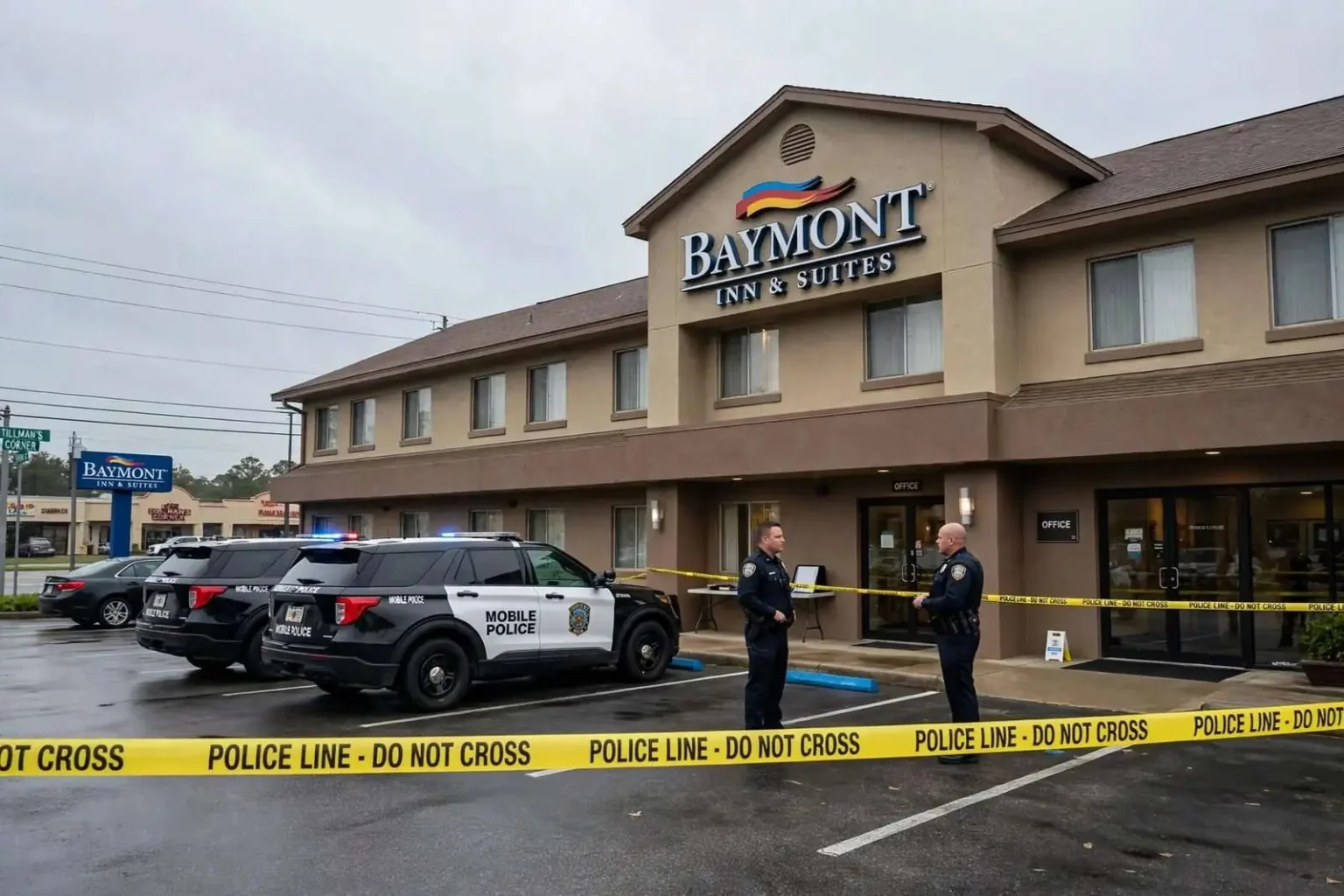
TILLMAN’S CORNER, Ala. — Mobile police are investigating after a body was discovered inside a hotel room in the Tillman’s Corner area Sunday morning. The discovery put the department’s investigators to work on a death whose cause and manner remained unknown as the weekend closed, with few details released to the public.
The discovery was made in a room at the Baymont Inn and Suites, according to authorities. The hotel sits along the commercial corridor of Tillman’s Corner, the busy south Mobile district where businesses, restaurants, and lodging properties line the main routes serving the city’s southern reaches.
Police have not determined whether the death was a suicide or a homicide. That distinction — the manner of death — is the central question in any unattended death, and investigators had not reached a conclusion when the case became public. Until the medical examiner’s review and the police investigation converge, the case remains open in every direction.
Officials released no other details about the person found or the circumstances, citing the active investigation. Authorities said more information would be released as the inquiry progresses, a position that leaves family notifications, evidence work, and the medical examiner’s findings ahead of any public accounting.
Tillman’s Corner and Its Corridors
Tillman’s Corner is one of Mobile’s major commercial districts, centered where several main thoroughfares converge in the southern part of the city. The area developed as a retail and service hub serving neighborhoods stretching toward the bay and the county line, and its mix of businesses includes the lodging properties that serve travelers, workers on temporary assignments, and long-term guests.
Hotels along corridors like this one see a constant turnover of guests, and they occupy a particular place in police work: a large property with many rooms, steady traffic day and night, and staff who are frequently the first to encounter anything unusual. A death in a hotel room brings investigators into that environment, where privacy and anonymity are part of what the property sells.
The district is served by police precincts and fire stations positioned across south Mobile, giving the area quick emergency coverage. A Sunday-morning discovery, with the weekend’s steady hotel traffic as backdrop, set the department’s standard sequence in motion from the first call.
How an Unattended Death Is Worked
A body found in a hotel room with no obvious explanation falls into the category police call an unattended death — a death that occurs outside medical care and without a doctor able to certify the cause. Every unattended death gets a full response: patrol secures the scene, investigators take over the room, and the medical examiner’s office is called to claim the body and determine the cause and manner of death.
The early hours are devoted to the scene itself. Investigators document the room in detail, collect any evidence present, and interview hotel staff and guests about who entered the room, when, and under what circumstances. Registration records, surveillance video, and housekeeping schedules all become part of the timeline that establishes the person’s last known activity.
The medical examiner’s work runs on its own track. An autopsy determines the medical cause of death — the injury or condition that ended a life — while the manner of death, the classification that distinguishes natural death, accident, suicide, or homicide, comes from the combination of autopsy findings, toxicology results, and the circumstances investigators document.
That division of labor is why police could not say whether the death was a suicide or a homicide. The answer requires evidence that takes days, sometimes weeks, to assemble, and announcing a preliminary conclusion that later changes serves no one — least of all a family already dealing with a loss.
Why Departments Limit What They Say
The minimal public statement in a case like this follows department practice rather than secrecy for its own sake. Investigators withhold the identity of the deceased until family members are notified — a rule that exists to ensure relatives hear of a death from authorities, not from a news report — and they withhold details of the scene and circumstances because those details are the pieces only a person connected to the death would know.
Withholding specifics also protects the investigation’s integrity. If the case turns out to involve foul play, the details kept from public release become the means of testing whether a suspect’s account of events is genuine. Investigators treat every unattended death as potentially criminal until the evidence says otherwise, and the public statements are written with that possibility in mind.
The promise that more information would be released as the inquiry progresses is the standard commitment in these cases. Depending on the findings, the next update may come quickly — if the death is determined to be natural or self-inflicted with no third party involved — or it may come only after an arrest, if the investigation goes in that direction.
Hotel Deaths and Police Work in South Mobile
Deaths in hotel rooms occupy a familiar niche in urban police work. Most resolve as medical events — a guest found by housekeeping after dying of natural causes, an overdose, or a medical emergency unnoticed overnight. A smaller number involve foul play, and the ambiguity of a hotel room — a place where guests come and go without local ties — means investigators work each case without presuming the outcome.
The Baymont Inn and Suites property is part of a national chain, one of the mid-scale lodging brands operating along the Tillman’s Corner corridor. Properties of this kind maintain their own security cameras and guest records, tools that investigators use routinely to reconstruct a guest’s stay when something goes wrong in a room.
For the department, the Sunday-morning discovery meant pulling investigators on a weekend, securing a scene in an operating hotel, and managing a case whose most basic questions — who the person was, how they died, and whether anyone else was involved — were all unanswered at the outset. That is the standard starting point for an unattended death, and the work that follows is methodical by design.
The Medical Examiner’s Role in Mobile County
Deaths that fall under medical examiner jurisdiction in Mobile County — unattended deaths, suspicious deaths, accidents, and suicides among them — are referred to the county’s forensic authority, which conducts the examinations that produce official cause-of-death findings. The office’s determinations feed directly into the police investigation and into death certificates, insurance matters, and any criminal proceedings that follow.
Toxicology is typically the longest step. Results that establish or rule out the presence of drugs, alcohol, or other substances routinely take weeks to return, which is why families and investigators alike often wait on a final manner-of-death ruling long after an autopsy itself is complete. Police sometimes close their investigation in the interim and reopen the classification if toxicology changes the picture.
The cooperation between investigators and the medical examiner’s office is the mechanism that turns a Sunday-morning discovery into a definitive account. Until both tracks conclude, the case officially remains what it was at the start — an active investigation into a death whose circumstances had not been determined.
What the Public Can Expect
Residents tracking the case should expect updates to come only when investigators have something firm to say. The department’s practice in unattended deaths is to confirm the basics — that a body was found, where, and when — and to go quiet while the work proceeds, releasing the identity after family notification and the manner of death once the evidence supports it.
The Sunday-morning discovery at the Baymont Inn and Suites in Tillman’s Corner remained in that holding pattern. Police had not named the person found, had not said when the person died or who found the body, and had not ruled in either direction on the question that defines the case — whether the death was a suicide or a homicide.
What authorities said publicly was limited to the essentials: a body was discovered in a hotel room Sunday morning in the Tillman’s Corner area, the death had not been classified, and the investigation was active. More information, officials said, would be released as the inquiry progresses — the standard closing note on a case whose answers were still being assembled.
The First Call and the First Hours
Every case like this one begins the same way: a call to 911, a patrol response, and a room that becomes a scene the moment officers confirm what they are dealing with. From that point, the room is closed to everyone but investigators and the medical examiner’s personnel, and the hotel’s normal operations continue around a small area of the property that has become part of a death investigation.
Patrol officers handle the perimeter and the preliminaries — identifying who reported the discovery, holding witnesses on scene, and starting the log of everyone who enters or leaves the room. Detectives then take the scene, bringing the documentation and evidence-collection work that will define everything the case can prove later.
The first hours also set the family-notification process in motion. Identifying a deceased guest means working through registration records, personal effects, and, when needed, fingerprints or other confirmation with outside agencies. Once identity is established, the notification to next of kin comes before any public release of the person’s name — a sequence that exists to spare families the shock of learning of a death from a stranger or a headline.
A Community Waiting on Answers
For the Tillman’s Corner community, a death investigation at one of the district’s hotels is a jarring note in a corridor known for its commerce and its bustle. Residents and hotel guests followed the case through the weekend’s end and into the week, with the visible signs limited to investigators’ vehicles and the closed section of the property.
The questions the case leaves open are the ones the investigation itself is designed to answer. Who the person was, how they came to be in the room, what led to their death, and whether anyone else bears responsibility — each is a question the department’s investigators and the county’s forensic system were built to resolve, and each was unanswered in the initial public report.
The case remained active as of the initial announcement, with Mobile police holding to the standard sequence that governs every unattended death in the city: secure the scene, establish the identity, let the medical examiner’s work and the detective work converge, and release what can be confirmed — no more, no less — as the inquiry progresses.


