Body of woman recovered from Escambia County waterway near Ruby’s Fish Camp
The body of a woman who drowned was recovered near Ruby's Fish Camp at a boat launch in Escambia County, Florida. The medical examiner is identifying her.
Body of Woman Recovered from Escambia County Waterway Near Ruby’s Fish Camp
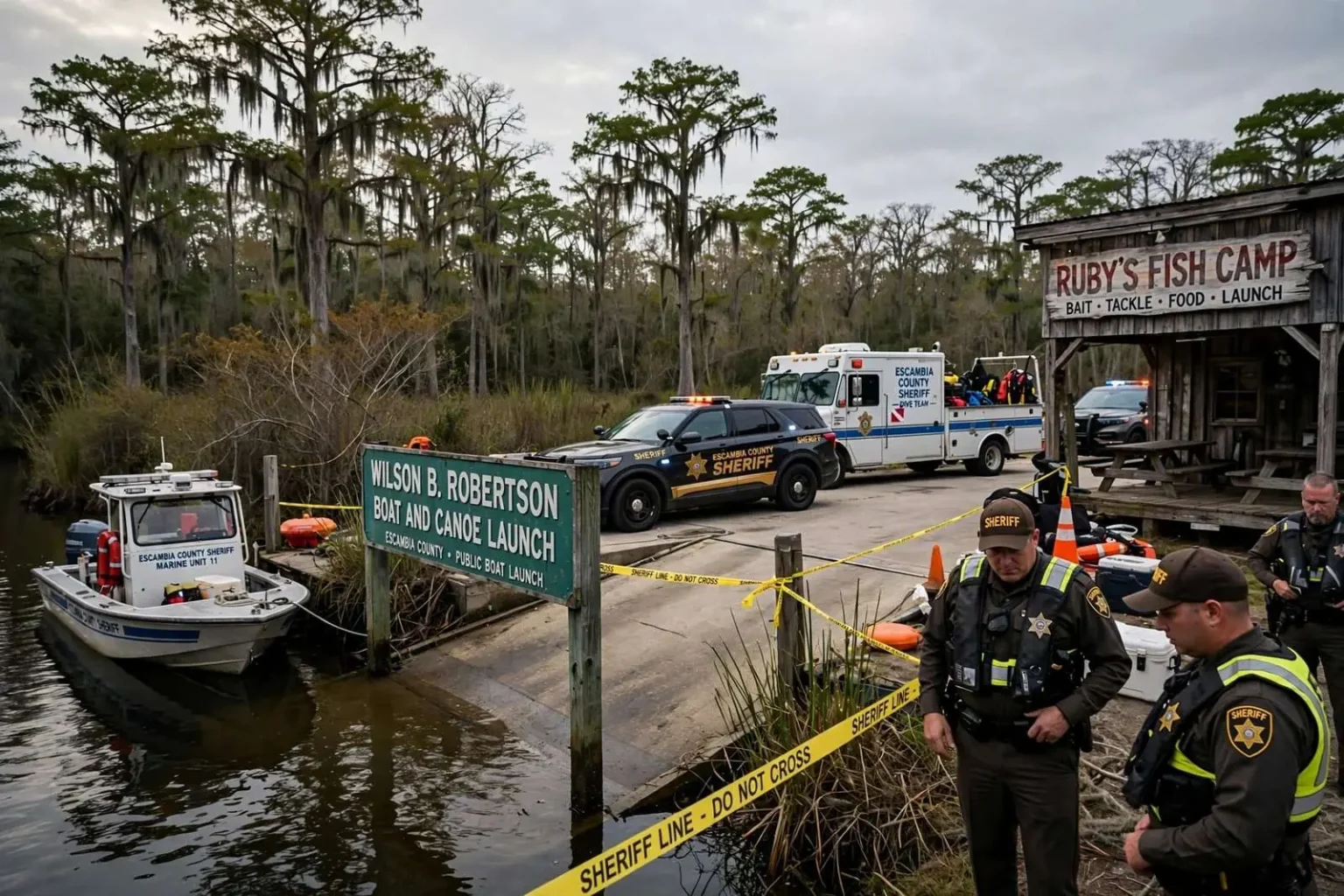
The body of a woman who drowned has been recovered near Ruby’s Fish Camp in Escambia County, Florida, according to authorities, bringing a somber end to a recovery operation along one of the county’s popular waterfront spots. The victim was located Friday afternoon around 5 p.m. at the Wilson B. Robertson Boat and Canoe Launch, the public landing that shares the waterway with the nearby fish camp.
Officials have not released her name, and the medical examiner is working to confirm her identity. Details about how the drowning occurred have not been made public, and investigators have been careful not to speculate while the facts are still being established. The Escambia County Sheriff’s Office is handling the recovery, and the investigation remains open as identification is completed.
Recovery operations of this kind draw on specialized resources. Sheriff’s offices in waterfront counties maintain dive teams and marine units trained to search dark, tangled freshwater environments — work that is slow, methodical and demanding — and they coordinate with fire rescue personnel and the medical examiner’s office once a victim is located.
The Scene: Robertson Landing and Ruby’s Fish Camp
The Wilson B. Robertson Boat and Canoe Launch sits on a waterway in the northwestern part of Escambia County, near the Alabama line, and serves boaters, paddlers and anglers who use the river and its connecting creeks. Ruby’s Fish Camp, a longtime gathering spot nearby, is known in the community as a place where fishing tournaments, cookouts and weekend crowds bring people to the water’s edge.
The landings and camps along the region’s rivers see steady use throughout the year. Freshwater fishing, kayaking and canoeing are staples of life in rural Escambia County, and public launch sites like Robertson Landing give residents access to waters that wind through swampy, forested country. But the same waterways carry inherent risks: currents that shift with rainfall, sudden drop-offs, submerged logs and stumps, and water that is often far murkier than it appears from the bank.
That combination — heavy recreational use and natural hazards — is why drownings along Northwest Florida’s rivers and creeks remain a persistent concern for emergency officials, who repeat the same advice every season: wear a life jacket, avoid alcohol on the water, keep watch over children near the bank, and never swim alone in unfamiliar water.
How a Drowning Investigation Proceeds
When a body is recovered from a waterway, the medical examiner’s role becomes central. Before any name can be made public, the examiner’s office must confirm who the person is, typically through identification provided by family, medical records or other means, and then work to establish the cause and manner of death. In a drowning case, that examination answers questions the recovery itself cannot — whether the death was accidental, whether other factors contributed, and whether anything about the circumstances requires further investigation.
The Escambia County Sheriff’s Office investigation runs on a parallel track. Detectives document the scene, interview anyone who was at the launch or the fish camp when the woman was last seen or first reported, and gather physical evidence before releasing the area. Officials emphasized that no details about how the drowning occurred have been made public, which is standard practice early in such cases: premature conclusions can color witness accounts and complicate the work of the medical examiner.
The timing of the recovery — Friday afternoon around 5 p.m. — suggests the operation extended into the end of the workweek, when the landing would ordinarily be drawing its first weekend visitors. Deputies secured the site during the recovery, and authorities have not said how long the woman had been in the water or who reported the initial emergency.
Water Safety on the Panhandle’s Rivers
Escambia County’s waterways drain a wide swath of the Gulf Coast, flowing south toward Pensacola Bay, and the county’s rural northern rivers are bordered by some of the most scenic paddling country in Florida. State and local agencies have invested in public launches, paddling trails and river access points across the region to encourage outdoor recreation, and sites like the Wilson B. Robertson launch are part of that network.
The safety message that accompanies those investments is constant. Florida consistently records hundreds of unintentional drownings each year, among the highest totals in the nation, and freshwater incidents account for a significant share. Safety officials urge anyone on the water to wear a properly fitted life jacket rather than simply carrying one aboard, noting that currents and cold-water shock defeat even strong swimmers. They also warn about river currents after heavy rain — a frequent hazard in the Panhandle, where storms can raise water levels and speed dramatically within hours.
Alcohol is another recurring factor. Fish camps and landings are social settings, and investigators across the country have repeatedly linked fatal water incidents to drinking on the bank or in the boat. Florida law treats boating under the influence as a criminal offense, and public safety campaigns each summer press the point that judgment on the water matters as much as it does behind the wheel of a car.
What Authorities Are Asking
The sheriff’s office has not called for tips in this case so far, and with identification still pending, there is little the public has been asked to do beyond allowing investigators the time to complete their work. Once the medical examiner confirms the woman’s identity and the family is notified, authorities typically release the name and may add details about the circumstances that led to the recovery.
Anyone who was in the area of Ruby’s Fish Camp or the Wilson B. Robertson Boat and Canoe Launch recently and believes they have information relevant to the investigation can contact the Escambia County Sheriff’s Office. As with any open case, investigators treat even seemingly minor observations — vehicles in the parking area, people on the water, unusual activity along the bank — as potentially useful pieces of the timeline.
The Anatomy of a Water Recovery
Water recoveries differ from most other death investigations in one fundamental way: the environment itself is the obstacle. Divers searching a freshwater river work with little or no visibility, feeling their way along the bottom through snags, rocks and mud, often in gear that limits how long they can stay down. Teams use sonar, rope grids and shoreline spotters to narrow the search area, and progress is measured in hours rather than minutes.
Escambia County’s sheriff’s office maintains marine and dive capabilities for exactly these situations, as do sheriff’s offices across the Florida Panhandle. When a person is reported missing in the water, the first hours are a rescue; once it becomes clear the person has died, the mission shifts to recovery, with the added duty of preserving evidence for the investigation. Every stage is documented, because the location of a body, the condition of the scene and the statements of witnesses all feed the medical examiner’s eventual determination.
Family members typically wait out that process nearby, notified at each step. Deputies serve as the family’s point of contact until the case moves to the medical examiner’s jurisdiction, and victim advocates often assist in the days that follow. It is a side of law enforcement work the public rarely sees, but it is part of every incident of this kind.
A Community’s Response
News of a drowning at a well-known local gathering spot travels quickly in rural communities, where the fish camp is as much a social institution as a business. Regulars at Ruby’s know the waterway and the people who work it, and incidents like this one prompt familiar conversations about safety — about life jackets left in the truck, about currents after a storm, about watching the water when children are near.
Those conversations matter. Public health researchers who study drownings consistently find that awareness campaigns and simple precautions — life jackets, sober supervision, buddy systems — prevent a large share of fatal incidents. The grief that follows a recovery like Friday’s often translates into renewed caution among the people who use the same landing, the same creek, the same stretch of dark water. Emergency officials hope each incident reinforces those habits for every visitor who follows.
For now, the case remains in the hands of the professionals: sheriff’s investigators completing their work at the scene, the medical examiner confirming who the woman was and how she died. When those findings are complete, the community will learn more. Until then, the launch that ordinarily hums with weekend traffic stands as the site of a quiet investigation — and a reminder that the region’s beautiful, heavily used waterways demand the same respect they have always required.