
Bond Denied for Two Teens Charged in Mobile Mardi Gras Shooting That Wounded Bystanders
Two teens charged in a shooting that injured two innocent bystanders after a Mobile Mardi Gras parade were denied bond by a judge.
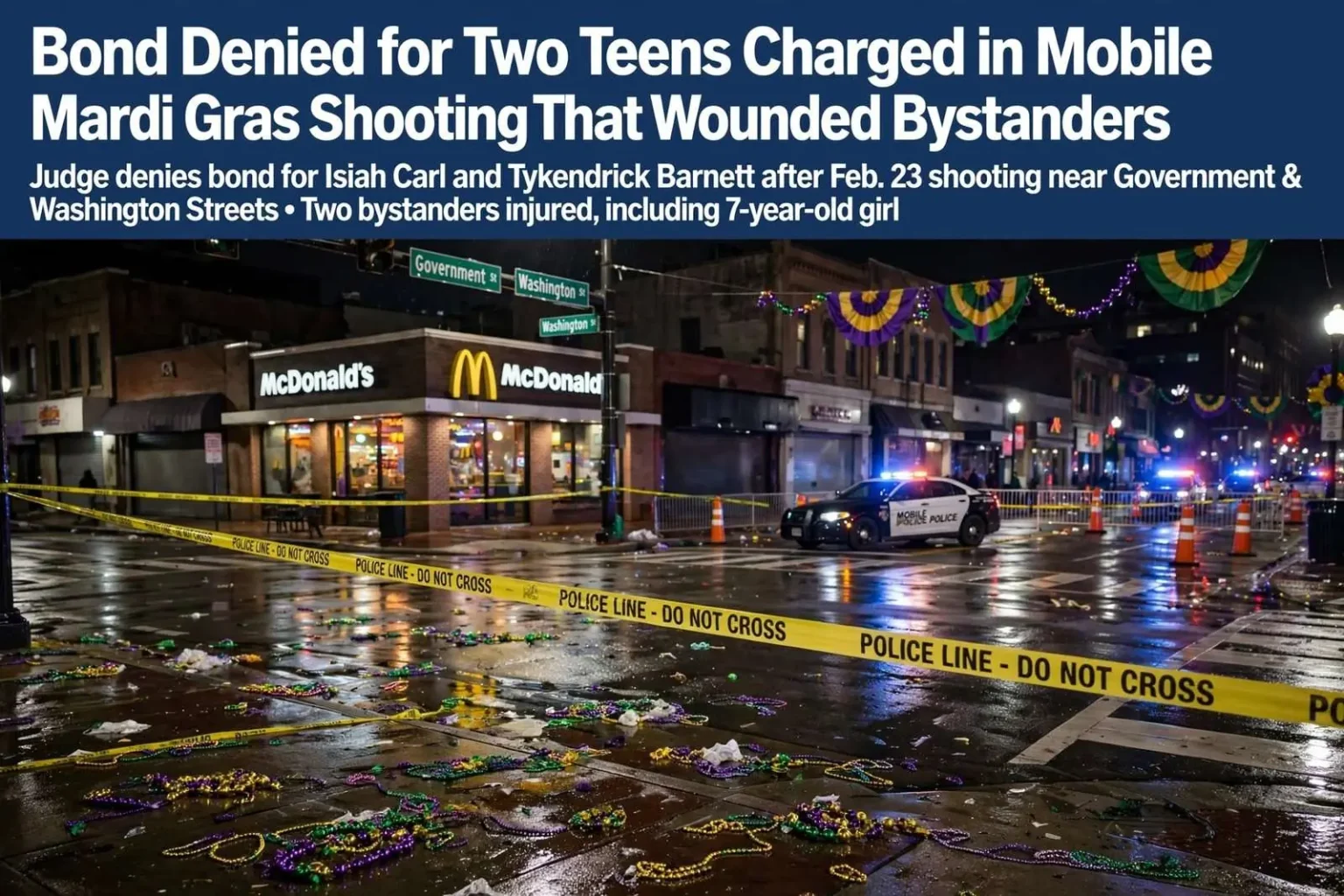
A Mobile judge denied bond for two teenagers charged in a shooting that followed a Mardi Gras parade and wounded two innocent bystanders, keeping Isiah Carl and Tykendrick Barnett in custody while their cases move forward.
The two appeared in court Tuesday, days after the February 23 shooting. Each is charged with two counts of assault, discharging a firearm and possessing a firearm. Carl faces an additional receiving-stolen-property charge after police said he was found with a stolen gun — the same weapon investigators recovered during the investigation that led to the arrests.
Prosecutors asked that no bond be set, telling the court the shooting happened in such a public place that both suspects pose a danger to the community. The judge agreed, denying bond outright rather than setting an amount — a step reserved for cases where the court finds no conditions of release can reasonably protect the public.
How the shooting unfolded
The gunfire erupted near a McDonald’s at Government and Washington streets in downtown Mobile shortly after that Saturday’s parade, with crowds from the procession still filling the area. Video recorded by a bystander captured the moment multiple shots rang out as parade-goers scrambled — footage that spread quickly and became part of the public record of a frightening few seconds in the middle of the city’s celebration season.
Mobile Fire-Rescue said the girl — police put her age at 7 — was struck in the leg and taken to University Hospital, while a male in his late teens was shot in the arm and treated at the scene. Neither was the intended target, according to the account that emerged from the investigation; both were bystanders caught in the path of gunfire that had nothing to do with them.
Police detained four to five people for questioning before announcing an arrest early Sunday morning. The speed of the arrests — within hours of the shooting — reflected the combination of witness statements, the bystander video and a heavy police presence already assigned downtown for the Mardi Gras season, when parade nights bring extra officers into the entertainment corridor.
Prior record cited in hearing
At the time of the shooting, Barnett was on probation for a juvenile court matter and had been arrested on a burglary charge in January — a case in which he is also charged as an adult. Prosecutors presented that history in arguing that no bond should be set, telling the court that the combination of pending charges and active probation made him a demonstrated risk while awaiting trial.
The argument mirrors the standard prosecutors apply in bond hearings across Alabama: where a defendant already under court supervision picks up new violent charges, the state asks the court to conclude that release on any conditions would not guarantee public safety. Denying bond entirely means the defendant remains in the county jail until trial or until a later motion changes the court’s assessment.
For Carl, the additional receiving-stolen-property charge connected to the stolen gun found in his possession added to the state’s account of the incident — a weapon that had been reported stolen, carried into a crowded entertainment district and fired, by the state’s account, in a dispute between people who had no regard for the families around them.
Stolen guns and the Mardi Gras problem
Investigators recovered a stolen gun during the investigation, underscoring what Mobile police have repeatedly flagged as one of the city’s most persistent problems: firearms stolen from vehicles, particularly during Mardi Gras. The Carnival season draws thousands of visitors downtown every night, and the packed parking lots and street parking along parade routes create abundant opportunity for break-ins — with firearms left inside unattended cars among the most valuable targets.
The pattern has made stolen-from-vehicle guns a recurring thread in the city’s violent-crime caseload. A pistol taken from a car during a parade night can surface weeks later in a robbery, a shooting or, as in this case, recovered alongside a suspect in a public act of violence. Police have urged parade-goers not to leave weapons or valuables in vehicles, and the department’s enforcement during Carnival season pairs extra patrols with attention to the parking areas surrounding the route.
The February 23 shooting gave the problem a public face. A gun reported stolen, carried downtown amid the largest crowds Mobile assembles all year, and fired in a dispute while families with young children were still in the area — the sequence combined several of the risk factors police have highlighted in their appeals to gun owners and parade-goers alike.
What the bystander video meant for the case
The bystander video that captured the shooting has become a fixture of modern criminal cases, and its role here was immediate. Footage of the moments around a public shooting helps investigators fix timelines, identify participants and corroborate witness accounts — and it documents, for prosecutors and judges alike, exactly how chaotic and dangerous the scene was for the people nearby.
In the bond hearing, the setting of the shooting was central to the state’s argument. Government and Washington streets sit in the heart of downtown Mobile’s parade corridor, where families gather curbside for hours before and after processions. Prosecutors told the court that gunfire in a place so crowded, at an hour when the streets were still full, meant both defendants posed a danger to the community regardless of who the intended targets may have been.
The two wounded bystanders — a 7-year-old girl shot in the leg and a male in his late teens shot in the arm — are, in the state’s framing, the consequence of that recklessness. Their injuries, and the video that shows the crowd’s scramble, form the emotional and evidentiary core of a case that will now move through the court system without bond for either defendant.
What comes next
With bond denied, both Carl and Barnett will remain in custody as their cases proceed through the Mobile County court system. The charges each faces — two counts of assault, discharging a firearm into an occupied area’s crowds, and possession of a firearm, with the stolen-gun count against Carl — will be tested at trial, where the prosecution will rely on the bystander video, the recovered weapon and the accounts of witnesses detained and questioned in the hours after the shooting.
The case also lands in the middle of a broader conversation Mobile has been having about violence during Mardi Gras. Each season, the city balances the economic and cultural life of its Carnival celebration against the security challenges of hosting enormous nightly crowds, and incidents like this one sharpen the debate over police deployment, camera coverage and the habits — like leaving firearms in parked cars — that police say turn celebration nights into opportunities for crime.
For the two wounded bystanders and the families who were downtown that Saturday night, the court’s decision to deny bond closes one chapter: the people charged with the shooting will await trial from jail, not from the street. For the city, the case stands as the season’s starkest reminder that the guns stolen from cars during Mardi Gras do not stay stolen quietly — they resurface, sometimes in the most crowded places Mobile gathers.
The anatomy of a bond denial
Bond in Alabama criminal cases is presumed for most charges, but the presumption is not absolute. Judges weigh the nature of the offense, the weight of the evidence, the defendant’s criminal history and ties to the community, and — above all — the danger a release would pose to the public. When prosecutors ask for bond to be denied outright rather than set at a high amount, they are telling the court that no financial incentive or supervision condition can substitute for custody.
In hearings like Tuesday’s, the argument turns on circumstances as much as charges. A shooting in a residential dispute at 3 a.m. is dangerous; the same gunfire in a crowd of hundreds at the height of a parade night multiplies the potential victims many times over. That distinction is what prosecutors emphasized, and it is what judges in Mobile have repeatedly cited when denying bond in public-place shootings: the risk is not only that a defendant will flee or reoffend, but that the community’s public gatherings themselves become unsafe if such conduct draws only a price tag.
For the defendants, denial of bond has practical consequences beyond custody. Cases proceed faster when a defendant is jailed rather than out on bond — court dates arrive sooner, plea discussions begin earlier — and the defendant who remains in custody typically loses access to the family support and employment that often shape a defense. Both teenagers will now build their cases from the county jail.
The system responding in real time
The timeline of the case shows how the pieces of the response fit together. The shooting occurred on a Saturday night, with parade crowds still in the streets. Police detained four to five people for questioning that night, announced an arrest early Sunday morning, and had both defendants in court by Tuesday for the bond hearing — a pace that reflects both the gravity of the charges and the amount of evidence available immediately, from the bystander video to the recovered stolen weapon.
Mobile’s Mardi Gras enforcement posture made that speed possible. During the Carnival season, the police department assigns additional officers to the downtown corridor, and the shooting occurred in one of the most heavily patrolled blocks in the city on one of the most heavily staffed nights. Witnesses were abundant, officers were nearby, and the surveillance and bystander footage that cities accumulate in entertainment districts did the rest.
The case now moves into the slower machinery of felony prosecution: grand jury review, motion practice, and eventually trial unless a plea resolves the charges first. But the first week set its course — two arrests within hours, two bystanders wounded, a stolen gun recovered and logged, and a judge’s finding that the community’s safety requires both defendants held without bond. For a city that measures every Mardi Gras season against its worst nights, the message from the courtroom was that gunfire among parade crowds will be met with the system’s most restrictive response.


