Bond Granted for Irvington Man Accused of Abducting His Toddlers; Released From Jail
Carl Caballero, accused of abducting his two toddlers in Irvington, was granted an $82,500 bond and released from Mobile Metro Jail.
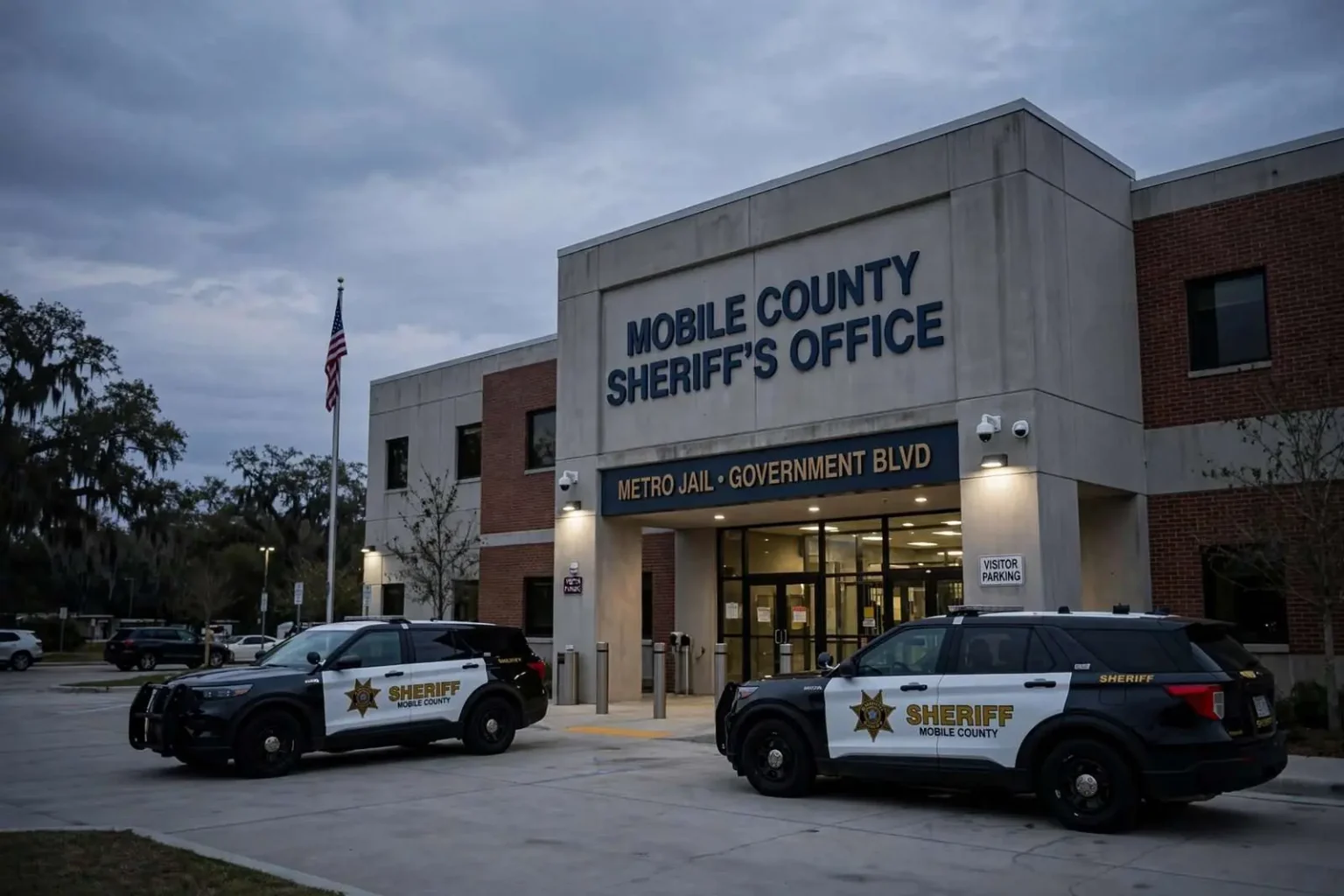
An Irvington man accused of abducting his two young children during an incident that ended in a standoff with deputies and a SWAT team was granted bond Friday, one day after his arrest — and bonded out of jail that same night. The quick turnaround from a jail cell to release underscores how the bond process moves through the Mobile County court system, even in cases involving serious domestic violence allegations, once a judge sets conditions intended to protect the alleged victim.
Carl Caballero posted bond at the Mobile Metro Jail around 7:11 p.m. Friday after being granted an $82,500 bond earlier in the day. The bond had been set at a hearing following his arrest Thursday, and the release came less than a day and a half after the standoff that ended with deputies taking him into custody. Jail booking records showed his bond was posted in the evening hours, allowing him to leave the facility before the weekend.
Conditions of Release
As conditions of his release, the judge ordered Caballero to stay away from weapons and to have no contact with the victim. Conditions of that kind are standard in domestic violence cases in Alabama courts, where judges routinely impose no-contact orders as part of any pretrial release. Violating those conditions can result in the bond being revoked and the defendant being returned to jail to await trial behind bars.
Caballero faces several charges, including first-degree domestic violence, interference with a domestic violence emergency call, and domestic violence by strangulation or suffocation. Taken together, the charges describe what authorities characterize as a violent episode inside a household, along with an attempt to keep the victim from reaching help by phone.
The Mobile County Sheriff’s Office said he was accused of taking his two children before he was captured following the standoff. Deputies, supported by the agency’s SWAT team, took him into custody after the confrontation ended, and the children were recovered. Officials have not released extensive details about the standoff itself, citing the ongoing nature of the case.
The Community Where It Happened
Irvington is a small community in southern Mobile County, west of Tillmans Corner and near the communities of Theodore and St. Elmo, in an unincorporated stretch of the county served by the sheriff rather than a municipal police department. Residents there rely on the Mobile County Sheriff’s Office for patrol and emergency response, and major incidents in the area often draw a larger law enforcement presence than they would inside city limits, where municipal departments handle calls.
The case has drawn attention across the Mobile area not only because of the abduction allegation but because of how quickly events moved — from a standoff involving a tactical team, to an arrest, to a bond hearing, to release, all within roughly two days. Court records in Mobile County show that defendants arrested on felony charges typically appear before a judge within 48 to 72 hours of arrest, when bond amounts and release conditions are set.
The $82,500 bond amount reflects the way Alabama judges structure bond for defendants facing multiple charges. Rather than a single figure, bonds are commonly set for each charge and stacked, with the total representing the combined amounts. Judges weigh the severity of the allegations, the defendant’s ties to the community, any prior record, and the perceived risk to the victim when deciding whether to grant bond at all and how high to set it. In cases involving domestic violence, Alabama law also directs courts to consider the safety of the alleged victim when setting conditions.
How the Bond Process Worked
Posting bond at the Mobile Metro Jail on Government Boulevard is the final step in the release process. Defendants or their families can use a bonding company, which typically charges a non-refundable fee of about 10 percent of the bond amount, or they can post the full amount in cash or qualifying property. Once the bond is posted and paperwork is processed, the jail releases the defendant, usually within a few hours. Evening releases such as the one in this case are routine, since bonding companies operate outside regular court hours and jail staff process releases around the clock.
Being released on bond is not an indication of innocence, and it does not end the case. Caballero remains charged and will be required to appear at every court date as the case moves through the Mobile County court system. Missing a court appearance would trigger a bond forfeiture and a warrant for his arrest.
The Sheriff’s Office Role in the Case
The Mobile County Sheriff’s Office is one of the largest law enforcement agencies in south Alabama, with responsibility for patrolling the county’s unincorporated areas and providing support to smaller municipalities. Its deputies handle everything from traffic crashes to major felonies, and the agency maintains specialized units, including investigators who focus on domestic violence and crimes involving children. In an abduction case involving young children, those units would typically work alongside patrol deputies from the first moments of the response.
Standoffs of the kind that ended this case are among the most delicate situations deputies face. When a suspect refuses to surrender and may be armed or holding others against their will, agencies generally fall back on a tactical playbook: establish a perimeter, clear surrounding residents from the area, attempt communication with the suspect, and deploy a SWAT team only when negotiation fails or the situation escalates. The goal in nearly every case is to end the incident without injuries and to recover any children or other vulnerable people unharmed. When children are involved, the Alabama Department of Human Resources is typically notified and works with law enforcement to place them with relatives or other safe caretakers.
Sheriff’s officials have not detailed how long the standoff lasted or what ultimately prompted Caballero to be taken into custody, but the outcome — a peaceful arrest and the recovery of the children — is the resolution officers train for. Cases that begin with a domestic violence call and end with a tactical deployment are a recurring pattern across Mobile County, where deputies answer thousands of domestic-related calls each year.
The Charges He Faces
First-degree domestic violence is among the most serious charges in Alabama’s criminal code. Under state law, a person commits the offense when they commit certain underlying felony offenses — including first- or second-degree assault — against a family or household member, or when they cause serious physical injury to such a person. It is a Class A felony, the most severe classification short of capital offenses, punishable upon conviction by a sentence of 10 years to life in prison. The classification signals how seriously Alabama prosecutors and legislators treat violence within families compared with similar conduct between strangers.
The strangulation charge carries its own weight. Alabama created domestic violence by strangulation or suffocation as a distinct felony in 2011, recognizing what research has shown for years: strangulation is one of the strongest predictors that abuse in a relationship will escalate to lethal violence. Because strangulation often leaves little visible injury, investigators are trained to look for internal signs and to document complaints of difficulty breathing, dizziness, or loss of consciousness. A conviction for the felony charge can bring a decade or more in prison.
Interference with a domestic violence emergency call is a narrower offense, but one prosecutors say serves a critical purpose. The crime targets a person who prevents or attempts to prevent a household member from calling 911 during a domestic violence incident — grabbing a phone, cutting service, or threatening the caller. The offense exists because the first minutes of a domestic violence emergency are often when victims have their only realistic chance to reach help, and blocking that call can trap a victim inside a dangerous situation.
What the Allegations Mean Under Alabama Law
Alabama defines family or household members broadly for purposes of its domestic violence statutes, covering spouses, former spouses, people who live together or have lived together, people who share a child, and people in dating or former dating relationships. That breadth means cases like this one are handled under a dedicated framework in the courts: specialized dockets in some jurisdictions, mandatory consideration of victim safety at bond hearings, and no-contact conditions as a default rather than an exception.
Prosecutors in Mobile County pursue domestic violence cases through the District Attorney’s office, which works closely with law enforcement agencies from the earliest stages of an investigation. Victims in these cases are frequently consulted about plea terms and sentencing, though the decision to prosecute rests with the state, not the victim. Cases can take months or longer to move from arrest to trial, depending on the court’s calendar and the complexity of the evidence.
For the children at the center of this case, the legal process will likely unfold alongside parallel proceedings. When children are present during domestic violence incidents, the Department of Human Resources can become involved to assess their safety, and family court judges may issue separate protective orders governing custody and contact. Those civil protections operate independently of the criminal charges, and they can remain in place even if the criminal case is later resolved.
What Happens Next
With bond posted, Caballero’s case moves into the standard pretrial sequence. A preliminary hearing or grand jury review will determine whether the felony charges proceed in Mobile County Circuit Court, where an arraignment will formally enter his plea. Defense attorneys in bond cases typically advise clients to comply strictly with every condition, because judges in the county revoke bonds for violations ranging from a prohibited phone call to possessing a firearm. A revoked bond means returning to the Mobile Metro Jail to await trial, often for months, with a much harder path back to release.
The no-contact condition covering the victim is enforced through the courts and by law enforcement. If the victim reports contact, or if deputies document a violation, the defendant can be arrested on a new charge of violating a bond condition in addition to facing revocation. Weapon possession while on release for a domestic violence charge can also trigger federal consequences under gun control statutes that bar defendants in such cases from possessing firearms.
Support for Domestic Violence Victims in the Region
The case arrives against the backdrop of a wider effort across Mobile and southwest Alabama to respond to domestic violence, which remains one of the most common calls for service area law enforcement receives. Advocates stress that help is available around the clock: Penelope House in Mobile operates a crisis line and shelter services for victims and their children, and the Alabama statewide and national domestic violence hotlines connect callers with local resources, safety planning, and legal advocacy at any hour of the day or night.
Judges in Mobile County can also issue protective orders that direct an abuser to stay away from a victim’s home, workplace, and school, and to have no contact by phone or through third parties. Violating a protective order is itself a crime, and advocates encourage victims to keep copies of the order and to report every violation so a record exists if further court action becomes necessary.
A Case the Community Is Watching
For now, the facts of the case remain those laid out by the Sheriff’s Office: a man accused of taking his two children, a standoff that ended with a SWAT deployment, and an arrest that was followed within a day by a bond and a release. Caballero is presumed innocent unless and until he is convicted in court, and the charges against him will be tested through the evidence presented as the case proceeds. The Sheriff’s Office has not said when additional details of the incident might be released, and updates are likely to come through court filings as the case advances through the Mobile County judicial system.
What began as a domestic call and escalated into a standoff is now, in the courts’ hands, a question of evidence, prosecution, and the conditions meant to keep everyone involved safe while the case runs its course.