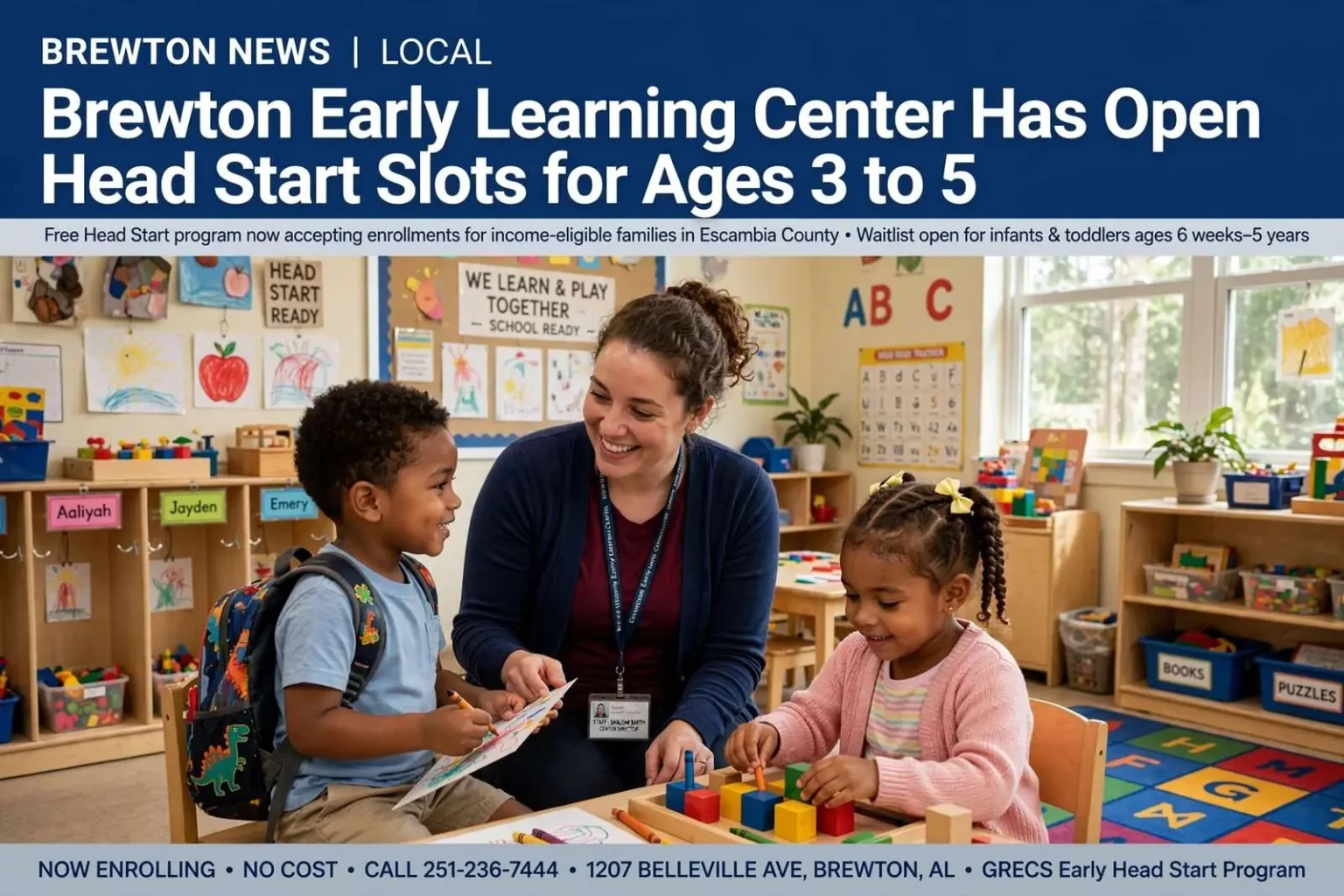
Brewton Early Learning Center, the local site for the GRECS Early Head Start program, has openings for children ages 3 to 5, according to center officials. The announcement is a direct invitation to Escambia County families who have been priced out of private preschool: the seats are free, and the program exists precisely to reach the families who qualify for them.
Center Director Shalom Smith said the open slots are reserved for families that meet income-eligibility guidelines for the federally funded program. Smith said families interested in enrolling can also join a standing waitlist for infants and toddlers, meaning even households with younger children have a path into the program’s pipeline.
“Parents, we still have free child slots available for families who are income-eligible,” Smith said. “Our current availability is ages 3-5, though we take applications for the waitlist for ages 6 weeks through 5 years all year long.”
The distinction between immediate openings and the waitlist matters for parents planning child care. A family with a 3-, 4- or 5-year-old can move from application to enrollment as soon as eligibility is verified and paperwork is complete. A family with an infant or toddler can apply now, secure a place in line and be positioned to move in as openings occur — which in a program that serves children from six weeks old is a realistic timeline, not a formality.
Early Head Start and Head Start together form the federal early childhood program administered through the Office of Head Start under the U.S. Department of Health and Human Services, with services delivered locally by grantee organizations. GRECS — the Gulf Regional Early Childhood Services network — operates sites across southwest Alabama, bringing the program to communities like Brewton where private child care options are limited and where many working families spend a large share of their income on care.
The timing of open slots varies through the year as families move, children age into kindergarten and household circumstances change, so a mid-year announcement of availability is an opportunity worth acting on quickly for families who have been on the fence about applying.
What the Program Provides
The Early Head Start program provides no-cost early childhood education and support services to eligible families, with priority typically given based on household income and other need-based factors. The “no-cost” element is the program’s defining feature: tuition, meals and the core educational services are covered by federal funding for enrolled families.
For children ages 3 to 5, that means a preschool experience built on the Head Start model — structured early learning aligned with school-readiness goals, trained teachers, health and developmental screenings, and nutritious meals served on site. The curriculum focus at that age is the one that research has shown to matter most: language development, early literacy and numeracy, social skills and the classroom routines that make the transition to kindergarten smoother.
The support services extend beyond the classroom. Head Start programs connect families with health care resources, assist with developmental screenings that can catch delays early, and work with parents on family goal-setting — everything from continuing education to employment. Parent involvement is built into the program’s design, with families encouraged to participate in program governance and classroom activities.
Eligibility is anchored primarily to family income relative to the federal poverty guidelines, with additional considerations — homelessness, children in foster care, families receiving public assistance — that can qualify a household automatically. Families who are slightly over the income line are sometimes still eligible under program flexibility, which is why center officials urge interested parents to apply rather than disqualify themselves in advance.
The program’s reach in a community like Brewton is easy to underestimate. Free, high-quality early education for a 4-year-old can be worth thousands of dollars a year in avoided child care costs, and it frees parents to work or finish school knowing their child is in a structured, supervised learning environment rather than informal care.
Meals deserve their own mention in that calculation. Head Start programs serve nutritious meals and snacks as part of the school day, and for families on tight budgets, feeding a child breakfast and lunch through the program removes one more recurring expense while ensuring the child starts each day ready to learn. Nutrition, health screenings and education are packaged together in the Head Start model by design, on the theory that a hungry or unwell child cannot benefit from even the best classroom.
Why Early Learning Matters in Escambia County
Brewton sits in the heart of Escambia County, a rural Alabama county where access to quality early childhood education has historically lagged behind that of urban counties. For families in Brewton, East Brewton, Flomaton and the surrounding communities, the options for infant and toddler care are few, and preschool seats that are both high quality and affordable are rarer still.
The economics are straightforward. Alabama’s First Class Pre-K program has expanded publicly funded pre-kindergarten across the state, but it generally serves 4-year-olds, and it does not reach infants and toddlers at all. Early Head Start fills the gap from six weeks old, which is why the program’s waitlist for the youngest children fills quickly wherever a site operates.
Research on early childhood has repeatedly found that the return on investment in the earliest years is the largest of any phase of education — children who attend quality early learning programs enter kindergarten better prepared, read on grade level at higher rates and are more likely to graduate. In rural counties, where school systems face their own resource challenges, giving children a strong start is one of the most effective interventions available.
For the local economy, the program’s value compounds. Parents who could not otherwise afford care can join or remain in the workforce, employers in the Brewton area keep workers who would otherwise be forced out by child care costs, and children arrive at Brewton Elementary and the county’s other schools ready to learn.
GRECS has operated early childhood programs across southwest Alabama for decades, and its Brewton site gives Escambia County families access to a program model that urban families take for granted. The center’s directors emphasize that its doors are open to any income-eligible family in the area, not just those already connected to social services.
Parents considering the program should also know what a typical day involves. Children in the 3-to-5 classrooms follow a preschool schedule that balances teacher-led learning with play, outdoor time, meals and rest, and the day is structured to build the attention span and social habits kindergarten teachers look for. Teachers communicate regularly with parents about each child’s progress, and screenings track development across language, motor and social milestones so that any concern is caught and addressed early.
How to Apply
Brewton Early Learning Center is located at 1207 Belleville Avenue and operates daily during the school year. Smith said parents can pick up and complete a paper application in person at the center, and are encouraged to call ahead to find out which documents are required to finish the enrollment process.
Calling first saves families a wasted trip. Eligibility verification typically involves proof of income — pay stubs, benefit letters or tax documents — along with proof of the child’s age, usually a birth certificate, and updated immunization records, which Alabama requires for enrollment in child care programs. Families receiving public assistance can often substitute benefit documentation for income records.
Families with questions or seeking more information can reach the center at 251-236-7444. Staff can walk parents through eligibility questions over the phone, explain what the daily schedule looks like for each age group and note exactly which documents to bring.
For parents of infants and toddlers, applying for the waitlist now rather than later is the practical move. Waitlists for children under 3 are typically the longest in any Early Head Start program, and families who apply during pregnancy or early infancy are best positioned when openings occur.
The center’s offer to parents is simple, and Smith put it in plain terms: free slots are open right now for income-eligible families with children ages 3 to 5, and applications for every age from six weeks up are taken all year long. For a Brewton family weighing child care costs against a tight budget, a phone call to Belleville Avenue may be the most financially significant call of the year.
Enrollment is completed in person, and staff encourage parents to visit the center, see the classrooms and meet the teachers before finalizing the decision — part of a program model that treats parents as partners from the first day forward.
Families who cannot apply during regular weekday hours should still call: center staff can arrange a time that works, and the application itself is short. The most common barrier to enrollment is not ineligibility but delay — families who wait to apply until child care arrangements fall through often find the waitlist ahead of them, while families who apply on the strength of an announcement like this one are in place when the slots open.