Cancer Survivor Brings Port-Friendly ‘ComfyCozy’z’ Shirts to Young Chemo Patients in Mobile
Cancer survivor Frank DeBlasi delivered port-accessible ComfyCozy'z for Chemo shirts to children at USA Children's and Women's Hospital in Mobile.
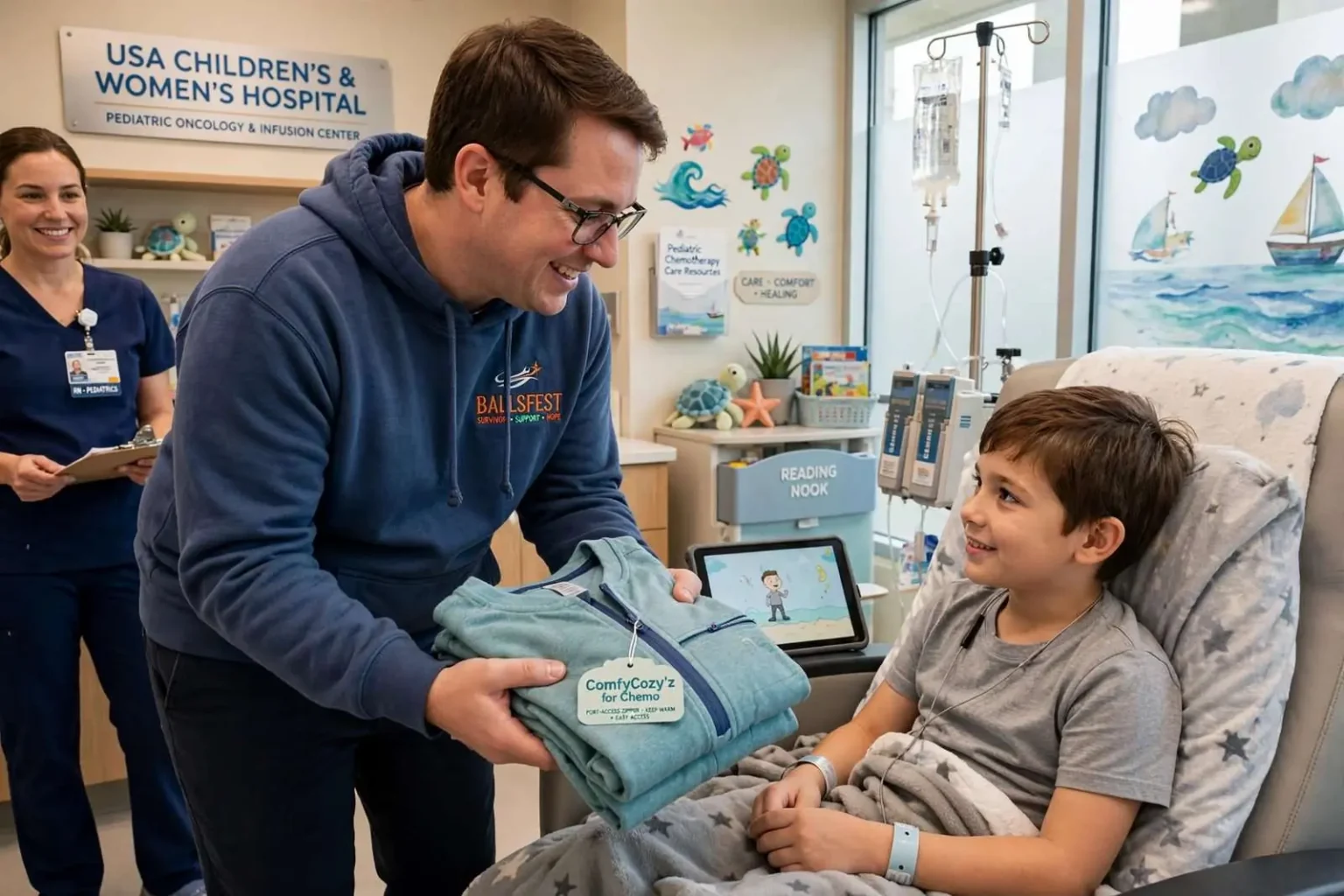
Chemotherapy is hard on anyone, but for children it can be especially daunting. On Monday, young patients at USA Children’s and Women’s Hospital in Mobile got a small comfort from someone who has been in their shoes.
Testicular cancer survivor Frank DeBlasi visited the hospital on behalf of Ballsfest, the nonprofit he founded to support others battling cancer. His gift: “ComfyCozy’z for Chemo” shirts designed with zippers at the top that give easy access to a patient’s infusion port — so kids don’t have to undress to hook up to treatment.
From one survivor to young fighters
DeBlasi knows firsthand what treatment takes out of a person, and he said giving back means everything. “I know the day-to-day battle, emotionally and physically, with cancer is a struggle,” DeBlasi said. “To be a part of a process to help them manage through tough days and lift their spirits by providing some sort of gift that’s going to help them through the process, it means so much to me.”
His visit brought a moment of brightness to the hospital’s young patients — and shirts that will make every treatment session a little easier.
Why the shirts matter
To understand the gift, it helps to understand the port. Many chemotherapy patients have an implanted port — a small device placed under the skin, usually in the upper chest, connected to a vein — that gives nurses reliable access for infusions without repeated needle sticks in the arms. For children who face treatment over months, the port becomes the doorway through which nearly every session runs.
The problem is clothing. Ordinary shirts do not open at the chest, so every infusion — and there are many, often on an outpatient schedule of weekly or more — requires pulling an arm out of a sleeve, exposing the chest and shoulder, and sitting half-undressed in a treatment chair for hours. In a cold infusion room, for a child who already feels worn down, that is one more indignity layered onto a hard day.
The ComfyCozy’z design solves it with a zipper placed directly over the port site. A nurse unzips, accesses the port, and the patient stays dressed, warm and covered throughout the session. It is a simple piece of engineering — a zipper, moved a few inches — but for a kid spending long hours hooked to an IV pole, it changes the texture of the entire day.
The hospital receiving them
USA Children’s and Women’s Hospital is the Gulf Coast’s dedicated children’s and women’s hospital, serving families from across south Alabama, the Florida Panhandle and the Mississippi Gulf Coast. Its pediatric patients include children receiving cancer care close to home — families who would otherwise face long drives to Birmingham, New Orleans or Pensacola for the same treatment.
For those families, days revolve around infusion schedules, lab work and clinic visits, and the small logistics — what the child will wear, how long the session will run, how to keep them comfortable — fill the hours in between. Comfort items like these shirts slot directly into that daily reality, and hospital staff see immediately what a design like this means in practice: fewer cold, exposed patients, and kids who can stay bundled up with a book or a tablet while the medicine runs.
The visit itself carried its own weight. A survivor walking the halls where children are in treatment offers those families something no supply closet can stock — proof, standing in front of them, that the other side of treatment exists.
Ballsfest’s mission
DeBlasi founded Ballsfest to support others battling cancer, with a particular focus on the disease he survived. Testicular cancer is among the most common cancers in young and middle-aged men, and it is also one of the most treatable — especially when caught early — but the experience of diagnosis, surgery and chemotherapy leaves a mark that survivors often carry into a desire to help the next patient through it.
The ComfyCozy’z for Chemo effort is that instinct turned into something practical. Rather than a donation with no specific use, the shirts address a named, daily problem in cancer care — port access without undressing — and they are given directly to the patients who will use them. Survivors who run projects like this tend to be precise about such details, because they lived the problem themselves.
The nonprofit’s support mission also extends to the emotional side of treatment that DeBlasi described: the day-to-day battle, emotionally and physically, that he referenced in his own words. Gift visits, comfort items and survivor outreach all serve that side of the fight, and pediatric units — where the patients are young and the treatment schedules are long — are where those gestures land hardest.
Pediatric cancer care on the Gulf Coast
Children receiving cancer treatment in Mobile are part of a patient population that USA Children’s and Women’s serves from a wide geographic radius. The hospital’s pediatric specialists treat young patients from Baldwin County, the Wiregrass, the Mississippi coast and the Panhandle, and its position as the region’s children’s hospital means families facing a pediatric cancer diagnosis can plan treatment around a facility within driving distance of home.
That proximity matters enormously in pediatric oncology. Treatment schedules run for months, immune-suppressed children need to limit exposure to infection, and repeated long-distance travel compounds the strain on families already managing a crisis. Every resource that makes treatment days easier — comfortable facilities, child-life support, and yes, clothing designed for infusion ports — helps families sustain the marathon.
Hospital staff who accepted the shirts on Monday did so with an eye to exactly that: the children who will wear them week after week, and the parents who will no longer have to negotiate sleeves and cold infusion rooms at the start of every session.
What a survivor’s visit gives
Ask anyone who has spent time in a pediatric cancer unit, and they will tell you the medical care is only half the environment. The other half is morale — the parents’ as much as the children’s — and survivor visitors move that needle in a way staff and family cannot quite duplicate.
DeBlasi’s message to the young patients and their families was not medical advice or statistics; it was presence. He sat with kids, handed out the shirts, and told them what he tells audiences when he speaks about his own treatment: the battle is real, it is hard every day, and it is worth fighting — and there are people who have come out the other side ready to help you through it.
“To be a part of a process to help them manage through tough days and lift their spirits by providing some sort of gift that’s going to help them through the process, it means so much to me,” he said.
A small gift with a long tail
Unlike a one-time gift that is used and gone, the shirts keep working. A child receiving months of chemotherapy will put the same shirt on for dozens of sessions, and the zipper-over-the-port design will quietly do its job every time — no undressing, no cold shoulders, no fuss at the start of a treatment day. Parents will wash it, pack it and reach for it first.
That durability is what makes the ComfyCozy’z concept effective as a donation. It addresses a recurring problem, not a single moment, and it was built by someone who understood the recurrence from the inside. For the young patients at USA Children’s and Women’s, Monday’s visit ended with a new shirt and a survivor’s handshake; the shirts themselves will keep showing up for them at every session that follows.
How the community can help
Families and supporters who want to follow the example of Monday’s visit have clear paths. Hospitals like USA Children’s and Women’s accept support through their foundations, which channel donations to patient comfort programs, child-life services and family assistance; comfort-item drives and pediatric-unit giving programs run year-round. Nonprofits like Ballsfest, which turn survivors’ experience into practical support, likewise run on community contributions.
The simplest takeaway from Monday, though, is the one DeBlasi embodied: people who have been through cancer treatment carry knowledge nobody else has — what the days actually feel like, which small things help and which don’t. When survivors turn that knowledge into something concrete for the next patient, it lands with a force that generic generosity cannot match.
For the children in treatment in Mobile this week, the result is tangible: warmer treatment days, easier port access and a visitor who could honestly say he knew what they were going through. For their parents, it was a reminder that the community around them includes people who have walked this road and come back to walk it with them.