Cantonment Woman Charged in Alleged Knife Threat, Lawn Damage Near Becks Lake Road
A Cantonment woman faces felony aggravated assault and criminal mischief charges after allegedly threatening a man with a knife and damaging his lawn off Becks Lake Road in February.
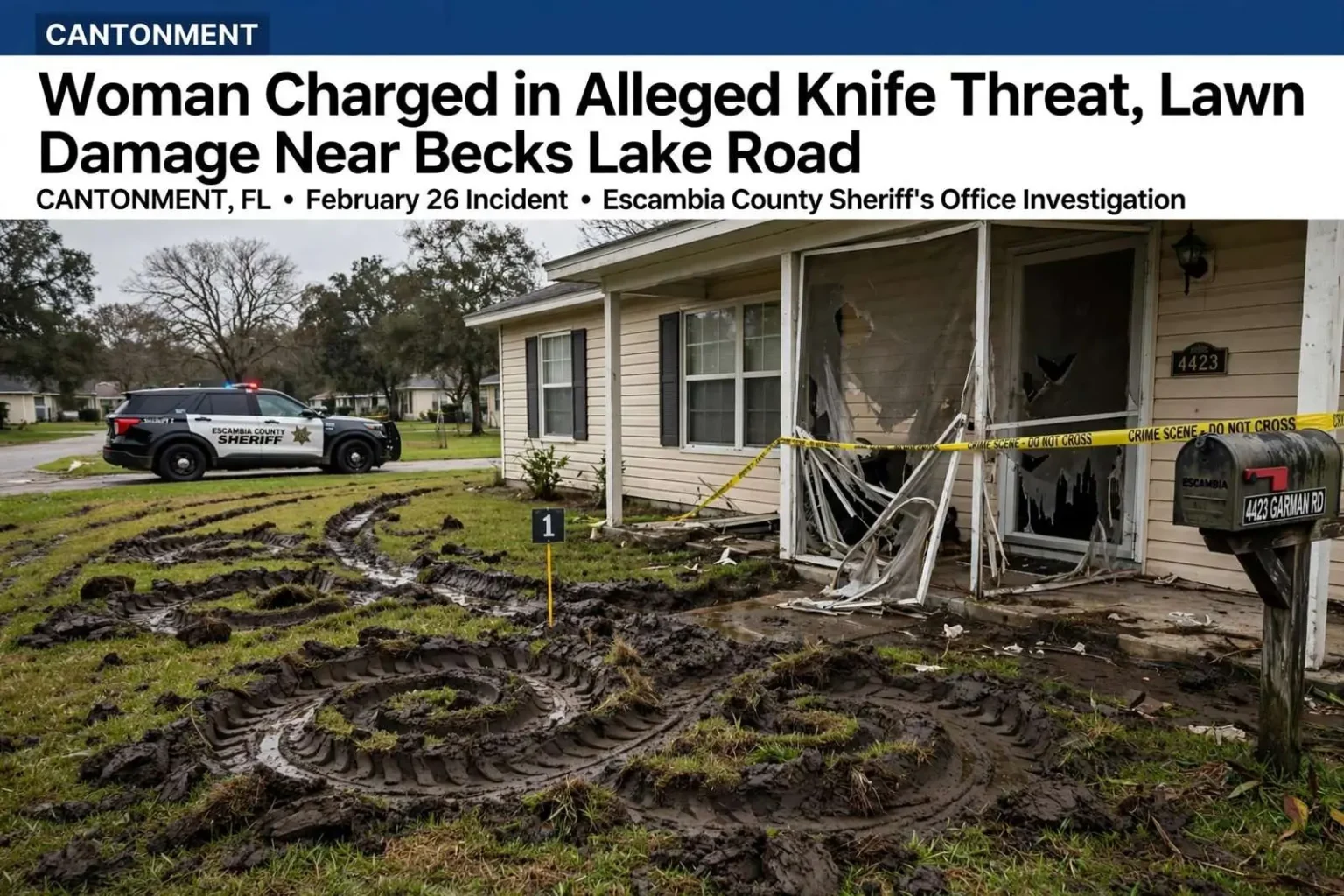
CANTONMENT — A Cantonment woman is facing multiple charges after she allegedly threatened a man with a knife and tore up his lawn during a dispute in February, according to the Escambia County Sheriff’s Office. The incident, which unfolded at a home along Garman Road, left a front yard scarred with deep tire tracks and a porch screen torn, and it has now resulted in felony and misdemeanor charges against a 44-year-old local resident.
Missty Louise Tarver, 44, was arrested recently on an outstanding warrant charging her with felony aggravated assault with a deadly weapon without intent to kill and misdemeanor criminal mischief. The arrest came months after the reported disturbance, a gap that is not unusual in cases where investigators take time to review evidence, interview witnesses, and present the case to prosecutors before a warrant is issued and served.
According to a sheriff’s office arrest affidavit, deputies responded to a disturbance complaint on Feb. 26 at a residence on Garman Road, just off Becks Lake Road in Cantonment. The road runs through a quiet residential pocket of the community, an unincorporated area of Escambia County north of Pensacola where homes sit on generous lots and the sheriff’s office serves as the primary law enforcement agency.
What deputies say happened
A resident told deputies Tarver had called him earlier that evening sounding irate and slurring her words, appearing to be heavily intoxicated. The phone call set the tone for what authorities describe as a rapidly escalating confrontation that moved from a threatening conversation to an in-person encounter at the man’s front porch later that night.
She then arrived at the residence in a black Chevrolet pickup truck with her 7-year-old child inside the vehicle, the affidavit states. The presence of a young child in the truck during the episode added another layer of concern for deputies responding to the scene, though the affidavit focuses on the alleged threats and the property damage left behind.
When the resident held the unscreened porch door shut to keep her out, Tarver allegedly pushed a camo-handled pocket knife with a serrated blade through the porch screen toward his wrist. The detail, recorded in the affidavit, describes how the blade came through the woven screen material directly at the man’s arm as he braced the door from the inside to keep her from entering.
The man told deputies he had to pull his hand back to avoid being cut as Tarver yelled threats at him, according to the affidavit. His quick reaction, investigators noted, prevented what could have become a far more serious injury — one of the factors that shaped the aggravated assault charge now filed in the case.
Deputies said Tarver then returned to her truck holding two knives. By that point in the evening, the confrontation had already produced a damaged porch screen and a set of allegations serious enough to support a felony count, but what happened next is what most visibly marked the property before she drove away.
Tire ruts and an estimated $500 in damage
Before leaving the scene, she allegedly drove the pickup in circles across the front lawn, performing what the affidavit describes as “donuts.” The maneuver — spinning the truck in tight, accelerating circles — is a familiar sight on rural roads and empty lots across the region, but carried out on a neighbor’s yard it left the grass badly torn and the ground churned up.
The maneuver left deep tire ruts in the grass, causing an estimated $500 in property damage, deputies said. Ruts of that depth do more than cosmetic harm; they can kill the grass in the affected area, create uneven ground that becomes a trip hazard, and require regrading and reseeding before the yard returns to its original condition.
Responding deputies documented the torn porch screen and the fresh tire ruts across the lawn as part of their investigation. Photographs and observations recorded at the scene form the basis of the criminal mischief count, which under Florida law covers willful and unlawful injury or damage to another person’s property.
The charges explained
The felony count, aggravated assault with a deadly weapon without intent to kill, is one of the more serious assault classifications in Florida’s penal code. Under state statute, an aggravated assault involves an assault made with a deadly weapon or with intent to commit a felony, and it is prosecuted as a second-degree felony, carrying a potential prison term of up to 15 years upon conviction.
The “without intent to kill” distinction matters in how the case is framed. It indicates the alleged threat was made in a manner calculated to put the victim in fear of imminent harm, without a claimed purpose of taking his life. Prosecutors weigh factors such as the type of weapon involved, the distance between the parties, and the words spoken when deciding how to charge an incident of this kind.
The misdemeanor criminal mischief charge stems from the estimated $500 in damage to the lawn and the torn screen. In Florida, criminal mischief is generally a second-degree misdemeanor when the damage is under $200, and a first-degree misdemeanor when it totals $200 or more — placing this case in the higher of the two tiers, with up to a year in jail possible on that count alone.
Tarver was booked into the Escambia County Jail and was later released on an $8,000 bond. The bond amount reflects the combined charges, with the felony count driving most of the total. Release on bond allows a defendant to remain out of custody while the case moves through the court system, subject to conditions imposed by a judge at first appearance.
How the process moves from here
An arrest on an outstanding warrant typically follows a period in which detectives compile the affidavit, review the physical evidence, and refer the case to the State Attorney’s Office for the First Judicial Circuit, which handles prosecutions for Escambia County. Once charges are formally filed, the case proceeds through arraignment, pretrial hearings, and potentially trial unless a plea agreement resolves it sooner.
Conditions of release in cases involving alleged assaults and intoxication often include no-contact orders, restrictions on alcohol use, and requirements to stay away from the alleged victim’s residence. Violating those conditions can result in the bond being revoked and the defendant being returned to jail to await trial in custody.
As is standard, the charges against her are accusations, and she is presumed innocent unless and until proven guilty in court. An arrest affidavit contains only the account presented by investigators at the time of the warrant application, and the allegations have not yet been tested in any courtroom proceeding.
What it means for the Cantonment community
Incidents like this one draw attention in close-knit communities such as Cantonment, where the Escambia County Sheriff’s Office handles law enforcement for the unincorporated areas outside Pensacola’s city limits. The community sits north of Pensacola near Molino and Century, and Becks Lake Road connects residential streets like Garman Road to the broader network of county roads that carry commuters toward the city each morning.
Residents who encounter a volatile situation at a neighbor’s home are generally encouraged to call law enforcement rather than intervene directly, particularly when weapons or intoxication appear to be involved. Deputies stress that early calls give them the best chance to de-escalate a situation before it turns dangerous, and that documentation from the initial response often proves critical to the charges that follow.
Property disputes and personal conflicts that spill into violence remain a recurring call type for rural and suburban deputies across the Panhandle. When a disturbance involves a deadly weapon, the response and the follow-up investigation both rise to a higher level, as they did in this case.
The question of the child in the vehicle
The presence of a 7-year-old in the pickup truck during the alleged episode is the kind of detail deputies and child welfare workers take seriously, even when the child is not physically harmed. Florida law enforcement agencies routinely coordinate with the Department of Children and Families when young children are present during incidents involving alleged intoxication or threats, though the affidavit in this case does not indicate that any additional charges were filed on that basis.
For neighbors on streets like Garman Road, the case is a reminder of how quickly a personal dispute can escalate into something requiring a police response. What began, according to the affidavit, with an irate phone call ended with a felony charge, a torn screen, and a front yard in need of repair.
For Tarver, the case now moves into the Escambia County court system, where the evidence gathered on the night of Feb. 26 will be weighed and a final resolution determined. The Escambia County Sheriff’s Office has not indicated whether additional charges or arrests are anticipated in connection with the incident.
Anyone facing a similar situation — a threatening confrontation at their home or damage to their property — can report it to the sheriff’s office directly, and deputies note that preserving evidence, such as photographs of damage and records of threatening calls, helps investigators build an accurate account of what took place.