
Car Catches Fire in Mid-Town Mart Parking Lot on Dauphin Street
Fire crews extinguished a car fire in the Mid-Town Mart parking lot on Dauphin Street in midtown Mobile; no injuries were reported.
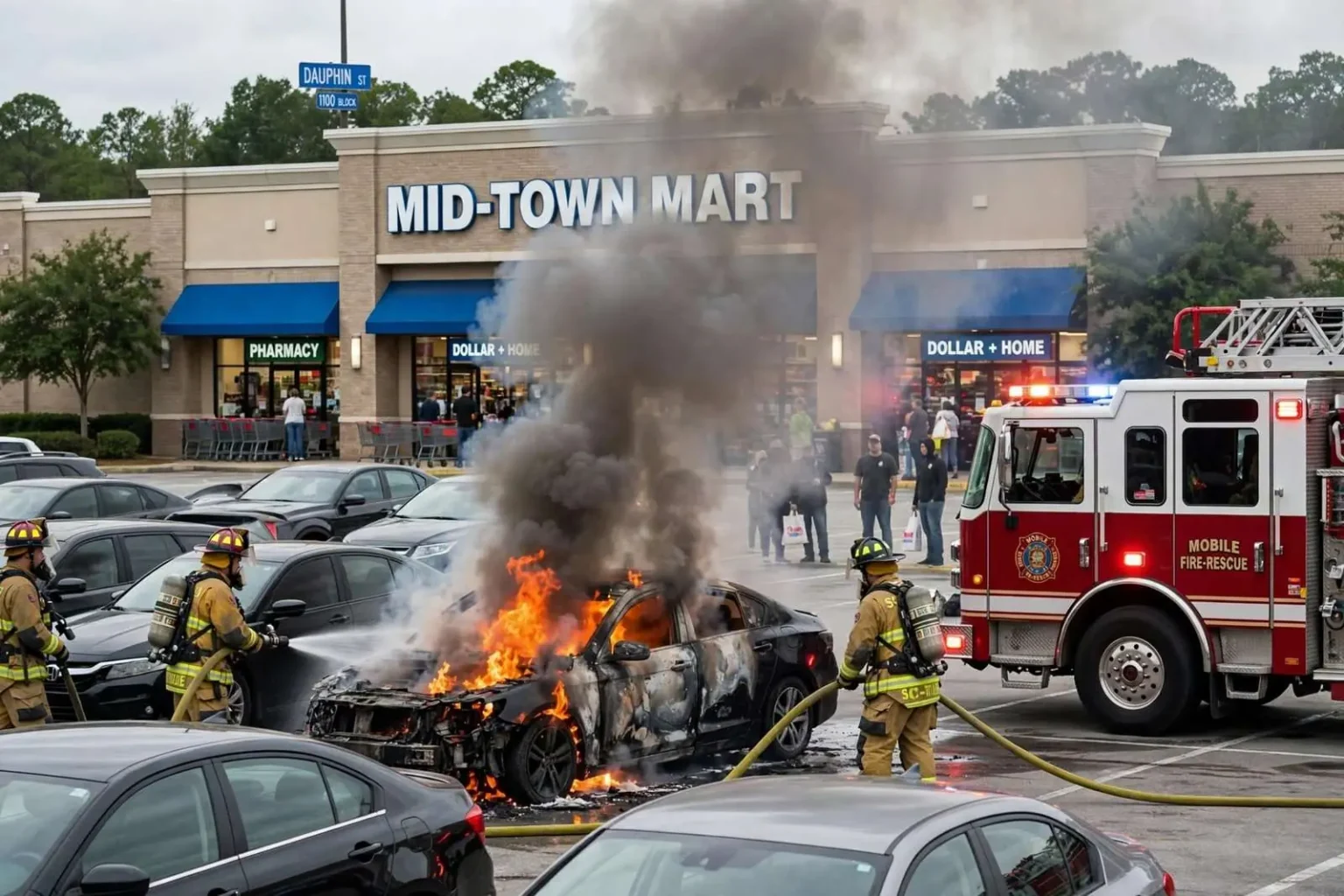
MOBILE, Ala. — A car caught fire Sunday afternoon in the parking lot of the Mid-Town Mart shopping center on Dauphin Street, sending smoke across one of midtown Mobile’s busiest retail corners. Fire crews responded and worked to knock down the flames in the midtown Mobile shopping center’s lot, and the episode ended the way vehicle fires usually should: no injuries were reported, and the cause of the fire had not been determined as of the initial reports.
Parking-lot vehicle fires occupy a particular place in a fire department’s workload. They are common, they are usually contained to a single vehicle, and they draw outsized attention when they happen in a crowded commercial center on a weekend afternoon. Sunday shoppers at the Mid-Town Mart — a long-standing retail fixture on the Dauphin Street corridor — got a close look at that reality as crews arrived, positioned their apparatus, and put the fire down while the center’s parking lot temporarily became a working scene.
A Sunday afternoon in midtown
The timing and location shaped the response. Dauphin Street is one of Mobile’s principal east-west arteries, running from downtown through the heart of midtown past shops, restaurants, churches, and neighborhoods, and the Mid-Town Mart shopping center sits squarely in that commercial stretch. A Sunday afternoon brings steady traffic to the center’s stores and its parking lot, so a car burning among the parked vehicles is both a hazard and a spectacle. Responders have to manage the fire, protect nearby vehicles from heat and flames, and keep onlookers and passing traffic clear of the operation.
Vehicle fires present challenges that distinguish them from structure fires, even in a parking lot. Modern cars carry plastics, synthetic upholstery, tires, fuel, and in many vehicles high-voltage battery components, all of which burn hot and produce heavy, toxic smoke. Crews approach with full protective equipment and self-contained breathing apparatus, attack the fire while protecting exposures, and typically remain on scene after the visible flames are out to check for reignition — a live risk with fuel lines, battery terminals, and hot catalytic converters long after a car appears extinguished.
The fact that no injuries were reported suggests the occupants were out of the vehicle and clear of the danger before conditions worsened, which is exactly the behavior fire officials urge. A burning car gives little warning before its fuel system or interior becomes fully involved, and the safest distance for bystanders is considerable. Shoppers and drivers who see smoke coming from a parked vehicle are advised to keep well away, call 911, and let the fire service handle it.
Why cars catch fire in parking lots
The cause of the Mid-Town Mart fire had not been determined, and investigators consider a familiar list of possibilities in cases like this. Mechanical and electrical failures are the most common sources of vehicle fires — fuel line leaks, worn wiring, overheated components, and battery problems can ignite under the hood or beneath the car. Other potential sources include collisions, however minor, that damage fuel or electrical systems; fluids leaking onto hot exhaust components; and, less often in a public lot, deliberately set fires. Determining which applies typically falls to fire investigators, sometimes with input from insurance adjusters and mechanics.
Parking lots add their own wrinkle: a vehicle that was driven normally for miles can ignite minutes after it parks, when a failing component finally reaches ignition temperature or a leak drips onto hot metal. That pattern — the car that catches fire after a safe, uneventful trip — surprises owners, but it is a recognized failure mode, and it is why a burning car in a shopping center lot does not necessarily mean anything happened in that lot. The fire’s origin may be a mechanical history that ended, dramatically, in midtown.
Vehicle fire prevention advice has stayed consistent for years. Owners are urged to act on warning signs — a burning smell, smoke from under the hood, an engine that runs hot, frayed wiring, or fluid stains beneath a parked car — rather than driving on and hoping. Recalls for fire risks should be taken seriously and completed promptly, and fuel system repairs belong with qualified technicians. For older vehicles especially, the habit of a quick look for leaks before driving, and attention to anything unusual under the hood, catches many of the failure points before they reach ignition.
Fire crews at a retail center
The response at a commercial parking lot also involves coordination with the property itself. Shopping center management typically helps clear the immediate area, move shoppers and vehicles back, and manage the disruption while crews work. Fire crews arriving at the Mid-Town Mart would have staged apparatus to protect the surrounding parked cars from radiant heat, deployed a hose line on the burning vehicle, and controlled the scene perimeter while the fire was knocked down. The lot’s layout — wide lanes, multiple exits onto Dauphin Street and the connecting side streets — generally gives responders the room they need for that work.
The aftermath of a vehicle fire in a shared lot falls to the vehicle’s owner and the property owner. A burned car is towed once investigators release it, the pavement beneath it is left stained and often damaged by the heat, and insurance claims begin with the fire department’s incident report. Nearby vehicle owners who notice heat or smoke damage to their own cars are advised to document it and report it, since radiant damage from a neighboring vehicle fire is a recognized claim scenario.
By the time the flames were knocked down Sunday afternoon, the immediate danger had passed: no one was hurt, the fire was contained to a single vehicle, and the shopping center’s Sunday resumed around the cleanup. The unanswered question — what started the fire — remains with investigators, who had not determined a cause as of the initial reports. For the drivers and shoppers who watched it happen, the episode was a practical reminder of how quickly a parked car can go from ordinary to fully involved, and why distance, a 911 call, and patience for the fire crews are the right response every time.
What happens after a vehicle fire
Once the fire is out, a documented process takes over. Fire crews confirm the vehicle is fully extinguished and monitor it for reignition, investigators record the scene, and the wreck is ultimately removed by a tow operator the owner or insurer arranges. Vehicle fires almost always total the car they burn — even a fire limited to the engine compartment destroys wiring, hoses, and electronics — and the insurance claim that follows starts with the incident report from the responding department. Owners sorting out a claim are generally advised to get that report number at the scene or from the department soon after.
The shopping center’s own exposure matters too. Property managers handle the damaged pavement, check that no spread occurred to landscaping, canopies, or the building itself, and review the incident with their insurer. Commercial lots are designed with fire lanes and spacing that make single-vehicle fires manageable, and the Mid-Town Mart’s lot performed that function Sunday: the fire stayed with the vehicle that brought it.
For midtown Mobile, the episode added one more entry to the long list of vehicle fires that departments along the Gulf Coast handle every year. Most end the way this one did — one car, no injuries, an investigation to follow — and most pass with little consequence beyond the owner’s loss. The exceptions, the fires that spread or injure, are almost always the ones where people got too close or tried to fight the fire themselves with a garden hose or an inadequate extinguisher. The distance-and-call-911 rule exists because of those exceptions.
Electric and hybrid vehicles add new considerations
Fire officials responding to parking lot fires today also work with a changing vehicle fleet in mind. Hybrid and electric vehicles bring high-voltage battery systems into every fire scene, and a battery fire behaves differently from a conventional fuel fire: it can burn hotter, release different toxic gases, and reignite hours or even days after being knocked down. Fire services across the country, including departments along the Gulf Coast, have updated their response procedures for these vehicles — larger water supplies, thermal monitoring, and careful post-fire handling when the vehicle is towed.
None of that changes the guidance for the public at a scene like the Mid-Town Mart. Bystanders cannot tell from smoke whether a burning car is gasoline-powered or electric, and the response is identical either way: get away, keep others back, and let crews work. The first-arriving responders identify the vehicle type and adjust, which is one more reason the perimeter they establish is not a suggestion.
The cause determination in this case will follow the vehicle’s history wherever it leads — mechanical failure, a prior collision, or something else entirely. Until investigators release findings, the report stands as it began: a car fire in the Mid-Town Mart parking lot on Dauphin Street, Sunday afternoon, crews on scene, no injuries, and a cause still undetermined.


