Government building representing a congressional campaign and election seasonBoth special primaries are scheduled for August 11, with the general election set for November 3.

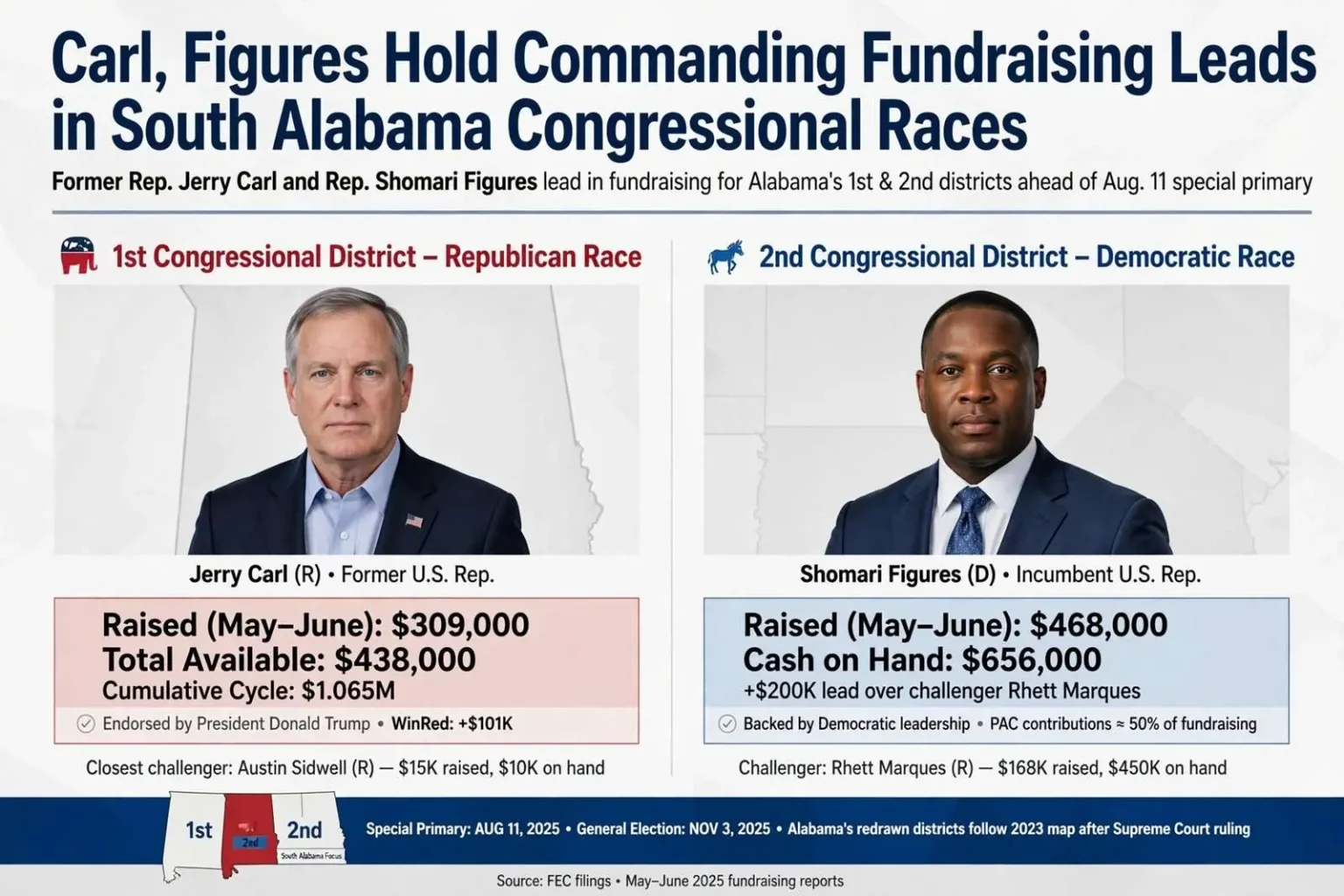
Former Republican U.S. Rep. Jerry Carl and incumbent Democratic Congressman Shomari Figures are holding significant financial advantages in their respective races for Alabama’s redrawn congressional districts, according to the latest fundraising figures.

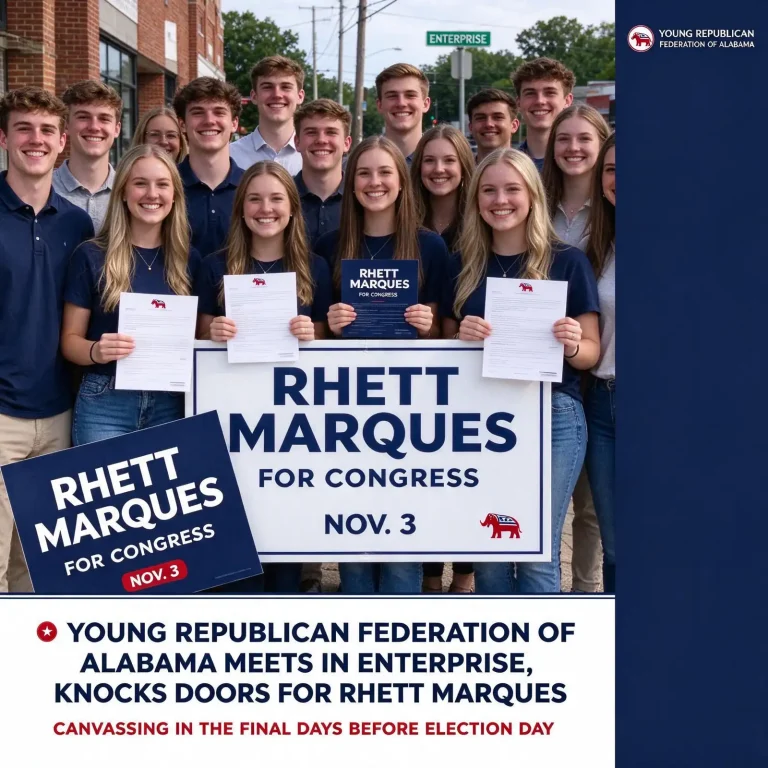
In the 2nd Congressional District, Figures maintains roughly a $200,000 cash advantage over his leading Republican challenger, state Rep. Rhett Marques. The incumbent Democrat raised approximately $468,000 between May and June, building a war chest of about $656,000. Marques, who has secured endorsements from President Donald Trump and U.S. Sen. Katie Britt, raised $168,000 over the same period and holds roughly $450,000 on hand.

Democratic leadership has backed Figures’ reelection bid with contributions from Speaker Emeritus Nancy Pelosi, House Minority Whip Katherine Clark, and several Democratic political action committees. PAC contributions make up just over half of his recent fundraising haul.

In the 1st Congressional District, Carl has built a commanding lead among Republican primary contenders. The former congressman raised nearly $309,000 in May and June through his campaign committee, with his joint fundraising committee bringing in an additional $189,000, for total available funds of approximately $438,000.

Carl’s closest primary opponent, Air Force veteran Austin Sidwell, raised just $15,000 and has $10,000 remaining on hand. Other Republican candidates, Lucas Burger and John Mills, reported no fundraising activity during the period.

Democrat Clyde Jones faces no primary opposition in the 1st District and has raised $18,000, with $15,000 currently on hand.

Both special primaries are scheduled for August 11, with the general election set for November 3.

Full Election-Cycle Totals

Looking at cumulative fundraising for the entire campaign cycle rather than just the most recent reporting period, Carl’s advantage widens further. Federal Election Commission filings show Carl has raised $1.065 million overall in his bid to reclaim the 1st Congressional District seat he held from 2021 to 2025 before losing to U.S. Rep. Barry Moore, R-Enterprise, in 2025. Carl has not loaned his campaign any personal money; instead, the Jerry Carl Victory Committee contributed $82,000 and the Republican fundraising platform WinRed added another $101,000. He has spent $696,785 to date and carries a full endorsement from President Donald Trump, who has called Carl a steadfast supporter of his agenda.

Sidwell’s cumulative total stands at $190,248, which includes a $124,000 loan he made to his own campaign plus family contributions; his largest outside donation, $3,500, came from a backer in Mississippi. He has spent roughly $180,000 so far. Mills, who ran for a Florida congressional seat in 2025 before relocating to a rented home in Seminole, Alabama, near the Styx River, has raised just $14,162 cumulatively, almost all of it self-funded, and has spent $15,191.

See also  Baldwin County Commission Democrat Roy Browning Confirms He Dropped Out of Race Months Ago

Democrat Clyde Jones’ cumulative total stands at $55,423 raised and $40,075.67 spent, with no personal loans to his campaign. Lucas Burger, who qualified for the Republican ballot, announced on Facebook in June that he is not actively campaigning, citing a chaotic, last-minute reopening of candidate qualifying amid the ongoing redistricting fight.

Behind the Special Election

The special primary was triggered after the U.S. Supreme Court intervened in Alabama’s long-running redistricting dispute, allowing the state to use a 2023 congressional map rather than a court-ordered version that had split Mobile and Baldwin counties. That court-ordered map, stemming from the Allen v. Milligan case, had combined the city of Mobile with the Black Belt and Montgomery to form a second district with a Black voting-age majority, while shifting the remainder of Mobile County into a 1st District alongside Baldwin County and the Wiregrass. Alabama’s successful appeal, bolstered by the Supreme Court’s ruling in Louisiana v. Callais, led the high court to lift a renewed injunction that a three-judge panel had issued in late May. Voters can check their registration status at myinfo.alabamavotes.gov ahead of the August 11 special primary.
Probate courts in Alabama handle matters distinct from the trial courts that hear criminal and civil cases, including wills, estates, guardianships, and involuntary commitments for mental-health treatment. In Mobile County the probate judge is an elected official with broad administrative and judicial duties.

Collegiate athletics are a major part of life in southern Alabama, where the University of South Alabama in Mobile fields the Jaguars across a range of sports. The university’s football program, which began competition in the 2000s, has become a rallying point for students, alumni, and residents and a source of regional pride.

Charitable and nonprofit organizations form a vital safety net across South Alabama, addressing needs from hunger and homelessness to disaster relief and holiday assistance. Groups such as The Salvation Army operate local corps that provide shelter, food, and seasonal programs funded largely by community donations.

Local government in the Mobile area operates through a combination of mayor-council or commission structures at the municipal level and a county commission in Mobile County, with elected officials handling budgets, public safety, infrastructure, and zoning. Baldwin County has its own commission and a collection of incorporated municipalities.

See also  Mobile Radio Station's St. Jude Radiothon Aims to Help Local Families

The economy of the Mobile region is diversified across shipping and logistics, aerospace and shipbuilding, healthcare, tourism, and manufacturing. The Port of Mobile is one of the nation’s busiest seaports and a cornerstone of the local and state economy.

Mobile is the county seat of Mobile County in southwest Alabama and the state’s only saltwater port. Situated where the Mobile River meets Mobile Bay near the northern Gulf of Mexico, the city has long served as a commercial and cultural gateway between Alabama and the wider Gulf Coast. Founded in 1702 as Fort Louis de la Louisiane and ruled in turn by France, Britain, and Spain before joining the United States in 1813, Mobile carries a layered heritage distinct from the rest of the state.

Baldwin County sits directly east of Mobile County across Mobile Bay and is the largest county in Alabama by land area. It encompasses the Eastern Shore communities of Daphne, Fairhope, Spanish Fort, and Foley and stretches south to the beaches of Gulf Shores and Orange Beach along the Gulf of Mexico.

Alabama is a state in the southeastern United States bordered by Tennessee, Georgia, Florida, the Gulf of Mexico, and Mississippi. Often called the Heart of Dixie, it spans Appalachian foothills in the north and flat coastal plains in the south. Its largest cities include Birmingham, Montgomery, Huntsville, and Mobile.

The natural environment is central to life on the Gulf Coast, where barrier islands, bays, rivers, and wetlands support fisheries, recreation, and storm protection. Coastal Alabama faces challenges common to low-lying regions, including hurricane exposure, erosion, and the management of fragile ecosystems.

The history of South Alabama is shaped by its position at the crossroads of cultures and waters. Indigenous peoples, including the Muscogee (Creek) and Choctaw, lived in the region for centuries before European colonization by French, British, and Spanish powers.

Healthcare in the Mobile area is anchored by several hospital systems and provider networks that serve patients across southwest Alabama, the Gulf Coast, and into parts of Mississippi and Florida. Large employers in the sector include regional health systems operating hospitals, clinics, and specialty centers, alongside university-affiliated providers.

Education in South Alabama spans public school systems in Mobile and Baldwin counties, a network of private and parochial schools, and institutions of higher learning including the University of South Alabama, Spring Hill College, and community colleges. Public-school governance rests with locally elected boards.

See also  Erwin Rolls Out the Heavy Artillery: A Host List That Reads Like Mobile's Political Rolodex

Local journalism serves as the connective tissue of communities like those across South Alabama, informing residents about government, schools, public safety, and the events that shape daily life. Outlets covering Mobile and Baldwin County help hold institutions accountable and give voice to neighborhood concerns larger media may overlook.

Local law enforcement across South Alabama is carried out by municipal police departments, county sheriff’s offices, and state agencies that together cover a mix of urban, suburban, and rural territory. City departments handle policing within municipal limits, while sheriff’s offices provide courthouse security, jail operations, and patrol in unincorporated areas.

The Federal Bureau of Investigation is the principal investigative arm of the United States Department of Justice, tasked with protecting the country against terrorist threats, foreign intelligence operations, cyber attacks, and major criminal activity. Established in 1908, the bureau operates a network of field offices across the country, each responsible for federal law-enforcement matters within its region.

Behavioral-health care on the Gulf Coast is provided by a mix of community mental-health organizations, hospital systems, and private practitioners. Community centers play an especially important role in serving patients who might otherwise lack access to care, often coordinating with courts, jails, and social services.

Mobile lays claim to a long tradition of outdoor festivals and public celebration, most famously its Carnival or Mardi Gras season, which predates the better-known celebrations of New Orleans. Throughout the year the region hosts music festivals, food and arts events, and waterfront gatherings that draw visitors from across the Gulf Coast.

The Gulf of Mexico borders Alabama’s southern edge and defines much of the state’s coastal identity. Alabama’s Gulf coastline, centered on Dauphin Island, Gulf Shores, and Orange Beach, supports a tourism industry built around beaches, charter fishing, and marine recreation, while offshore waters host shipping lanes and energy interests.