California City Votes to Boycott Alabama Over Immigration Law
Leaders in Carson, California, adopted a resolution calling for a boycott of Alabama in protest of the state's tough new immigration law, directing staff to review contracts with Alabama businesses.
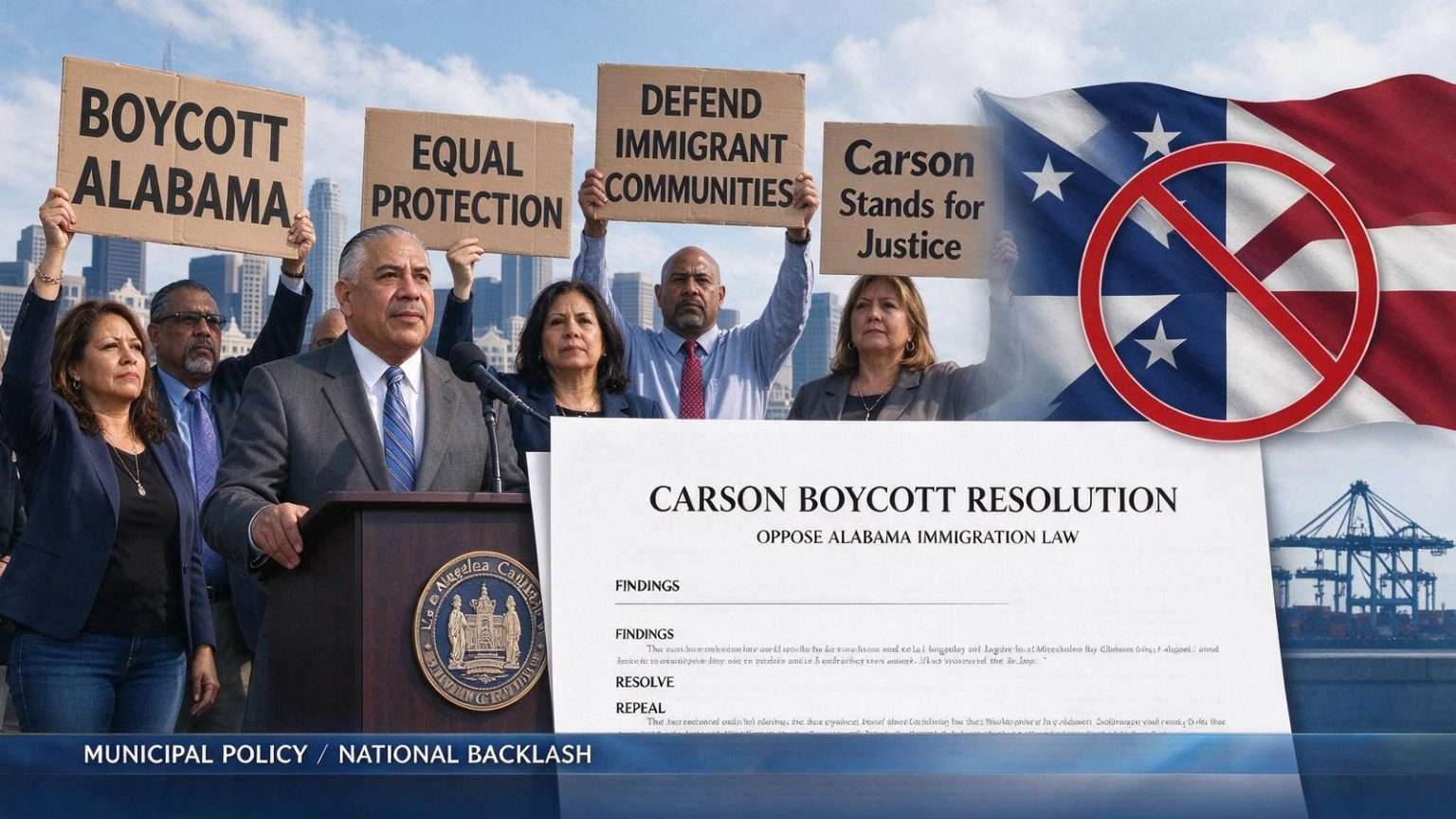
Leaders in Carson, California, adopted a resolution calling for a boycott of Alabama in protest of the state’s tough new law targeting illegal immigration, escalating a national backlash against the measure into a formal act of municipal policy. The vote put a city of 100,000 people on the other side of the country on record against Alabama’s immigration enforcement law, and it signaled that the debate over the statute would be carried far beyond the Gulf Coast.
The Carson resolution criticized the Alabama law as, among other things, un-American, and cited what its authors described as racial profiling, discrimination based on race, violations of the 14th Amendment and a usurpation of the federal government’s authority over immigration. Those four objections tracked the criticisms that had followed the law since its passage: that it invited police to question people based on appearance, that it imposed state penalties on a matter the Constitution assigns to Washington, and that it ran against the equal protection guarantees written into the Constitution after the Civil War.
What the Resolution Said
Structured with eight whereas clauses and multiple resolving provisions, the measure declared Carson’s opposition to the Alabama legislation, called for its repeal and expressed the city’s intent to refrain from conducting business with Alabama. That included staying away from conventions or other activities that would require city resources. The whereas clauses built a legal and moral case paragraph by paragraph before reaching the operative instructions, a drafting style common in municipal resolutions that lets a council lay out its reasoning on the record.
Officials directed city staff to analyze contracts to determine where a boycott would be fiscally appropriate and effective in pressuring Alabama to reverse course. The city manager was instructed to suspend official travel to Alabama and to review current and likely future contracts with Alabama-based businesses to examine whether the same goods or services could be obtained elsewhere. No specific instances were cited where such measures might be applied — an omission that reflected the reality that Carson’s direct business ties to Alabama were, at most, modest. The economic weight of the resolution was largely symbolic, but the council argued that symbols matter when a state’s law draws national condemnation.
The measure concluded with a pledge that Carson would continue monitoring what it called anti-immigration tactics in Alabama, along with the effectiveness of its own actions in influencing the state’s course. In other words, the council committed itself to a standing agenda item rather than a one-time statement, reserving the right to escalate or publicize further as the Alabama law worked its way through the courts.
A Unanimous Vote Far From Alabama
The resolution passed unanimously. Carson, a city of roughly 100,000 people, sits in Los Angeles County between Compton and the Port of Los Angeles. Incorporated only decades earlier, the community traces a deeper history to Spanish land grants of the 18th century, a heritage its leaders invoked as they positioned the city as a defender of immigrant communities.
Carson’s demographics give the vote its context. The city is one of the most diverse in California, with large Latino, Filipino, Korean and Pacific Islander communities, and its council members spoke to constituencies that include immigrants from nearly every corner of the world. A unanimous vote in a city like that is less a surprise than a statement — no council member wanted to be the one to defend Alabama’s law, or even to abstain from criticizing it.
The unanimity also reflected the political moment. California’s legislature and several of its largest cities had already gone on record against the wave of state immigration enforcement laws that began with Arizona’s SB 1070, and Alabama’s statute — drafted with that Arizona law as a model — was widely described as going even further. For Carson’s council, joining the boycott campaign placed the city alongside a growing list of local governments choosing sides in a national fight.
Municipal boycott resolutions carry a particular weight in California politics, where city councils routinely take positions on national questions and where the state’s own skirmishes with the federal government over immigration enforcement give local governments both precedent and confidence. A Carson vote is not merely symbolic to the constituents who elected the council; it is part of a dense network of California municipalities that have committed to defending immigrant communities, and council members expected their residents to hold them to that standard. In that sense the resolution was as much a message home as a message to Montgomery: Carson was declaring how it expected its own police, contractors and city staff to operate, whatever happened in Alabama’s courts.
Silence From the Sponsor
The bill’s sponsor in the Alabama Legislature, a state representative from north Alabama, was not immediately available to respond to the California city’s action. The absence of an immediate reply left the resolution to stand as a one-sided rebuke from across the country, at least for the day. In the Alabama Statehouse, reactions to out-of-state criticism had generally followed a familiar script: sponsors defended the law as a mirror of federal standards, dismissed boycott threats as political theater, and pointed to the courts as the proper venue for the dispute.
For Alabamians, the boycott resolution offered an early sign that the immigration law would carry consequences well beyond the state’s borders, drawing organized opposition from governments elsewhere even as the measure worked its way through the courts. Cities and conventions that had once booked Alabama venues without a second thought now had to consider whether their own councils or boards had taken positions on the state’s law — a new wrinkle in the routine business of booking conventions and choosing vendors.
A Law Under National Scrutiny
The Carson vote fit a broader pattern of protest that had greeted the Alabama law, which ranked among the strictest state immigration measures in the nation. The statute required police to check the immigration status of people they stopped, directed officials to verify the status of students in public schools, and criminalized everyday interactions — renting housing, giving a ride, hiring day labor — that the state had never regulated before. Civil rights groups, the U.S. Department of Justice and clergy from across Alabama challenged the law in federal court within days of its signing, arguing that its provisions violated the Constitution and invited discrimination.
Critics framed such laws as invitations to discrimination and as intrusions on federal authority, while supporters defended them as necessary responses to gaps in national enforcement. In Alabama, supporters pointed to the state’s schools, hospitals and jails absorbing costs they attributed to illegal immigration, and argued that federal inaction had left states no choice but to act. Opponents answered with the 14th Amendment argument Carson’s council endorsed: that a state cannot create its own immigration policy, and that laws forcing local police to check papers inevitably sweep in citizens and legal residents who happen to look a certain way.
The courts would ultimately sort out which provisions could stand. Federal judges blocked key sections while the litigation proceeded, in a pattern that repeated across the states that had passed similar laws — a reminder that the fight over Alabama’s statute was always destined for the federal judiciary, not the statehouse.
What a Boycott Can Actually Do
Whether a boycott by a single California city would meaningfully affect Alabama’s economy was open to question. Carson’s contracts with Alabama businesses were likely few, and its convention attendance in the state minimal. The resolution’s authors effectively conceded as much by instructing staff to find “fiscally appropriate” targets rather than announcing any specific severance. Economic boycotts succeed, when they succeed, through accumulation and publicity — a hundred cities doing what Carson did, and the news coverage of each vote doing more damage than the severed contracts themselves.
That was the model the boycott movement had in mind. Civil rights–era boycott campaigns against states that practiced segregation had shown that reputational pressure can move legislatures in ways that litigation alone does not, and organizers of the modern campaign borrowed the playbook deliberately. Convention bureaus in Birmingham, Mobile and Huntsville watched the list of boycotting governments grow with unease, since conference bookings are the most vulnerable revenue: associations weighing competing cities can simply pick another, and no one has to break a contract to do it.
But the resolution ensured that the debate over the state’s immigration policy would be waged not only in courtrooms and the Legislature, but in the resolutions of city councils far from the Gulf Coast. A city council in Los Angeles County, invoking Spanish land grants and the 14th Amendment in the same document, had put Alabama’s law on its agenda — and every similar vote that followed would keep it there, in public, for as long as the statute remained on the books.