Cartoonist Marshall Ramsey’s Open Letter Captured Mississippi’s Katrina Anniversary Frustration
Cartoonist Marshall Ramsey's 2015 open letter to President Obama voiced Mississippi Coast frustration over skipping the Katrina 10th anniversary.
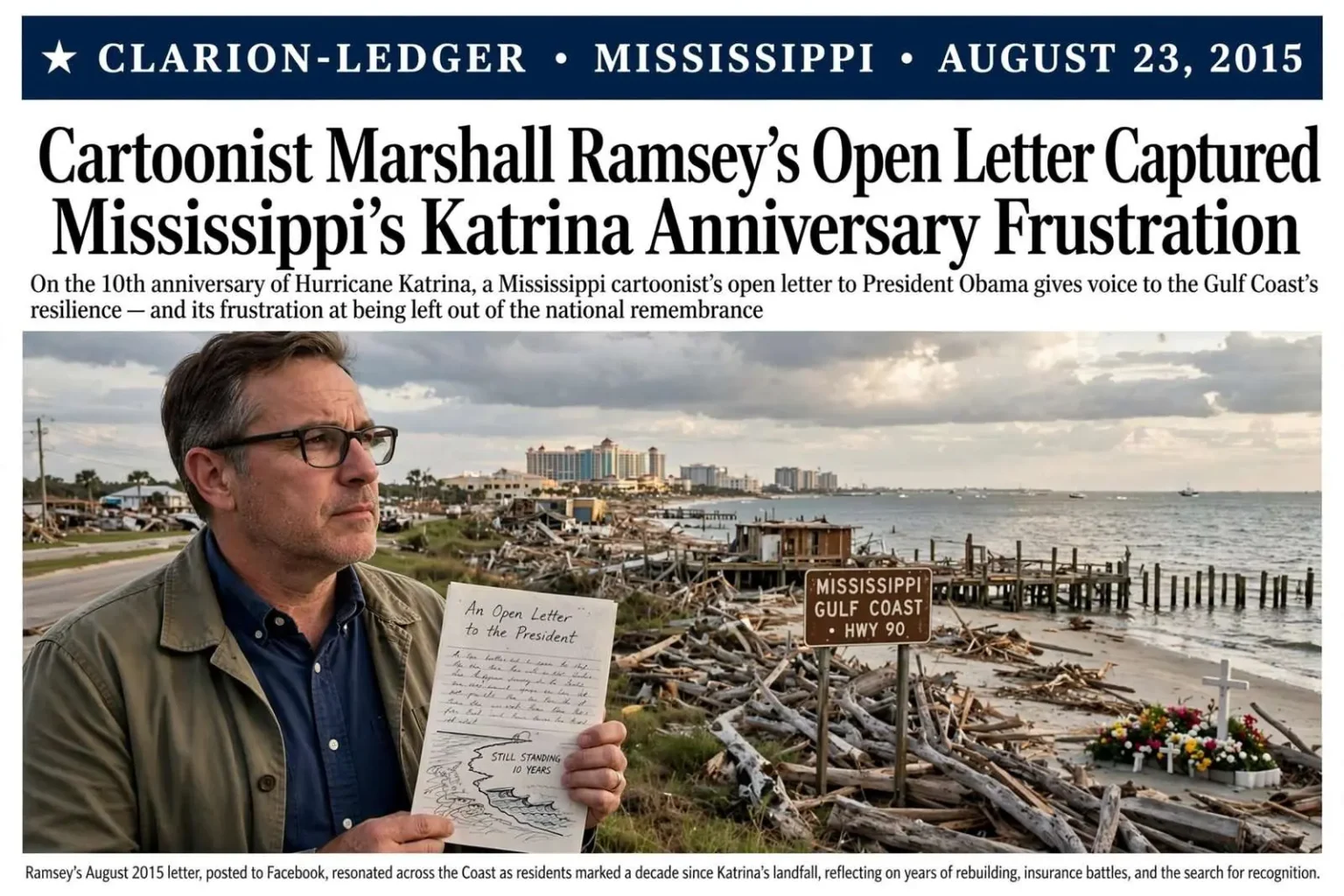
As the 10th anniversary of Hurricane Katrina approached in August 2015, plans for President Barack Obama to mark the occasion in New Orleans — and not on the Mississippi Gulf Coast — stung many residents of a region that bore the storm’s deadliest coastal blow. The frustration found an unlikely spokesman: veteran Mississippi editorial cartoonist Marshall Ramsey. In an open letter to the president posted on Facebook, Ramsey acknowledged that anniversary visits are often shaped by politics, but argued that the Coast’s story deserved a national audience. He recalled Obama’s earlier trip to the region during the BP oil spill and pointed to years of hardship that followed the storm — the recession, battles over insurance, and redrawn flood plain maps — that tested communities long after the water receded. “You should be proud of the people on the Gulf Coast,” Ramsey wrote, describing residents who were “hammered hard” by both the storm and its economic aftermath yet kept rebuilding anyway. The letter resonated quickly, drawing more than 1,000 likes and hundreds of shares within hours of being posted. In a follow-up essay on his own website, Ramsey declined to relitigate the long-running debate over whether New Orleans or the Mississippi Coast suffered more. “Both got the crap kicked out of them,” he wrote, adding that the anniversary was less about politics or regionalism than “a celebration of human resiliency.” The episode captured a familiar feeling along the Coast: pride in how far the region had come since Aug. 29, 2005, paired with a sense that its recovery story too often played second fiddle to New Orleans in the national memory of the storm.
Katrina’s Direct Hit on the Mississippi Coast
Katrina remains the lens through which the Mississippi Gulf Coast understands its modern history. When the hurricane made landfall on Aug. 29, 2005, the Mississippi coastline took a direct and catastrophic hit: in communities such as Biloxi, Gulfport, Waveland, Bay St. Louis and Pass Christian, the storm surge flattened blocks of the waterfront and claimed lives across the region. Mississippi’s coastal counties, led by Harrison County, absorbed some of the storm’s worst coastal damage even as national attention fixed on the levee failures and flooding in New Orleans. That asymmetry of attention — federal, media and presidential — became a lasting sore point for Mississippians who felt their losses were overshadowed.
Ramsey, a longtime editorial cartoonist whose work has appeared in Mississippi newspapers, gave that frustration a voice that was both pointed and generous. Rather than attacking the president, his open letter appealed to shared respect for the people who had rebuilt. By invoking the BP oil spill — the 2010 Deepwater Horizon disaster that again battered the Gulf’s economy and coastline — he connected two eras of hardship and reminded readers that the region’s recent history had been defined by one recovery effort piling onto another. The insurance battles and revised flood maps he cited were concrete, lingering burdens for coastal homeowners who found their properties reclassified and their premiums upended years after the water was gone.
The White House’s own 10th-anniversary plans underscored the dynamic Ramsey described. Federal commemorations centered on New Orleans, with President Obama scheduled to mark the date there, while other administration officials fanned out across the Gulf — visiting Mississippi communities such as Waveland, Gulfport and Biloxi as part of the broader remembrance. For many on the Mississippi Coast, the symbolism of where the president stood on the anniversary mattered, even as federal recovery dollars had flowed to all five Gulf states in the decade since the storm.
A Decade of Rebuilding After the Storm
In the years after Katrina, the Mississippi Gulf Coast did rebuild, often with a determination that became part of its identity. Federal assistance, insurance settlements and private investment reconstructed casinos, hospitals, schools and homes. Programs administered through FEMA and other agencies funded mitigation work meant to help communities withstand the next catastrophic storm. The Coast also confronted the BP oil spill’s aftermath, layering an environmental and economic crisis onto an already fragile recovery — exactly the “hammered hard” experience Ramsey described. For Ramsey, who witnessed the storm from inside a Mississippi newsroom — he has written of the moment someone shouted that water had reached the third floor of the Beau Rivage in Biloxi — the disaster was both a professional and a personal reckoning.
What made Ramsey’s letter endure locally was its refusal to turn the anniversary into a contest. His follow-up essay insisting that “both got the crap kicked out of them” reframed the moment as shared resilience rather than regional scorekeeping. That message — that the 10th anniversary should celebrate human resiliency — resonated because it spoke to a Coast that had spent a decade proving it could come back. The quick spread of the letter across social media showed how ready people were to see their experience affirmed.
A decade on, the episode remains a useful reminder of how disaster memory is uneven. The Mississippi Gulf Coast continues to balance pride in its recovery with the quiet frustration of being the part of the Katrina story least told. Ramsey’s open letter did not change the president’s itinerary, but it gave the Coast a line of its own — one that said the people there were proud, stubborn and still standing, and that their resiliency was worth a national audience whether or not the cameras were pointed at them. As later anniversaries arrived, the lesson Ramsey drew — that resilience, not rivalry, is the real story — kept echoing along a coast that has learned to measure progress in how well it rebuilds.
The disagreement Ramsey voiced was never really about the president — it was about recognition. The Mississippi Gulf Coast had, by 2015, spent a decade rebuilding in the shadow of a louder national story, and the prospect of a 10th-anniversary commemoration that bypassed the Coast felt like one more erasure. Ramsey’s cartooning career had long centered on Mississippi life, and his willingness to speak plainly to power, even admiringly, gave the sentiment a credible messenger. The letter’s virality — shared widely within hours — showed how hungry Coast residents were for someone to say out loud what many felt: that their losses counted, that their rebuilding counted, and that the anniversary belonged to them too. A decade later, as the Gulf Coast marks each Katrina milestone, that insistence on being seen remains part of how the region tells its own story.
Weighing Mississippi’s Story Against New Orleans
The anniversary moment Ramsey wrote into arrived at a natural inflection point for the Gulf Coast. A decade is the milestone at which communities take stock: children who were in elementary school when the storm hit were graduating high school; the casinos and waterfronts rebuilt in the years immediately after had aged into something like permanence; and the generation of leaders who steered the recovery — mayors, county supervisors, faith-based organizers — had begun passing the work to successors who never knew the pre-Katrina coastline. Anniversaries of this kind draw national media in search of “ten years later” narratives, and for Mississippi, the question each visit implicitly asked was which story the country would hear this time.
The answer, in 2015 as in earlier anniversaries, was complicated by the scale of what New Orleans endured. The flooding of New Orleans was a singular catastrophe — an engineering failure that stranded tens of thousands and dominated national broadcasts for weeks. Mississippi’s story was different in kind: a surge that simply erased the built coastline in hours, killing hundreds across the state and leaving little to film but foundations and debris. Disasters of the second kind generate less sustained attention, and the asymmetry Ramsey wrote about was the cumulative product of years of it — fewer cameras, fewer presidential visits, fewer national retrospectives, even as Mississippi accounted for a large share of the storm’s dead and its most complete physical destruction.
The recovery infrastructure that Mississippi built after Katrina also became part of the story Ramsey gestured toward. The state administered billions in federal recovery grants through programs that rebuilt ports, utilities, schools, and housing; created a permanent memorial and visitors’ infrastructure along the beach highway; and revised building codes to the strongest in its history. The Gulf Coast’s post-storm utility and public-safety upgrades — hardened power grids, improved warning systems, elevation standards for critical facilities — were shaped directly by what the surge did in 2005. None of that work made for dramatic television, but it is the substance of what “still standing” looks like at a ten-year mark.
Ramsey’s Cartoons Become Part of the Coast’s Memory
Ramsey’s own post-Katrina work became part of the Coast’s collective memory in its own right. His Katrina-era cartoons for the Clarion-Ledger were later collected in a book, “Drawing a Reality Check,” and his drawings from the days after the storm — including images of the destroyed coastline and the exhausted people working to dig out — circulated for years as touchstones of how Mississippians described the experience to themselves. His open letter to Obama extended a body of work whose through-line was the same: that the Coast’s experience deserved to be recorded accurately, by someone who lived it, in whatever medium the moment called for.
The letter also landed in a decade marked by successive blows that tested the recovery narrative Ramsey celebrated. The BP spill in 2010 devastated the same waters that Katrina’s surge had crossed, and its claims process, tourism campaigns, and restoration funding became a second full-time recovery bureaucracy for coastal governments. The recession that began in 2008 slowed the housing and commercial rebuilding that grants had seeded. Insurance market upheaval, which Ramsey cited directly, reshaped who could afford to live near the water at all. Each of these layered onto the original disaster in ways that national anniversary coverage rarely had space for — which is precisely the space his letter occupied.
In the years since, the anniversary itself has settled into the Coast’s calendar as both remembrance and advertisement of its own endurance. Waveland, Bay St. Louis, Pass Christian, Biloxi, and Gulfport hold observances each August; museums and interpretive sites preserve the storm’s record; and the imagery of the recovery — the rebuilt Beau Rivage, the new bridges, the restored beach — features in the region’s pitch to visitors and investors alike. Ramsey’s letter is remembered locally as a moment when that broader story found a concise national frame: pride without grievance, recognition sought without rivalry, and a insistence on the simple fact that the people who stayed and rebuilt had earned the country’s attention.