Case Dixon Concedes CD6 Primary to Rep. Gary Palmer, Says No Immediate Plans for Another Campaign
Republican Case Dixon conceded Alabama's 6th Congressional District special primary to Rep. Gary Palmer, saying he has no immediate plans to seek office again.
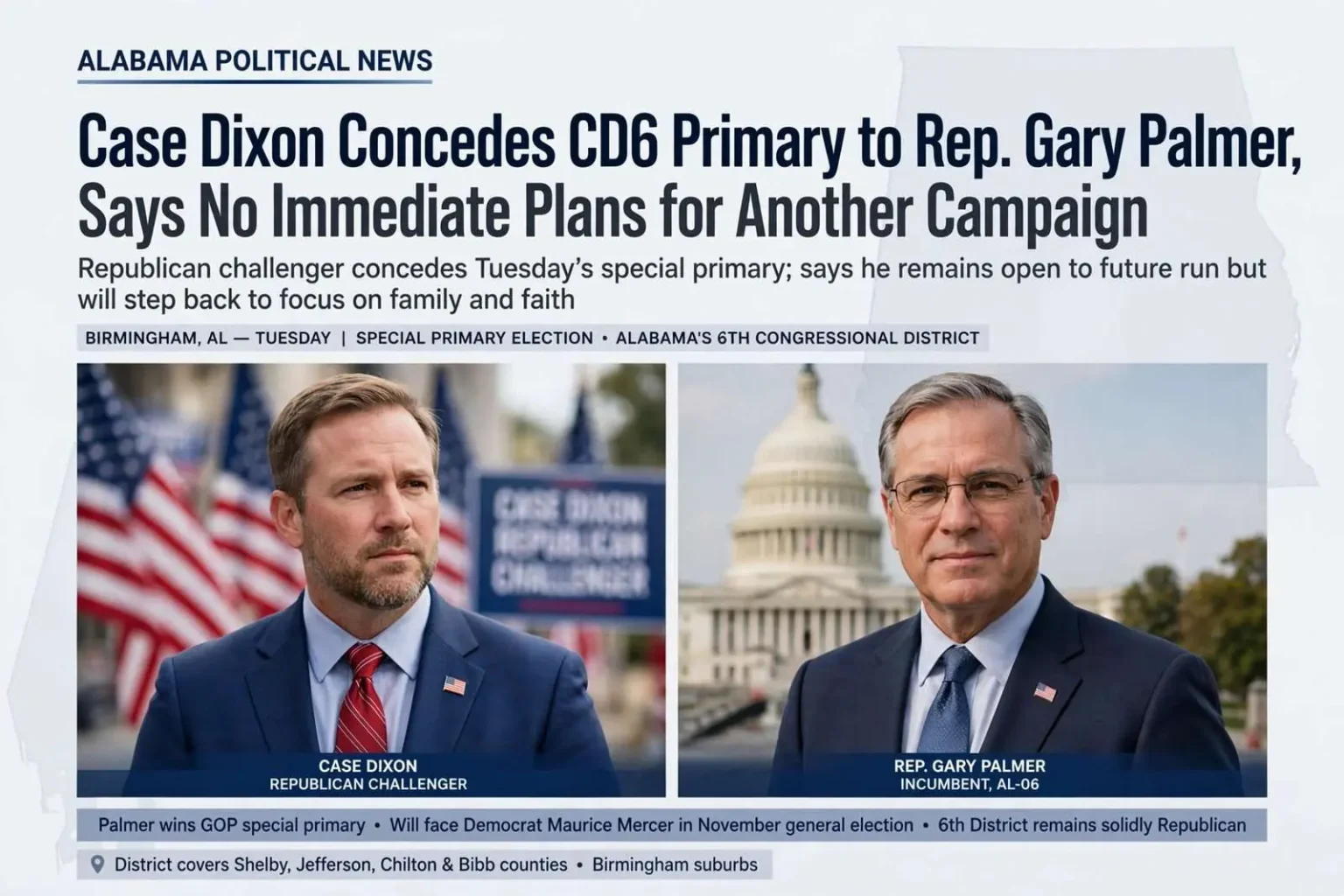
Republican challenger Case Dixon conceded Tuesday’s special primary election for Alabama’s 6th Congressional District to incumbent U.S. Rep. Gary Palmer, saying he has no “immediate plans” to run for another public office but remains open to doing so in the future.
“The district has spoken, and it appears voters believe Congressman Palmer has done a well enough job in Washington to send him back for at least two more years,” Dixon said. “While Congressman Palmer and I certainly have our disagreements, I respect the decision of the voters.”
Dixon said he hopes his campaign drew attention to concerns over federal spending and the national debt, and that the race might make Palmer think twice about future spending decisions. “My hope is that this campaign gave voters a real choice and that it might cause Congressman Palmer to think twice the next time he is asked to increase federal spending or raise the debt ceiling,” Dixon said.
The concession closed out a campaign that ran through a special primary schedule unlike the state’s ordinary election calendar, with voting compressed and attention divided among other races on the ballot. For a first-time challenger taking on an incumbent inside his own party, the race was always an uphill climb — and Dixon, in his statement, framed the effort in terms of the argument he made rather than the outcome he sought.
The Values Behind the Campaign
Dixon said the values that motivated his campaign remain intact even though it has ended. “I ran because I want my children and my children’s children to inherit a country that is freer and more prosperous than the one we have today,” he said. “I am incredibly grateful to everyone who voted, volunteered, donated, prayed, or supported us along the way. This campaign may be over, but my commitment to limited government, individual liberty, personal responsibility, and Christian values is not.”
That closing summary doubled as a description of the campaign’s platform. Dixon ran to the right of an incumbent who is himself one of the House’s most consistent fiscal conservatives, attacking federal spending and the national debt as the central dangers facing the country, and arguing that even conservative-led Washington had grown too comfortable with deficits.
Dixon said he plans to spend time with his family before deciding on his next steps. “For now, I’m going to enjoy some time with my wife and kids, get some rest, and see where the Lord leads me next,” he said.
Palmer will face Democratic nominee Maurice Mercer in the November general election. With the 6th District’s strong Republican lean, the special primary has historically been the decisive contest, and Palmer’s win positions him to return to Washington for another term representing the district centered on the Birmingham area’s suburbs.
Alabama’s 6th Congressional District wraps around Birmingham’s western and southern suburbs, taking in much of Shelby County, parts of Jefferson County and communities stretching down toward Chilton, Bibb and other counties at the district’s edges. It is one of the most reliably Republican districts in Alabama, and its congressional seat has been held by conservative Republicans for decades before Palmer’s tenure.
Palmer first won the seat in 2014 and built his Washington profile around the Republican Study Committee, the House’s largest conservative caucus, which he later chaired. His campaigns have emphasized federal spending restraint, opposition to debt-limit increases and government accountability — positions that made Dixon’s spending-focused challenge a matter of degree rather than direction.
That dynamic shaped a primary fought largely over who would be more aggressive in cutting federal spending. Dixon argued that the national debt, grown to generational highs, demanded more urgency than the incumbent had shown; Palmer’s record on appropriations votes, debt ceilings and budget resolutions became the campaign’s central evidence, cited by both sides to opposite conclusions.
Special Elections and Low-Turnout Math
Special primary elections test campaigns differently than regular cycles. Turnout is thinner, media attention is scattered, and name recognition matters more than in a November contest crowded with national races. Incumbents almost always hold the advantage in such conditions, and challengers typically need either a financial edge or an organized grass-roots network to compensate — advantages that are hard to build in a compressed special-election timeline.
Dixon’s campaign leaned on the argument that a primary challenge, win or lose, sends a message about the district’s expectations. His post-election statement made that theory explicit: the goal, he wrote, was to give voters a real choice and to pressure the incumbent on spending votes to come. It is a rationale common among primary challengers who fall short, and Dixon’s statement gave it an unusually full expression.
The concession statement’s gratitude section — thanking voters, volunteers, donors and those who prayed for the campaign — reflected the coalition a first-time candidate assembles in a district race: local party activists, church networks, family friends and small donors who give in increments an incumbent’s war chest dwarfs. Those networks often outlive the campaign, forming the base from which future candidates launch.
Dixon’s refusal to rule out future runs leaves that door open. Alabama political circles have watched a generation of first-time candidates use a hard primary against an entrenched incumbent as a proving ground, and Tuesday’s result gives Dixon both a name recognition base in the district and a platform — fiscal conservatism, family, faith — from which any future campaign would start.
The campaign’s closing weeks also reflected the character of the district’s Republican politics. Debates and joint appearances focused on mechanics of federal budgeting rather than cultural flashpoints, and both candidates directed their sharpest words at Washington as an institution. Dixon’s concession continued that tone, avoiding bitterness and directing his critique at the spending system rather than the man who won.
For Palmer, the primary win removes the only serious obstacle to another term. The November general election against Mercer will decide the seat formally, but the 6th District’s partisan arithmetic makes the general a formality in practice; no Democrat has seriously contested the seat since it was redrawn around the Birmingham suburbs, and recent cycles have produced wide Republican margins.
Palmer returns to a Washington agenda in which the issues Dixon raised remain live ones. Federal spending, the debt ceiling and annual appropriations fights are fixtures of every Congress, and the Alabama congressman’s committee work and caucus leadership keep him in the middle of them. Whatever effect the primary challenge had on his posture, the voters who returned him will be watching for the same discipline Dixon demanded.
What the Result Means for the District
The outcome preserves continuity for a district whose voters have favored consistency over turnover. Shelby County’s growing suburbs, the communities along the U.S. 31 and Highway 280 corridors and the smaller counties at the district’s southern edge have all shared in the economic growth of the Birmingham metro, and the district’s congressional representation has been a steady, familiar voice for that constituency.
For voters who supported Dixon, the statement offered a closing argument worth keeping. His framing of the race — as a referendum on federal spending discipline rather than a personal campaign — is likely to resurface in future primaries, whether his own or another conservative challenger’s, whenever spending votes give it fresh relevance.
The special primary itself will be remembered in district politics as a low-key affair: one challenger, one incumbent, a debate over fiscal policy conducted largely through statements and small events rather than televised spectacle. In a district where the primary is the real election, even a quiet one shapes the conversation its representatives hear at home.
Dixon, for his part, exits the race with the gratitude and goodwill his statement expressed. He thanked the voters of the 6th District for their consideration, his volunteers for their hours, and his family for their patience — and he left unspoken the possibility that a future campaign will bring him back before them. Alabama politics has a long memory for candidates who lose well.
His statement’s religious framing — resting, praying, and following where his faith leads — will be familiar to anyone who follows Alabama campaigns, where expressions of faith are a standard grammar of both victory and defeat. What distinguished Dixon’s was its lack of ambivalence: no hints of a recount, no complaints about the process, just a clear acknowledgment that the voters had chosen and a commitment to the ideas regardless.
The November election between Palmer and Mercer will settle the seat for the coming term, and voters in the 6th District can follow the campaign and the district’s returns through the Alabama Secretary of State’s election results. For now, Tuesday’s primary has answered the question the district was asked: Gary Palmer will carry the Republican banner again, and Case Dixon goes home to his family, his faith and whatever the future holds.