‘Ceasefire’ Called at Prichard Housing Complex After Shootings and 230 Emergency Calls
After 230 emergency calls and near-daily shootings, the Mobile Housing Authority calls for a ceasefire at Gulf Village Homes in Prichard.
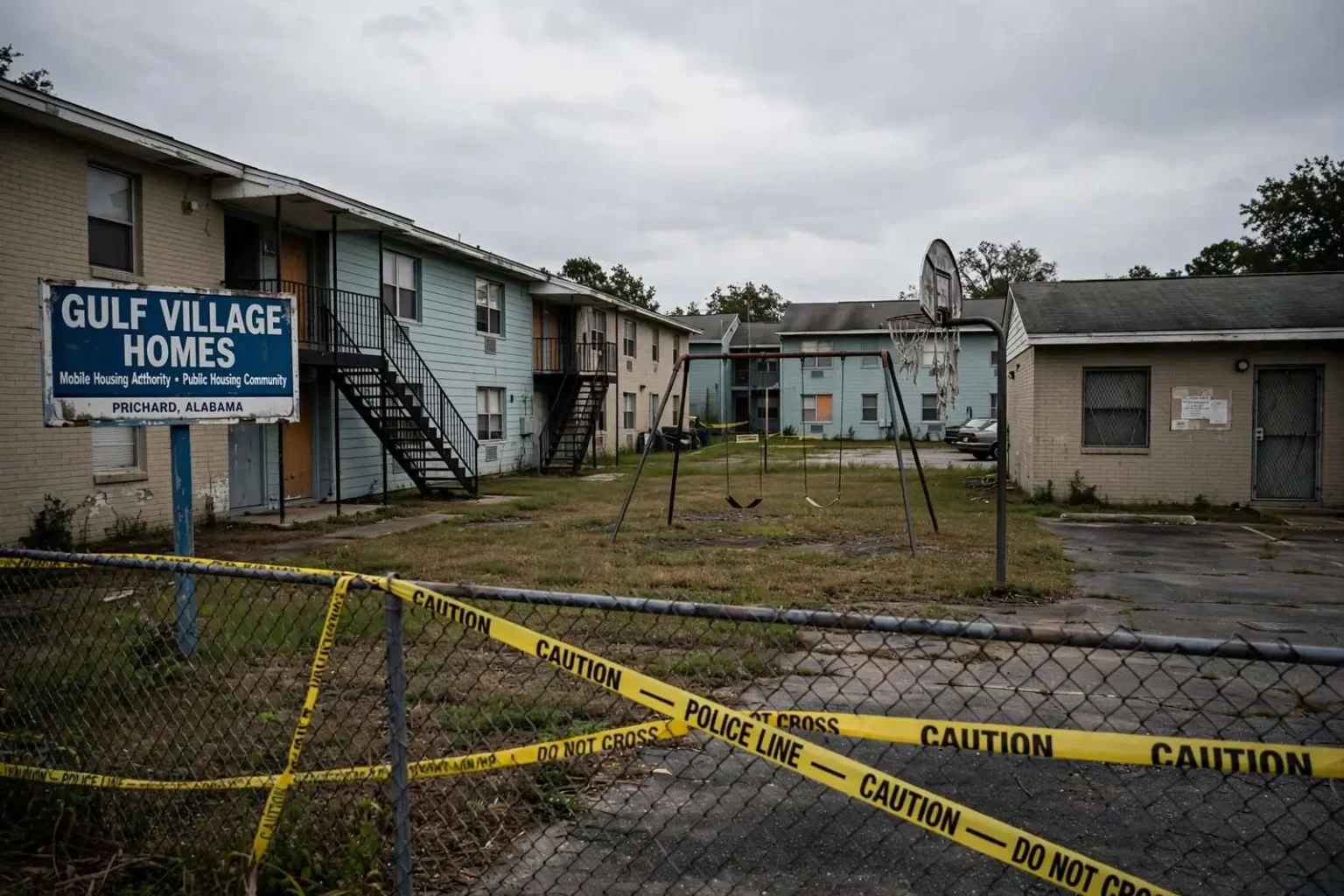
PRICHARD, Ala. — The Mobile Housing Authority is pleading for a ceasefire at one of its public housing communities after a wave of shootings and hundreds of emergency calls this year at Gulf Village Homes. Prichard police have been summoned to the property 230 times so far this year, according to MHA, which describes near-daily shootings that have put residents, employees and bystanders at risk.
The danger hit home recently when contractors working under the authority’s infrastructure upgrade had to duck for cover during a shooting — a moment that underscored for the authority that the violence is not an abstraction confined to after-dark hours, but a condition that interrupts the basic work of maintaining the property and endangers anyone who sets foot in the wrong place at the wrong time.
“There’s been a lot of shooting and carrying on and it’s crazy,” resident Erica Key said. Others were too afraid of retaliation to speak on camera, a fear that itself describes the environment residents are living in: when people will not be identified discussing the violence around them, the intimidation has effectively silenced the neighborhood’s public voice.
Life Under Fire
One mother said she no longer lets her children play outside — the kind of accommodation to danger that, over time, hollows out the ordinary life of a community. Children who cannot play outside, residents who time their movements around gunfire, and elderly neighbors afraid to sit on their porches are the texture of what near-daily shooting looks like on the ground.
“Our children don’t have a safe place to not only live but to play, and home is supposed to be a safe place,” said MHA CEO Michael Pierce. “Right now we can’t say that it’s safe.” Pierce’s statement amounts to an authority acknowledging that it cannot guarantee the most basic promise a housing provider makes — that the property is safe to live on — and the plea for a ceasefire was framed as an appeal to the people carrying out the shootings to stop before someone is killed.
The geography of fear within the property is telling. Some residents living away from the main road say they hear gunshots but don’t share the same level of worry — a split that maps onto where the incidents cluster and illustrates how unevenly violence distributes itself across a single property. For those closer to the main road, the shooting is a near-constant presence; for those farther removed, it is background noise punctuated by moments of terror.
Prichard itself has absorbed more than its share of hardship over the decades. The small city just north of Mobile has weathered significant financial and population decline across recent decades, and its neighborhoods — including its public housing communities — have carried disproportionate shares of the region’s violent crime. The 230 police calls to one property this year put the strain in stark numbers for a police department of modest size patrolling a city of roughly 20,000 residents.
Money Moving Toward the Property
In March, MHA rolled out its $1.8 million two-phase Gulf Village Homes Infrastructure Plan, backed by funds from the Mobile County Commission. The plan targets the physical backbone of the community — the infrastructure that public housing properties across the country have often deferred for years because maintenance money never keeps pace with need. Investment of that scale signals that the authority intends to keep Gulf Village operating as a home for its residents rather than allowing the property to decline into abandonment.
Infrastructure investment and public safety are more connected than they might appear. Dilapidated lighting, broken streets and dead spaces on a property create the conditions where shooting and loitering thrive, and the authority’s plan is understood as a first step toward reclaiming the physical environment — the paths, lighting and common areas where safety is either made or lost. County backing for the plan also signals that the Mobile County Commission regards Gulf Village as part of the county’s responsibility, not merely Prichard’s problem.
In hopes of curbing the violence, the authority has also increased its security budget at Gulf Village and asked for added patrols from both the Prichard Police Department and the Mobile County Sheriff’s Office. The request for county patrols reflects the reality that Prichard’s own police force cannot cover a property generating near-daily calls without help, and that the residents’ safety should not hinge on the response capacity of one small city department.
The heightened security spending comes with hard questions about what it can accomplish. Cameras, guards and patrols deter some activity and document the rest, but they do not by themselves resolve the disputes that drive shooting after shooting at a public housing community. Authority officials have acknowledged as much by framing their request as a ceasefire — an appeal directed at the people firing the weapons, since no amount of security hardware can substitute for a decision by those responsible to stop.
What a Ceasefire Would Require
Violence interruption in communities like Gulf Village typically demands several things working at once: a credible appeal to the people pulling the triggers, consistent law enforcement pressure on the small number of individuals responsible for most of the incidents, services for the young people most at risk of being drawn in, and physical improvements that change how the property feels and functions. The authority’s approach — infrastructure investment, security spending and public appeals together — tracks that understanding of what works.
The residents’ accounts make clear what is at stake in the short term. A mother who keeps her children indoors, workers who duck for cover, and neighbors who decline to be named are describing a community where normal life is on hold. Every shooting that ends without a death is, in the arithmetic of the streets, a reprieve; the authority’s plea is that it not take a death to force the issue.
For now, the Mobile Housing Authority has done what it can with the tools it holds: more security, better infrastructure, added patrols and a public demand that the shooting stop. What comes next depends on whether the appeal is heard — by the individuals pulling the triggers, by the community that can withhold its protection, and by the agencies whose response will determine whether Gulf Village Homes returns to being what its residents say a home is supposed to be.
The People Living Through It
Behind the statistics are residents managing daily routines around the sound of gunfire. Erica Key’s description of “a lot of shooting and carrying on” captures the atmosphere that residents say has replaced the ordinary rhythms of a neighborhood — children walking home from school, elders on porches, families coming and going. When those rhythms break down, the community pays in ways that never appear in a police report: sleep lost to shots fired at night, friendships strained by the fear of being seen talking to authorities, and a creeping sense that no one outside the property is coming to help.
The fear of retaliation that kept other residents from speaking publicly is itself a form of the problem. Witness intimidation is one of the most stubborn obstacles in violent crime cases nationwide, and in close-knit communities where everyone knows everyone, the calculus about what is safe to say extends even to commenting on the news. That silence makes the work of police harder, makes prosecution of shooters rarer, and feeds the cycle by leaving the impression that the violence carries no consequences.
The contractors who ducked for cover during the shooting represent another casualty of the environment — the workers and contractors whose labor the property depends on. When tradespeople hesitate to work at a site because of gunfire, maintenance falls behind, units stay offline longer, and the cycle of decline accelerates. The authority’s infrastructure plan depends on contractors willing to work at Gulf Village, which makes the recent shooting a direct threat to the property’s improvement.
The Larger Context of Public Housing and Safety
Gulf Village Homes is part of a public housing system managed by the Mobile Housing Authority, which administers communities and housing assistance across the Mobile area. Public housing authorities nationwide have spent decades managing properties built in the mid-twentieth century, when federal programs concentrated low-income families in developments that were often isolated from the surrounding city and left to age faster than the funding available to maintain them. The consequences — deferred maintenance, concentrated poverty and the social strain that follows — have made properties like Gulf Village focal points for exactly the kind of comprehensive reinvestment the authority is now attempting.
The Mobile County Commission’s decision to back the infrastructure plan reflects a broader recognition among local governments that public safety is a shared enterprise. A shooting at a Prichard housing community sends fear through families with ties across the county line, burdens hospital and emergency systems that serve the whole region, and costs the entire area in the currency of reputation and investment. County dollars flowing into Gulf Village are, in that light, an investment in the region’s stability as much as in one property’s pipes and pavement.
The request for a ceasefire now stands as the authority’s central message, repeated by its chief executive in plain terms: the children of Gulf Village deserve a safe place to live and play, and the adults firing weapons in their neighborhood are the only ones who can grant it. Whether that appeal, combined with increased security, county-backed infrastructure investment and added patrols from Prichard police and the county sheriff’s office, is enough to turn 230 emergency calls a year into a memory will be measured in the quiet — or the gunfire — that the rest of this year brings to Gulf Village Homes.