Cedar Point Fishing Pier Reopens Under Mobile County Ownership After $2.2 Million Purchase
The Cedar Point Fishing Pier reopened after renovations following Mobile County's $2.2M GOMESA-funded purchase. Free access this season.
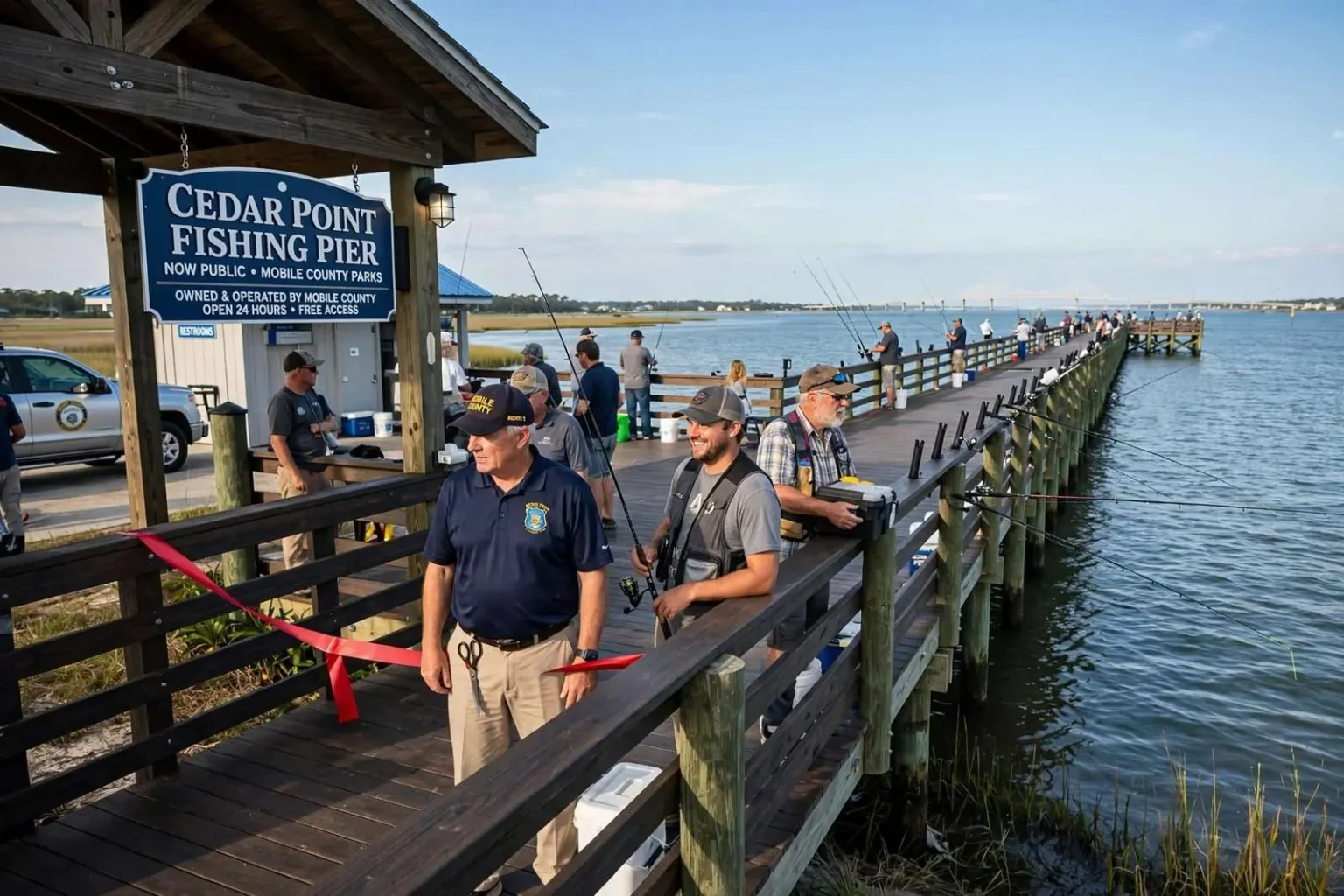
MOBILE COUNTY, Ala. — After nearly four months of renovations, the Cedar Point Fishing Pier is back open — this time as a publicly owned landmark. Mobile County bought the pier in December for $2.2 million, using grant money from the Gulf of Mexico Energy Security Act (GOMESA), converting one of the bay’s most beloved fishing spots from a family business into a public amenity in a single transaction.
Commissioner Randall Dueitt led the push for the purchase, which closed out more than three decades of McRae family ownership dating to 1986. The deal put a permanent shield over public access to the pier — a question that had always hung over a privately held stretch of planks that generations of Mobile County anglers treated as their own front porch on the bay.
“For me it’s one of the most exciting things I’ve done since I’ve been elected,” Dueitt said. “This part of the county means a lot to me.” The commissioner’s district takes in the bayfront communities along the county’s western shore, and the pier sits at the heart of the district’s identity — a destination that draws fishermen from across the county and beyond to a narrow spit of land where Mobile Bay meets the Gulf.
Anglers back on the planks
Dueitt and other officials cut the ribbon on the renovated pier Monday afternoon, and anglers wasted no time getting back on the planks. Within hours of the opening, regulars had claimed their usual stretches of rail, casting into the bay waters as if the four-month renovation pause had been little more than a long weekend between seasons.
“Since I was two years old, this is where it’s at for me,” said Christopher Goodwin, who was fishing the pier on opening day. “This is my home away from home. Relaxation — you can’t get a better place here.” His sentiments were echoed up and down the rail, where the reopened pier functioned less like a ribbon-cutting and more like a family reunion with rod holders.
The renovation work addressed the wear that decades of salt air and storms inevitably leave on a structure that extends far out over the bay. Pier maintenance is a constant reality on the Gulf Coast, where wooden pilings and decking face a punishing environment, and the county’s four-month project gave the aging landmark its most thorough refresh in years.
What GOMESA money does on the Gulf Coast
The $2.2 million purchase was funded through GOMESA, the Gulf of Mexico Energy Security Act, a 2006 federal law that shares offshore energy revenue with the four Gulf Coast producing states and their coastal political subdivisions. Congress designed the program to direct oil and gas revenue back to the places that host the industry’s infrastructure — with the money earmarked for projects like coastal conservation, hurricane protection and public access improvements.
Cedar Point is a textbook GOMESA project in that sense: federal offshore dollars converted into permanent public access to the very waters the revenue comes from. County officials have pointed to the purchase as a model for how the funding stream can work, translating an annual budget line into a tangible landmark that will outlast every official who voted for it.
The McRae family’s tenure dated to 1986, and under their stewardship the pier became a fixture of the regional fishing scene — a 24-hour destination where the rules were simple and the fishing was dependable. The county’s purchase deliberately carries much of that culture forward rather than remaking it.
Free access now, admission later
Access will be free this season; the county plans to begin charging admission in 2023. The grace period gives the county time to establish operations and lets the pier’s regulars ease into the new arrangement before a fee schedule takes effect — a transition that counties elsewhere on the Gulf Coast have managed with modest per-angler admission prices.
Most rules carry over from the previous owners, with a few changes: no alcohol is allowed on the pier, and anglers must bring their own bait and tackle. The ban on alcohol aligns the publicly owned pier with the standards that apply at other public facilities in the county park system, and the bait-and-tackle rule reflects the economics of a county operation that will not staff a tackle counter.
The pier has restrooms on site and stays open around the clock — the 24-hour schedule being one of the features longtime anglers cite first when they explain the pier’s appeal. Night fishing on Mobile Bay is its own pursuit, with the bay’s speckled trout, redfish and flounder caught under lights and along the shadow lines the long structure throws across the water.
Cedar Point itself occupies a singular spot on the map: the seaward tip of Mobile County’s western shore, where the causeway country of Highway 193 runs out of land and the view opens onto the mouth of Mobile Bay, the Dauphin Island bridge and the horizons of the Gulf beyond. Sunset crowds gather there for the same view the fishermen hold all day.
For the communities nearby — Coden, Alabama Port, Grand Bay and the bayfront neighborhoods in between — the reopened pier restores a daily rhythm as much as a recreation option. Pier fishing is woven into the culture of the western shore, and a public pier with around-the-clock access keeps that tradition available to everyone, not just those with boats.
County officials describe the purchase as an investment in exactly that kind of heritage — the sort of public asset that defines a place. The ribbon has been cut, the planks are open, and the first season under county ownership is underway: free to fish, quiet rules, restrooms on site and a rail full of anglers who have been coming here since they were two years old.
The county’s takeover also secures the pier’s future against the market forces that have claimed other private piers along the coast. Family-owned fishing piers across the Gulf have vanished steadily over the decades — sold for development, damaged by hurricanes and never rebuilt, or simply closed as owners aged out. Public ownership, backed by county maintenance budgets, is the sturdiest answer to that pattern.
Regulars will notice the small changes as the season unfolds. The renovation touched everything from decking and rail sections to the practical details anglers depend on, and the county’s management will settle into place over the free-admission period — the interval officials have set aside to learn how the pier operates under public ownership before fees begin.
The fishing itself has a way of marking seasons on the western shore. Mobile Bay’s pier catch runs with the calendar — spring brings the first runs, summer fills the nights, and fall brings some of the year’s best trout action — and reopening after a four-month closure dropped anglers back into the middle of a season they had spent watching from shore.
For now, the advice from the pier’s first days under county ownership is the same as it was under the McRaes’: come early or come after dark, bring your own bait, and leave the cooler space for fish. The planks are open, the lights are on, and the best seat on the western shore of Mobile Bay is once again available to anyone with a fishing license and a few hours to spare.
State fishing license requirements continue to apply at the pier as they would anywhere in Alabama’s public waters, and anglers are reminded to have their licenses in order before casting. Conservation rules — size limits, creel limits and closed seasons — remain in force as well, enforced at public facilities just as they are on private ones.
Local leaders hope the renewed pier also strengthens the western shore’s case as a destination. Travelers headed to Dauphin Island pass within sight of Cedar Point, and a well-kept public pier gives them a reason to stop, spend the day and see a side of Mobile County — quiet, working-waterfront, family-oriented — that the beach towns across the water cannot offer.
The story of the pier’s transition is, in the end, a story about what a community decides to keep. Thirty-six years of private ownership could have ended with a sale to any number of purposes; instead, the county used federal energy revenue to make sure the answer to “where can I fish tonight?” stays the same for the next generation of two-year-olds who grow up on these planks.
The pier’s reopening schedule runs with the seasons, and county staff expect traffic to build through the summer evenings when the fishing is best. For an investment of $2.2 million in federal energy dollars, the county has bought itself what planners call an anchor amenity — and what the anglers on the rail Monday called something simpler: their pier, back where it belongs.