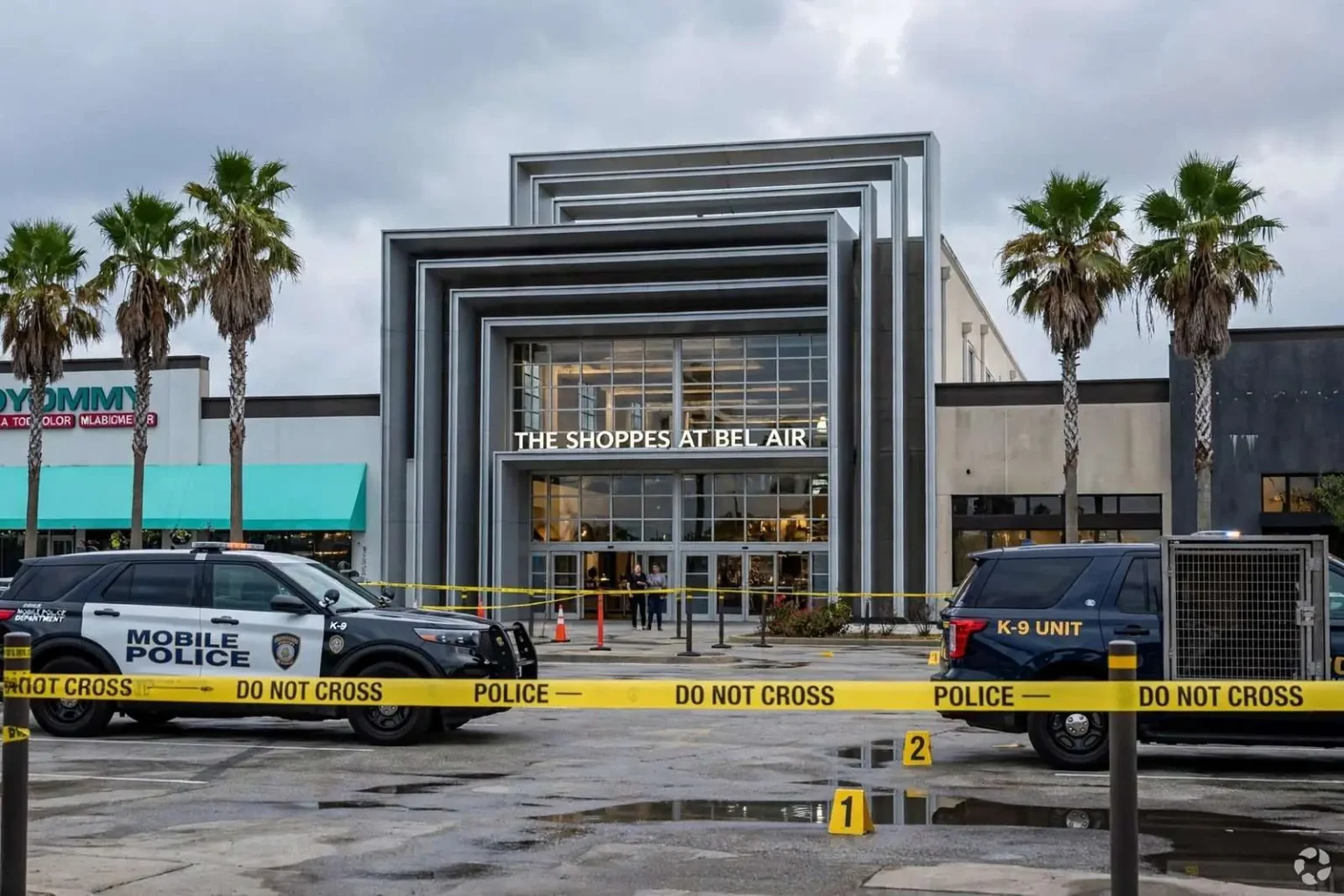
MOBILE, Ala. — Criminal charges against a teenager who was handcuffed and bitten by a security K-9 at the Shoppes at Bel Air have been dropped, according to the teen’s attorneys, who say a civil lawsuit against the mall and its security contractor will move forward. Lawyers for 16-year-old Cameron Robinson said prosecutors dismissed counts of disorderly conduct, second-degree marijuana possession and resisting arrest stemming from his June arrest at the west Mobile mall.
The dismissal removes the criminal cloud from a case that drew public attention almost from the moment the teenager was taken into custody, but it does not end the legal fight. The attorneys made clear that the heart of the dispute — what happened in the moments when a mall K-9 bit a handcuffed 16-year-old — will now be litigated in a civil courtroom rather than a juvenile one.
In a statement, the legal team — which includes attorneys from three separate firms — said the charges should never have been filed and that it is pursuing claims against the mall, its owner and the security company. The breadth of that lineup matters: rather than a single target, the suit contemplates responsibility shared among the property’s owner, the contractor that provided security services, and the individuals involved in the arrest.
Conflicting Accounts of the June Incident
According to the teen’s attorneys, Robinson was at the mall with two other teenagers and a 20-year-old chaperone on June 22 to shop for clothes when security officers handcuffed the group. The lawyers allege a guard slammed the handcuffed teen to the ground and directed the K-9 to bite him, and they say the animal bit him several times.
Mobile police gave a different account. In a department statement, officials said the mall’s K-9 bit the juvenile on the arm as officers took him into custody, and that while handcuffed he reached into his pants pocket, where officers found marijuana. Police said the teen was treated at a hospital for the bite before being taken to Strickland Youth Center and charged. A 20-year-old man accompanying the group was charged with disorderly conduct, according to the statement.
The gap between those two versions is the case. In the attorneys’ telling, the K-9 was deployed as an instrument of force against a teenager who was already restrained — an escalation that violated use-of-force norms even for police, let alone private security. In the department’s telling, the bite occurred during the taking of a suspect into custody, and the discovery of marijuana followed lawful procedure. What the surveillance video and body camera footage show is expected to decide which narrative survives.
The attorneys said surveillance video from the mall parking lot and Mobile police body camera footage of the encounter had not yet been released, and that they intend to seek both during discovery in the pending civil case. Until then, the public accounts of what happened rest on statements from interested parties — the family’s lawyers and the police department — with no neutral record in between.
Discovery in a civil suit can compel the release of materials no criminal process produced: the security company’s training records, its deployment policies for the K-9, the mall’s contracts with the contractor, and the full internal review of the incident. Civil litigation also opens witnesses to sworn depositions, under penalty of perjury, in a way the criminal phase of the case never required.
K-9s in Mall Security
The use of a security dog at a shopping mall sits at the center of the controversy. K-9 units are a routine and accepted feature of police work, valued for detection and for officer protection in volatile situations, but their use by private security forces against shoppers raises distinct questions — about training standards, about who bears liability when a dog bites, and about whether a retail environment can ever present the kind of threat that justifies a canine deployment.
Private security companies that field K-9s typically certify their animals and handlers through recognized training programs, and the industry’s professional standards call for dogs to be used defensively and under tight control. When a bite occurs, the legal analysis turns on whether the deployment was reasonable and proportionate to the threat — the same basic framework that governs police canines, though private actors generally enjoy less statutory protection than officers do.
Alabama law on dog bites and premises liability gives injured parties a path to recover damages, and plaintiffs’ attorneys in K-9 cases routinely pursue both the handler’s employer and the property owner on theories ranging from negligent training to negligent supervision of the contractor. That layered approach — naming the mall, its owner and the security company together — is designed to keep every potentially responsible party inside the litigation until the facts sort out who was responsible for what.
A Mall at the Center of the Debate
The Shoppes at Bel Air is one of the largest enclosed shopping centers in the Mobile area and a frequent gathering spot for teenagers, making the episode a flashpoint in ongoing debate over how mall security policies should treat the young people who fill its corridors. Malls have long functioned as de facto town squares for adolescents — a place to meet friends on a Saturday afternoon that belongs, in practice, to no one’s parents and no one’s school.
That role puts mall operators in a bind. Retail property managers are responsible for the safety of thousands of visitors a day, and they respond to incidents of shoplifting, fighting and loitering with security programs that vary from the invisible to the heavily armed. When a security program produces a bleeding teenager in the food court, the calculation behind it gets reexamined in public — by shoppers, by civil rights advocates, and now by a court.
The dropped charges do not settle the underlying debate; they raise its stakes. Prosecutors’ willingness to dismiss counts of disorderly conduct, marijuana possession and resisting arrest removes the alternative explanation for the force used, leaving the attorneys’ version of events without a criminal counterweight. Civil defendants in such a posture often look harder at settlement, because a jury hearing only the plaintiff’s evidence can be unforgiving.
The Juvenile Justice Side of the Case
The path the charges traveled — from booking into the Strickland Youth Center to dismissal — also illustrates how juvenile cases move differently from adult ones. Mobile County’s juvenile court system is built around the premise that young defendants are still developing, and prosecutors there have wider discretion to divert or dismiss cases outright, particularly when the underlying facts are disputed and the public interest in prosecution is thin.
The second-degree marijuana charge, for a small amount found in a pocket during an arrest, is the kind of offense that juvenile courts routinely handle with supervision or counseling rather than detention. Its dismissal alongside the more serious counts suggests prosecutors saw little value in pressing any part of the case once the arrest itself came into question — a reading the teen’s attorneys drew explicitly in their statement.
For the 16-year-old, the dismissal carries real consequences beyond the courtroom. A juvenile record, even for charges later dropped, can shadow school disciplinary proceedings, scholarship applications and background checks. Defense attorneys in cases like this typically move to have records sealed or expunged once charges are dismissed, closing out the last practical remnant of the arrest.
What Comes Next
The civil case now becomes the main event. The attorneys will seek the parking-lot surveillance video and the body camera footage through formal discovery, and the defendants — the mall, its owner and the security contractor — will respond with their account of a lawful detention and a justified deployment. Judge and jury, rather than news releases, will weigh the conflict.
What each side needs is clear. The plaintiff’s team wants the video, because in K-9 cases the footage usually decides the case; the defense wants to establish that the K-9 was deployed under circumstances its policies permit and that the handlers acted within their training. The security company’s documentation — its contracts, its deployment rules, its handler certifications — will likely matter as much as any single moment on video.
For Mobile shoppers, the case is a reminder that the security presence they take for granted operates under legal standards with real teeth. A mall’s right to detain suspects on its property is broad but not unlimited, and the distinction between a lawful detention and an assault is exactly what a Mobile County civil jury will be asked to draw when the Bel Air case reaches them. Until then, a 16-year-old’s dropped charges stand as the first verdict in a dispute that is only beginning.
The June 22 date of the encounter also matters to how the case will be litigated. That Saturday timing placed the mall near peak weekend traffic, with cameras covering the parking lots and common areas at their busiest — conditions that usually mean more footage exists, not less. The attorneys’ confidence that the video will support their account reflects the fact that a mall arrest of this kind is rarely unwitnessed: shoppers, store employees and security staff all move through the same space, and civil discovery will reach all of them.
Community response to the case has followed the contours of the accounts themselves. Supporters of the teenager see the dropped charges as vindication of their objections to aggressive mall security; defenders of the security operation note that the police statement described marijuana found on the teen’s person. The civil case will not resolve the argument in public opinion, but a trial — or a settlement with structural changes to security policy — could change how the Shoppes at Bel Air handles similar situations in the future.