Chicken Salad Chick, the Auburn-Born Chain, Acquired by California Investment Firm
Brentwood Associates acquired a majority stake in Chicken Salad Chick, the fast-casual chain founded in Auburn with locations across the Southeast.
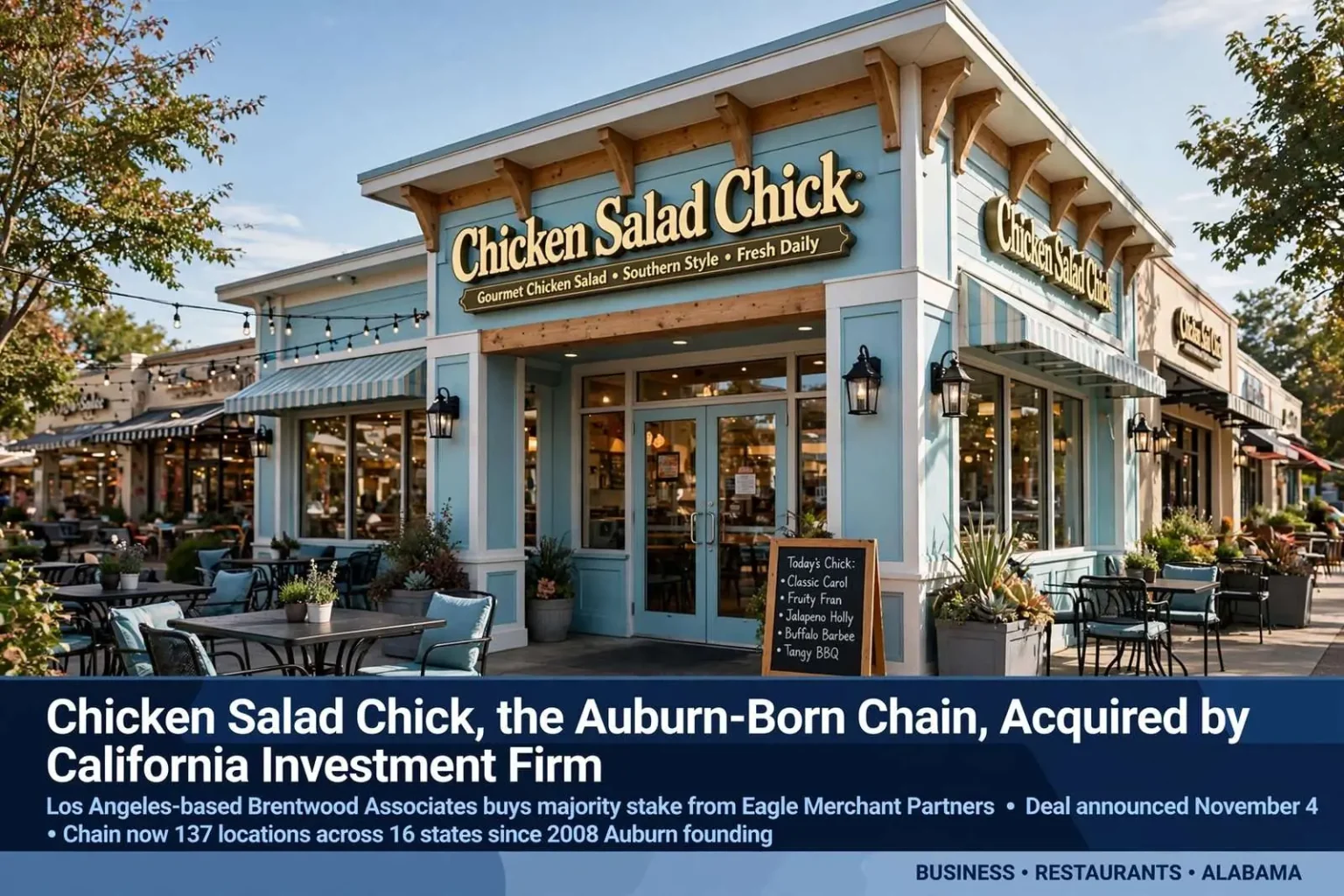
Chicken Salad Chick — the fast-casual chain founded in Auburn, Alabama — has a new majority owner. Los Angeles-based Brentwood Associates, whose portfolio includes Orange Theory, Blaze Pizza and MD Now Urgent Care, announced it acquired a majority interest in the restaurant company from Eagle Merchant Partners on November 4. Terms of the deal were not disclosed.
The transaction moves one of the Southeast’s most recognizable homegrown restaurant brands from one private equity owner to another, a sign that the chain’s growth story has attracted buyers rather than questions. For a company that started with a single storefront in a college town less than two decades ago, the sale marks the second chapter in an ownership journey that has carried it from Auburn’s downtown to more than one hundred restaurants across the South.
Founded in 2008 by Stacy and Kevin Brown with a single location in Auburn, Chicken Salad Chick has grown to 137 restaurants across 16 states, concentrated across the Southeast — including Gulf Coast locations that have made the brand a familiar name for Mobile- and Baldwin-area diners. The concept is built on a deceptively simple menu: a dozen-plus varieties of chicken salad, served by the scoop with sides, in a bright, hospitality-forward dining room aimed squarely at lunch crowds.
From a Kitchen in Auburn to 16 States
The company’s origin story has become part of its brand. Stacy Brown began by selling her chicken salad from her home kitchen, and when her recipes outgrew what health rules would allow, the Browns opened their first restaurant in Auburn. The menu’s founding idea — different flavors of a single beloved Southern staple, each with a name and a personality — proved endlessly expandable, and the brand’s “chick”-named varieties gave customers a way to order with loyalty rather than hesitation.
Growth from one Auburn restaurant to 137 locations in 16 states followed the pattern of the most successful Southeastern fast-casual concepts: company and franchised units spreading outward through Georgia, the Carolinas, Tennessee, Florida, Texas, and the Gulf Coast, with new markets selected where Southern comfort food translates naturally. The Mobile area’s locations put the brand in front of both year-round locals and the beach traffic that flows through Baldwin County, a combination that has made Gulf Coast markets reliable performers for Southeastern concepts.
A Fit for the Portfolio
Rahul Aggarwal, partner at Brentwood, said the chain’s approach aligns with the firm’s investment strategy. “Chicken Salad Chick’s model fits well within our strategy of investing in high-growth, best-in-class consumer businesses,” Aggarwal said. “We look forward to working with Scott and the Chicken Salad Chick team to build upon their success in the markets they serve.”
Brentwood’s portfolio language explains the attraction. The firm has built its reputation on consumer brands with passionate followings and long runways for unit growth — the boutique fitness chain Orange Theory, the fast-casual pizza concept Blaze Pizza, and the urgent care operator MD Now among them. A regional restaurant brand with more than 130 locations, a distinctive niche menu, and room to double its footprint fits that template precisely. Eagle Merchant Partners, the Atlanta-based firm that held the majority stake, guided the chain through a substantial stretch of its expansion before the sale.
What the Deal Means for Diners
For customers, a change in majority ownership rarely changes what lands on the tray. The recipes, the franchise agreements, and the day-to-day management of the 137 restaurants continue under the existing team — the reference in the announcement to working with “Scott and the Chicken Salad Chick team” signals continuity at the top of the company rather than a turnover. What changes is the capital behind the brand: new ownership typically brings fresh investment in new unit growth, technology, and marketing, the resources that determine whether a 137-restaurant chain becomes a 300-restaurant chain.
The acquisition signals continued expansion ambitions for the homegrown Alabama concept as private equity firms continue snapping up growing regional restaurant brands. The Southeast has become the proving ground for that playbook. Regional chains with devoted followings — Southern concepts especially — have attracted successive rounds of institutional investment, with each new owner betting that the brand’s loyal customers represent only a fraction of its potential market. Chicken Salad Chick’s move from Eagle Merchant Partners to Brentwood follows exactly that pattern.
Auburn’s Export Economy of Restaurants
There is a distinctly Alabama story inside the deal as well. Auburn has proven an unlikely incubator for national restaurant brands, its college-town economy producing concepts that scaled far beyond the city limits. Chicken Salad Chick’s path from a home kitchen in Auburn to a Los Angeles-owned, 137-unit regional chain is the kind of trajectory state business boosters point to when they describe Alabama entrepreneurship: an idea born in a home kitchen, proven in a single storefront, and refined into a system that institutional investors will pay to accelerate.
The brand’s Gulf Coast presence gives the story local texture. Mobile- and Baldwin-area diners have watched the chain grow from novelty to routine lunch stop, and the acquisition matters locally for what it promises next — more locations in the corridor between Mobile and the Panhandle, continued hiring in the markets where the brand operates, and the marketing muscle of a national investment firm behind a menu Mobile County already knows by its scoop names.
The Broader Deal Landscape
Restaurant dealmaking has been running hot as investors chase concepts positioned between fast food and casual dining. Fast-casual brands with focused menus — one signature item done many ways, in Chicken Salad Chick’s case — have proven resilient through economic swings because their food costs are predictable, their kitchens are simple, and their customers return weekly rather than annually. Those characteristics are exactly what buyers like Brentwood underwrite when they acquire a majority stake, and exactly why sellers like Eagle Merchant Partners can exit with a growth story intact.
The undisclosed terms keep the financial details private, but the structure tells the essential story: a founder-built Alabama brand, matured under one investor, sold to another with deeper resources and a consumer-focused portfolio. The next chapter will be measured the way restaurant growth always is — one new market, one new restaurant, and one scoop of chicken salad at a time — with Auburn’s fingerprints on every unit that opens.
How the Chicken Salad Niche Won the Southeast
The chain’s growth is worth understanding on its own terms, because it represents a genuinely unusual path in the restaurant business. Most fast-casual concepts chase broad menus and trend-driven variety. Chicken Salad Chick did the opposite: it built an entire restaurant around one dish, then created depth through variations — a dozen-plus recipes ranging from traditional Southern to fruity, spicy, and savory interpretations, each named for an imagined “chick.” The approach turned a lunch staple that generations of Southerners grew up eating into something customers could debate, rank, and return to weekly.
The single-dish focus brings operational advantages that investors prize. A narrow menu means shorter training for new kitchen staff, tighter food costs, and simpler supply chains — which in turn makes franchising more reliable. When a franchise model is reliable, growth compounds: each new market opened proves the system, and each proved system makes the next market easier to fund. That is the machinery behind the leap from a single Auburn storefront to 137 restaurants, and it is what Brentwood Associates is buying into.
The brand also benefited from impeccable timing within its home region. The Southeast’s population growth over the past two decades has been among the fastest in the country, with metropolitan areas across Georgia, the Carolinas, Tennessee, and the Gulf Coast adding residents and rooftops at a pace that feeds new restaurant demand. A Southern comfort concept expanding into the fastest-growing corner of the country enjoys a tailwind that colder regions cannot offer, and Chicken Salad Chick’s 16-state footprint traces that migration almost perfectly.
Private Equity’s Restaurant Playbook
The chain’s ownership journey mirrors the life cycle of many modern regional brands. Founders build proof of concept; a growth-oriented investor supplies capital and systems for expansion; and once the brand reaches scale, a larger firm acquires it to fund the next phase. Eagle Merchant Partners, the Atlanta firm selling its majority stake, played the middle role — and the sale to Brentwood represents the graduation that middle-stage investors aim for when they take on a young brand.
For the restaurants themselves, these transitions usually show up as acceleration rather than upheaval. New owners keep the founding recipes and the leadership that produced 137 locations; what they add is capital for faster unit growth, upgraded technology for online ordering and catering, and a national network of consumer expertise. Brentwood’s history with Orange Theory and Blaze Pizza — brands that multiplied their footprints under the firm’s ownership — is precisely the résumé Chicken Salad Chick’s next phase calls for.
Employees and franchisees across the Southeast, including the Gulf Coast locations Mobile and Baldwin County diners know, will be watching the same thing customers will: whether the brand’s famously personal service survives the scale-up. The company’s identity has always rested as much on hospitality as on recipes — the greeting at the door, the samples offered to first-timers, the small-town warmth exported from Auburn. Maintaining that culture while doubling in size is the challenge every beloved regional chain faces after a sale, and the one that will determine whether the next ownership chapter reads as well as the first.
What is already certain is the milestone itself: an Alabama-born brand, founded in a college town by a couple with a home kitchen and a family recipe, now commands the backing of a Los Angeles investment firm with a track record of building national consumer brands. For the Southeast’s restaurant economy — and for Auburn’s place in it — that is the real headline behind the deal announcement.