Childcare Shortage Emerges as Hidden Obstacle to Baldwin County’s Booming Growth
As Baldwin County’s population booms, providers say a shrinking supply of licensed childcare — especially for infants — is leaving families with monthslong waitlists and forcing tough choices about work.
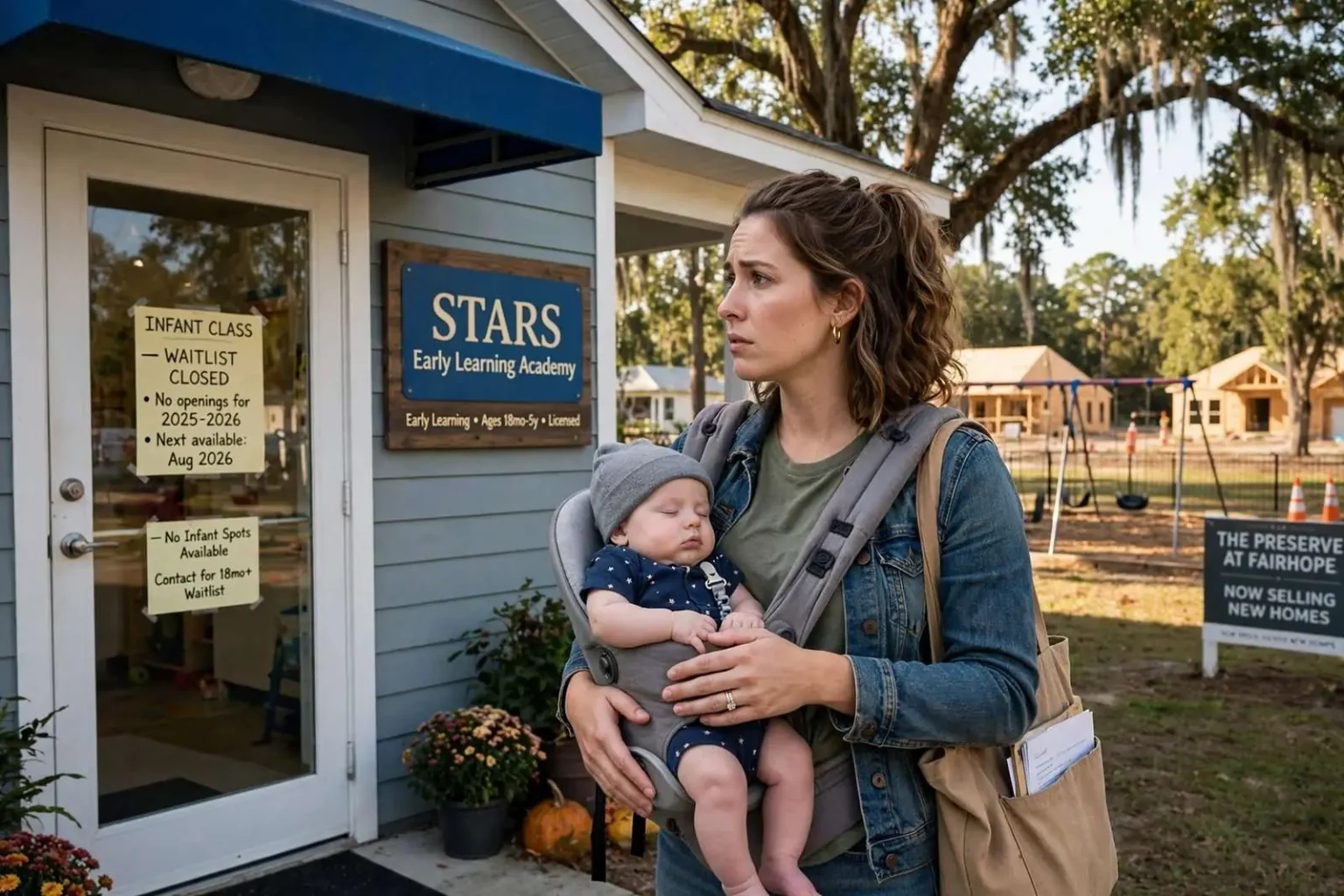
FAIRHOPE — Baldwin County is one of the fastest-growing counties in Alabama, adding thousands of new residents every year. But as subdivisions rise and businesses recruit workers to the Eastern Shore, providers say a critical piece of infrastructure is being left out of the conversation: childcare.
In Fairhope alone, there are only about 20 infant childcare spots citywide, according to Autumn Zellner, owner and executive director of STARS Early Learning Academy. All eight infant spots at her own center are filled, and most go to siblings of children already enrolled or to the children of staff members.
“The growth is booming, but childcare is not,” Zellner said. “In fact, in our area, childcare centers continue to fail.”
Growth Outpacing Capacity
Baldwin County’s population grew from 231,767 at the 2020 census to an estimated 267,761 in 2025 — a 15.5% increase, according to the U.S. Census Bureau. Fairhope grew even faster over that span, rising 16.6% from 22,477 residents to an estimated 26,625.
Providers say the math simply does not work: as more families move in needing care, the number of available seats is shrinking rather than growing. Zellner said four centers in the area — Color Us Kids, Bright Beginnings, Good Beginnings and RFM — have closed within the past six months. In Daphne, two centers closed within roughly four weeks of each other, eliminating about 150 childcare seats, according to Johnnie Frost, owner and executive director of Kinder Kids Learning Center.
Infants Hit Hardest
Zellner said most Fairhope-area centers don’t accept babies at all, typically starting children around 18 months, because infant care requires a much higher teacher-to-child ratio and is far more expensive to provide. Frost estimates there are only about 75 to 100 licensed infant spaces across Daphne and Spanish Fort combined, and her center’s infant waitlist can stretch beyond a year.
“If you’re a quality program, sometimes what the conversation with parents is is if the center has an opening, especially in those younger classrooms, really questioning the why of that opening,” Frost said.
A Monthslong Search
For families, the shortage turns what should be routine planning into a monthslong ordeal. Kylie Ross, a Fairhope-raised realtor who moved back to the area last fall with her infant son, said she assumed finding childcare would be simple.
“I just kind of thought growing up here, I was like, a lot of people live here. Surely won’t be a problem,” Ross said.
Instead, center after center told her they might not have room until the following August — nearly a year out. She expanded her search up and down the Eastern Shore, toward Interstate 10 and into Foley, and explored hiring a nanny or finding in-home care. After months of calls, a referral finally helped her land a spot at STARS.
“It was just serendipitous, but we just got really lucky,” Ross said.
Not every family is so fortunate, she said. Some parents she knows now drive 25 to 30 minutes toward Daphne or the interstate corridor just to reach an open center. Even nontraditional options were slow going — Ross paid for nanny-matching websites and searched for college-age babysitters, and it still took months to find in-home help.
“It wasn’t cost prohibitive,” she said. “It was literally just finding it.”
The Financial Squeeze on Providers
Childcare centers are caught in a financial squeeze, providers say, facing rising insurance, labor and operating costs while trying to keep tuition within reach for families.
“Childcare is a very specific kind of business,” Zellner said. “A lot of times churches go into it, but they don’t necessarily have the expertise.”
Frost said the gap between what it actually costs to care for a single infant and what parents can realistically be charged is often substantial, making infant classrooms especially hard to sustain financially even when demand is highest.
Families Turning to Unlicensed Care
As licensed options dry up, some families turn to informal arrangements that aren’t properly licensed — often without realizing it, Zellner said.
“Most of it is unintended,” she said. “A lot of times people don’t know they’re breaking rules.”
Still, she said, some parents feel they have no other choice. “Mostly, what I see is parents putting their children in places they would never want their children to be spending time in because they don’t have any other choice,” Zellner said. “They have to work.”
An Economic Development Problem
Providers say the shortage is increasingly becoming an economic development problem for a county trying to attract new residents and employers. Frost said her centers regularly hear from relocation recruiters trying to lure workers to the area.
“We’ve been called several times where a recruiter will say, ‘Hey, I need a space because I need this person to move there, but they need to secure childcare before they get there,’” she said.
Zellner said her center fields calls from families who accepted jobs in Baldwin County only to discover afterward that no childcare was available.
“These families are moving here with the promise of a new job and have no idea that there’s no childcare available to them,” she said.
For Ross, the shortage reshaped her own career calculus after having her first child. “I was changing careers … so I was trying to juggle whether I could work full time or not; having to think it through,” she said. “It sucks to have to figure out, you know, can I keep working or do I have to stay home with my kids, if you really love the job or whatever it may be?”
Missing From the Master Plan
Frost said communities routinely plan for roads, bridges and school capacity as they grow, but childcare is rarely part of that master planning.
“We talk about making sure we have enough seats in our public schools, making sure our roads, bridges and services can handle that growth,” Frost said, “but the one thing that sometimes I would say more often than not is missing from even that master plan is what about the services like childcare that support the families that are moving into the community?”
Zellner said available space, not staffing, is the biggest hurdle to expanding capacity. “I feel like I can find the workers,” she said. “If you’re going to build 200 houses, then there needs to be a daycare center in that neighborhood.”
Advice for New Arrivals
For now, Ross’s advice to any family considering a move to Baldwin County with young children is blunt: start early.
“Go ahead and start calling daycares as soon as possible,” she said.
As Baldwin County continues adding tens of thousands of new residents, providers and parents alike say childcare planning may need to begin long before the moving truck ever arrives.