
China Super Buffet Stakeholders Sentenced, Ordered to Forfeit $1.5 Million Over Illegal Labor Scheme
Three China Super Buffet stakeholders got probation and will forfeit $1.5 million for harboring undocumented workers and SBA loan fraud in Mobile.
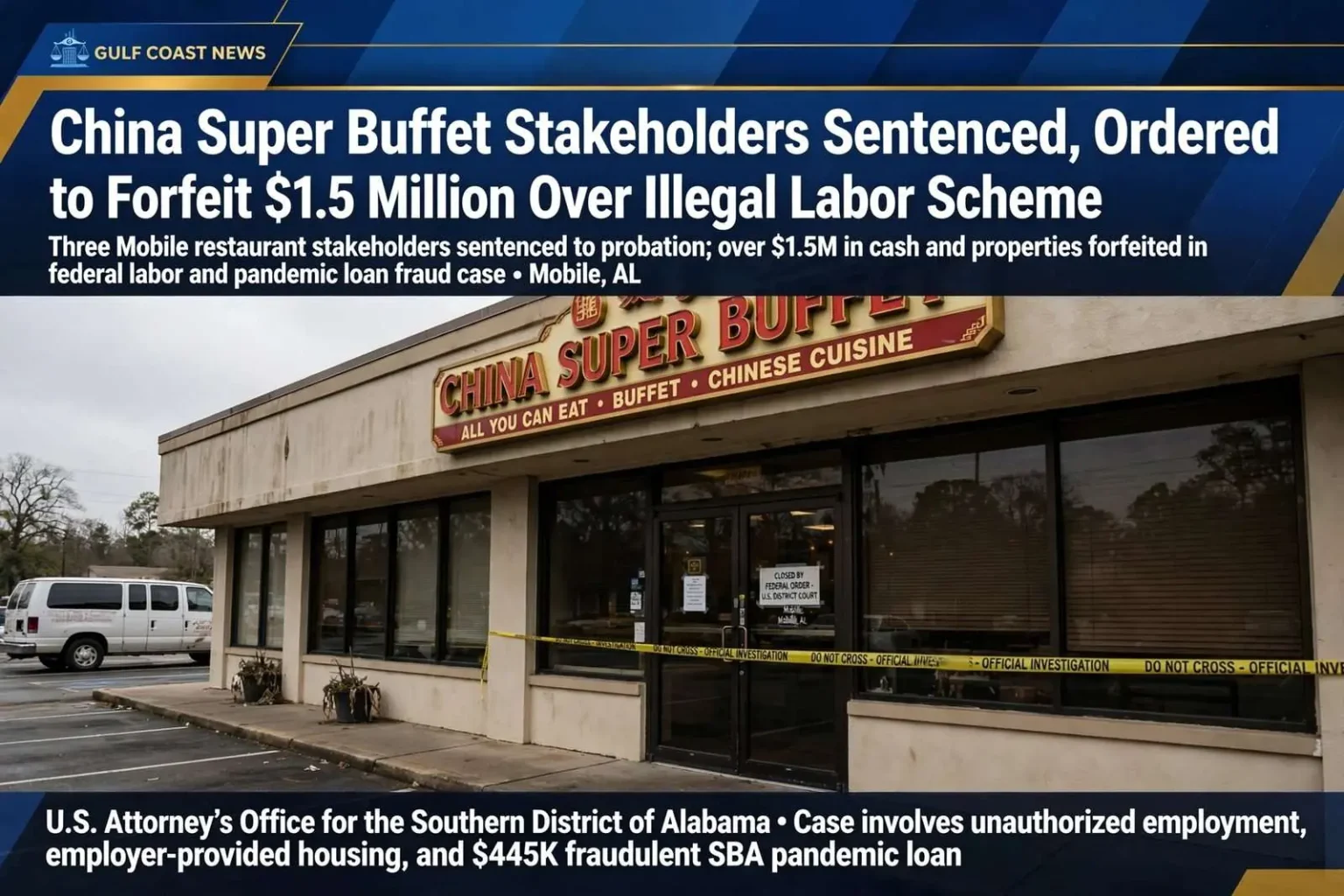
Three stakeholders of a Mobile restaurant have been sentenced to probation and ordered to forfeit more than $1.5 million in assets after federal prosecutors said they illegally employed workers and housed them at a nearby residence, according to the U.S. Attorney’s Office for the Southern District of Alabama. The sentencing closed out a case that federal authorities described as a years-long scheme combining unauthorized employment, concealed cash payments and, ultimately, fraudulent pandemic relief borrowing.
Zheng Kong Zheng, 57, of Mobile, received two years of probation with the first six months on home confinement with electronic monitoring. He was ordered to forfeit more than $500,000 along with five residential properties. De Yun Wang, 54, and Kong Mei Zheng, 55, both Chinese nationals, each drew one year of probation; Wang must forfeit over $500,000 and five properties, while Kong Mei Zheng was ordered to give up more than $200,000 and one residence. The forfeiture amounts, taken together with earlier sentences in the case, push the total seized from the operation past $1.5 million in cash and real estate.
Cash wages, free housing
Court documents state that Zheng Kong Zheng and his sister Kong Mei Zheng ran the China Super Buffet until 2019. Beginning at least as early as 2014, prosecutors said, the restaurant unlawfully employed workers who were not authorized to be in the country and housed them free of charge at a harboring residence near the restaurant owned by Zheng Kong Zheng and Wang. The proximity of the house to the restaurant meant workers could be moved between the two sites with ease, and prosecutors said a passenger van was used to shuttle them back and forth.
Utilities and taxes on the home were paid from restaurant accounts, and the workers were shuttled between the house and the restaurant in a passenger van. Prosecutors said the arrangement was concealed by paying the workers in cash, with their earnings never reported to the Alabama Department of Labor even as wages for lawful employees were. The split record-keeping gave the operation a legitimate-looking payroll on paper for authorized staff while an entirely hidden workforce labored alongside them.
Harboring cases of this kind are prosecuted under federal immigration and labor statutes, and the Southern District of Alabama has handled a number of them over the years, particularly along the Gulf Coast where restaurant, seafood processing and construction industries have historically drawn unauthorized labor. Investigators typically build such cases through payroll audits, witness interviews and surveillance of the residences where workers are housed.
Pandemic loans based on false information
In September 2019, Kong Mei Zheng transferred her interest in the business to her brother, making him sole owner, and the unlawful hiring continued, authorities said. While he owned it, the restaurant applied for Small Business Administration pandemic relief programs and received $445,307 in loans based on false information in its applications, according to the Department of Justice. The pandemic loan programs were designed to keep workers attached to legitimate payrolls, which made falsified applications in cases involving off-the-books workers a priority for federal investigators.
Two co-defendants were previously sentenced in the case. Zheng Guo Zheng, 67, drew five years of probation in November 2022, a $40,000 fine tied to the van used to transport workers, forfeiture of over $15,000, and an order to repay the full $445,307 to the SBA. Yan Jia Zhuo, 58, was sentenced in July 2022 to time served for unlawfully employing aliens.
Under their plea agreements, all of the defendants agreed to forfeit more than $1.5 million in cash and property described as illegal proceeds from the harboring convictions and labor practices. Forfeiture of this kind strips defendants of property the government can trace to the unlawful activity, and in this case the assets included residential real estate in addition to cash.
How the case came together
The investigation behind the sentencing involved federal agencies that pursue both immigration and financial crimes, tracing payroll records, loan applications and property ownership through years of transactions. Prosecutors said the pattern was consistent: workers paid in cash and kept off the books, housing provided at no charge in a residence owned by the business’s stakeholders, and the costs of that housing quietly absorbed into restaurant accounts.
The contrast between the two payrolls became a central piece of the government’s case. Wages for lawful employees flowed through the normal reporting channels, generating the state records that compliant employers file with the Alabama Department of Labor. The unauthorized workers’ earnings appeared nowhere in those filings, leaving no tax trail, no unemployment insurance coverage and no wage records for labor that prosecutors said spanned years.
The pandemic loan portion of the case added a financial fraud layer on top of the labor violations. SBA relief programs, including the Paycheck Protection Program and related lending, required applicants to certify the truth of their payroll figures and business operations. Receiving $445,307 in loans while maintaining an unreported workforce meant the applications misrepresented the very payrolls the programs were meant to sustain, and courts have ordered repayments in such cases across the country.
What the sentences mean
Defense attorneys and prosecutors alike noted that probation terms with home confinement, rather than prison time, reflect both the defendants’ cooperation through plea agreements and the forfeiture of substantial assets. The repayment of the full SBA loan amount by Zheng Guo Zheng stands as the case’s primary financial remedy for the fraudulent lending, while the cash and property forfeitures are treated as proceeds of the illegal labor scheme itself.
For the workers involved, cases like this often mark a turning point, as federal investigations of harboring operations typically result in the dispersal of the workforce that had been confined to the operation. Advocates for labor rights in the Gulf Coast region have long argued that wage theft and cash-only employment thrive wherever workers fear reporting abuse, which is precisely the environment prosecutors described at the China Super Buffet.
The sentencing also serves as a reminder to Gulf Coast business owners that pandemic-era loans remain under review years after the funds were disbursed. Federal investigators continue to audit relief applications for mismatches with payroll and tax records, and the repayment orders in this case show that loans obtained on false information are recoverable regardless of how much time has passed since the money was drawn.
The China Super Buffet case also illustrates how a single business can generate overlapping investigations from separate corners of the federal government. Labor and immigration enforcement examines who worked at the restaurant and how they were paid, while financial fraud units examine the truthfulness of the loan applications submitted in 2020 and 2021. When both threads point at the same ownership, prosecutors often fold the charges into plea agreements that resolve everything at once, as happened here.
Requirements employers must follow
Alabama employers are required to verify work eligibility for every hire, withhold payroll taxes, report wages to state and federal agencies, and carry unemployment insurance coverage for their workforces. The law applies regardless of industry, and the restaurant sector is audited at high rates precisely because cash-heavy operations create opportunities for off-the-books employment. The state Department of Labor relies on employer wage reports to administer unemployment benefits, which is why failing to report wages harms not only the government but also the workers themselves, who are left with no documented earnings history.
Housing employees is legal in many industries, but the conditions described by prosecutors crossed lines that courts treat seriously. When employer-owned housing becomes part of a scheme to employ and control workers who are not authorized to be in the country, the housing itself becomes evidence of harboring, and the costs paid from business accounts become part of the paper trail investigators follow.
For Mobile’s restaurant community, the case stands out both for its duration and for the sums involved. A neighborhood buffet operated with a hidden workforce for at least five years, drew nearly half a million dollars in pandemic loans, and ultimately cost its stakeholders more than $1.5 million in forfeited assets. The math, prosecutors note, rarely favors the scheme in the end: forfeiture, fines and repayment can exceed everything an operation saved in labor costs over its lifetime.
The U.S. Attorney’s Office for the Southern District of Alabama, which covers the Gulf Coast counties from the Mississippi line to the Florida line, has made workplace fraud and pandemic loan abuse recurring priorities in its criminal docket. Officials there encourage tips from workers and the public about unreported employment and loan fraud, noting that many of the largest cases in the district began with information supplied by people inside the operations being investigated.
With sentencing complete and the forfeiture judgments entered, the China Super Buffet prosecution is now closed, leaving behind a case record that local employment lawyers say will likely be cited for years as an example of how cash payroll schemes, employer-controlled housing and pandemic loan fraud interlock, and how they eventually unravel.


