Chunchula Man on Mower Killed After Corvette Leaves Roadway on Highway 217
A Chunchula man riding a mower was killed on Highway 217 when a Corvette left the roadway. ALEA traffic homicide investigation underway.
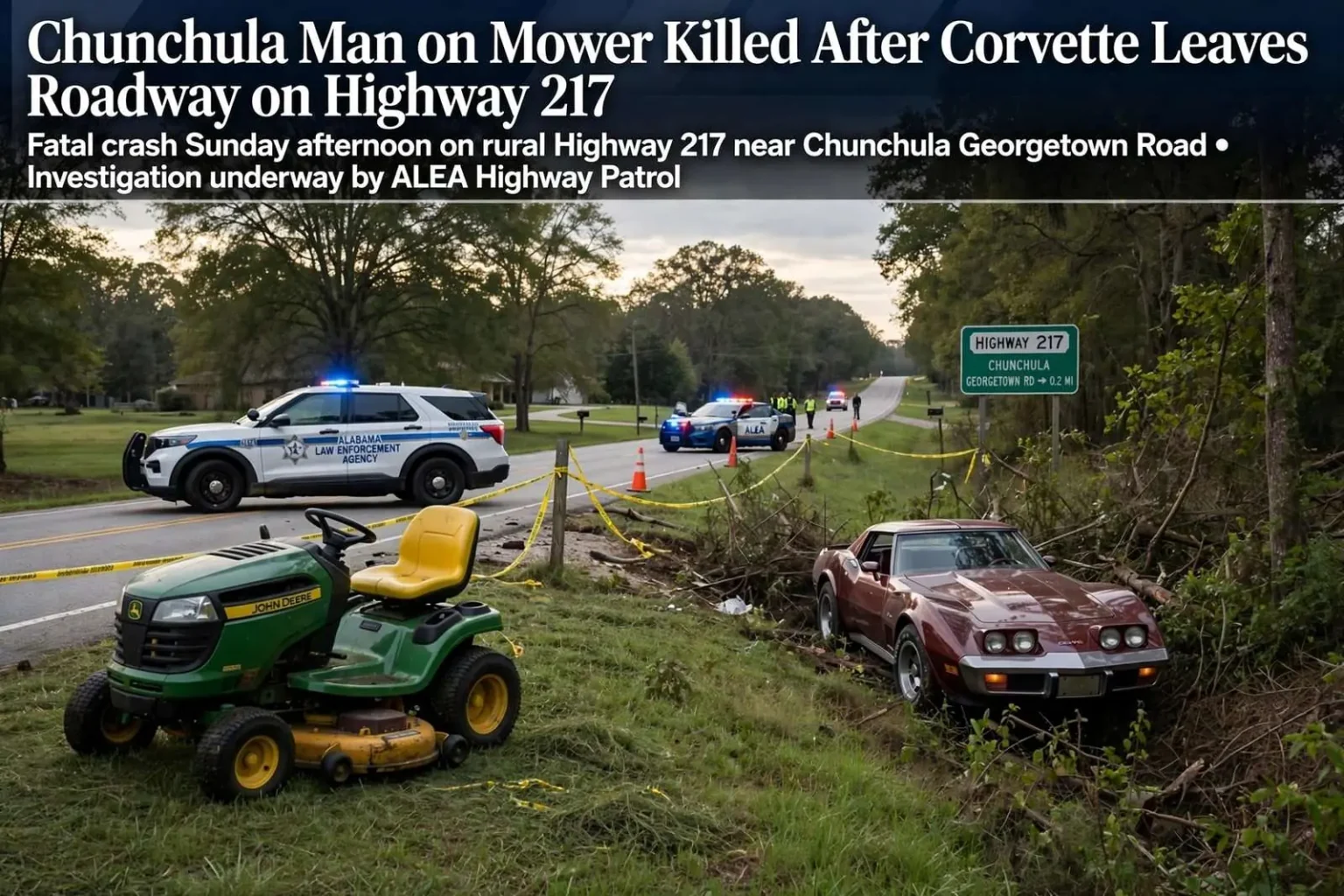
A Chunchula man riding a law mower was struck and killed Sunday afternoon when a 1978 Chevrolet Corvette left the roadway on Highway 217 near Chunchula Georgetown Road, according to the Alabama Law Enforcement Agency. The crash turned an ordinary weekend chore into a fatal emergency along a rural stretch of north Mobile County where residential driveways sit close to a road known for its curves and its traffic.
Heath Allen Byrd, 44, of Chunchula, was operating a John Deere mower shortly after 5 p.m. when the Corvette, driven by Calvin Dale Brewer, 54, of Saraland, left the road and struck him, ALEA said in a news release. Byrd was pronounced dead at the scene, located approximately 16 miles north of Semmes in Mobile County.
The crash site sits along a section of Highway 217 that threads through the Chunchula community, connecting the rural reaches of north Mobile County with the corridors running toward Saraland and Citronelle. Roads like it carry a mix of commuter traffic, farm equipment, and slow-moving vehicles, and the shoulders are narrow in many stretches, leaving little separation between passing vehicles and anyone working alongside or near the pavement.
The investigation
ALEA’s Highway Patrol Division dispatched a traffic homicide investigator to the scene and is leading the investigation. Traffic homicide investigators handle the most serious crash classifications in Alabama, conducting the detailed reconstruction work that standard patrol responses do not: measuring skid marks and final resting positions, documenting vehicle damage, canvassing for witnesses, and working to establish speed, impairment, or other contributing factors.
No additional details about the circumstances of the crash have been released. Authorities have not said why the Corvette left the roadway, what role speed or other factors may have played, or whether charges are anticipated. The case remains under investigation, and findings in crashes of this classification typically emerge only after reconstruction work and any necessary laboratory results are complete.
Under Alabama law, crashes involving a fatality trigger this higher level of review regardless of the apparent circumstances, and the results of a traffic homicide investigation are forwarded to the district attorney’s office, which decides whether any criminal charges are warranted. That process can take weeks or months, particularly when vehicle reconstruction or toxicology analysis is involved.
Mowers and roadways: a recurring rural hazard
Fatal collisions between vehicles and riding mowers along rural Alabama roads are not rare, and safety officials have long warned about the exposure created when residents mow ditches, shoulders, and easements that sit within feet of active traffic lanes. In unincorporated communities like Chunchula, property owners routinely maintain long frontages along state and county roads, and much of that work puts a person and a mower in the travel path of oncoming vehicles.
Visibility compounds the risk. A low-profile mower close to the pavement is difficult for a driver to distinguish from background until the closing distance is nearly spent, and curves, sun glare, and speed make the recognition window even shorter. Law enforcement agencies across the state urge drivers to slow down and move over for any slow-moving or stationary equipment at the roadside, and to treat the approach to a working mower with the same caution as an approaching emergency scene.
The Sunday afternoon timing also matters in the regional traffic picture. Weekend afternoons along north Mobile County highways see a blend of local residents returning from errands and recreational drivers out on scenic routes, with rural two-lane roads like Highway 217 offering the open stretches that attract spirited driving. Investigators will examine how those patterns intersected at the moment the Corvette left the road.
For the Chunchula community, the loss lands in a place where residents know one another and the roads are part of daily life. Chunchula is an unincorporated community, and when a fatal crash happens on a road like Highway 217, the impact spreads quickly through churches, schools, and neighborhood networks that tie the area together. Neighbors passing the scene in the hours afterward encountered the reality of what the statistics describe.
The crash also drew attention to the wider corridor. Highway 217 has long been a subject of local concern for its combination of curves, hills, and driveway access, and residents have periodically raised questions about speed and safety along the route. Each serious crash renews those conversations, though infrastructure changes on rural state routes are typically slow and depend on crash history data accumulating over time.
What happens next in the case
In the days ahead, the investigation will proceed largely out of public view. Investigators will complete their documentation of the scene, examine both vehicles, and follow up with witnesses who saw the Corvette before it left the roadway. The department’s news release identified the driver and the victim but otherwise provided no account of the sequence, reflecting ALEA’s standard practice of withholding detail while a traffic homicide case is active.
Once the investigation concludes, the file goes to prosecutors for a charging decision. In fatal crashes where a vehicle leaves the roadway and strikes a person, the range of possible outcomes runs from no charges, if the evidence shows an accident without criminal culpability, through traffic citations, to more serious charges if impairment, recklessness, or other aggravating factors are established. Nothing in the initial release indicated which direction the evidence might point.
For now, the confirmed facts remain those from the scene: a 44-year-old Chunchula man on a John Deere mower, a 1978 Corvette that left Highway 217 near Chunchula Georgetown Road shortly after 5 p.m. on a Sunday afternoon, and a 54-year-old Saraland man behind the wheel. One man was pronounced dead where he lay, sixteen miles north of Semmes, and the questions the family and the community are asking will be answered, if they are answered publicly, only when the investigation is complete.
The case stands as one more entry in Alabama’s rural road toll, where the distances between communities are crossed on two-lane highways that carry both heavy-footed through traffic and the slow, everyday work of the people who live along them. Until investigators release their findings, the crash on Highway 217 remains what ALEA described it as: an active traffic homicide investigation into a Sunday afternoon collision that took the life of a man doing yard work near his home.
Safety advocates point out that the half-second decisions involved in these crashes are shaped by design as much as by driver behavior. Roadway engineers classify sections like Highway 217 by their access density, shoulder width, and curve geometry, and corridors with frequent driveways and narrow shoulders carry higher rates of exactly this kind of collision. Where crash data shows a repeated pattern, remedies can include clear-zone widening, curve signage, or reduced speed limits, but rural routes typically rise to the top of improvement lists only after a documented history of serious incidents.
Alabama’s traffic fatality statistics have consistently shown that a disproportionate share of deaths occur on rural two-lane roads rather than interstate highways, a pattern driven by higher closure speeds, head-on exposure, and the mix of vehicle types, from loaded logging trucks to farm equipment to, as in this case, a piece of lawn equipment at the roadside. The Sunday crash near Chunchula fits that statistical profile in every particular, right down to the afternoon timing when such roads carry their heaviest local traffic.
For mower operators, the guidance from safety officials is specific: work facing traffic where possible, avoid mowing during low-sun hours when glare blinds approaching drivers, wear high-visibility clothing even for short jobs near the pavement, and never assume that an approaching driver has registered the mower’s presence. None of that guidance assigns fault in any particular crash, and investigators have not said what factors they are examining, but the recommendations reflect the reality that the person on the mower has the most to lose in any encounter with a vehicle traveling at highway speed.
The Mobile County area has recorded multiple fatal encounters between vehicles and people on or beside rural roads in recent years, a category that includes mowers, roadside pedestrians, and workers on equipment. Each case closes with the same bureaucratic path ALEA has set in motion here: a traffic homicide investigation, a reconstruction file, and a decision by prosecutors. The family of Heath Allen Byrd now waits at the start of that process, with few public answers beyond the location, the vehicles, and the names in the initial release.
Anyone who witnessed the crash or who saw the Corvette traveling on Highway 217 before it left the roadway has not been asked to come forward in the release ALEA issued, but investigators in traffic homicide cases routinely accept tips and witness accounts after the initial reporting. As with all active investigations, any new information would become part of the record prosecutors will eventually review.