Citronelle Crime Dropped Nearly 35% in 2019 as Police Launched ‘Operation Take Back Citro’
Citronelle police report a nearly 35% drop in major crimes for 2019, crediting Operation Take Back Citro and community policing.
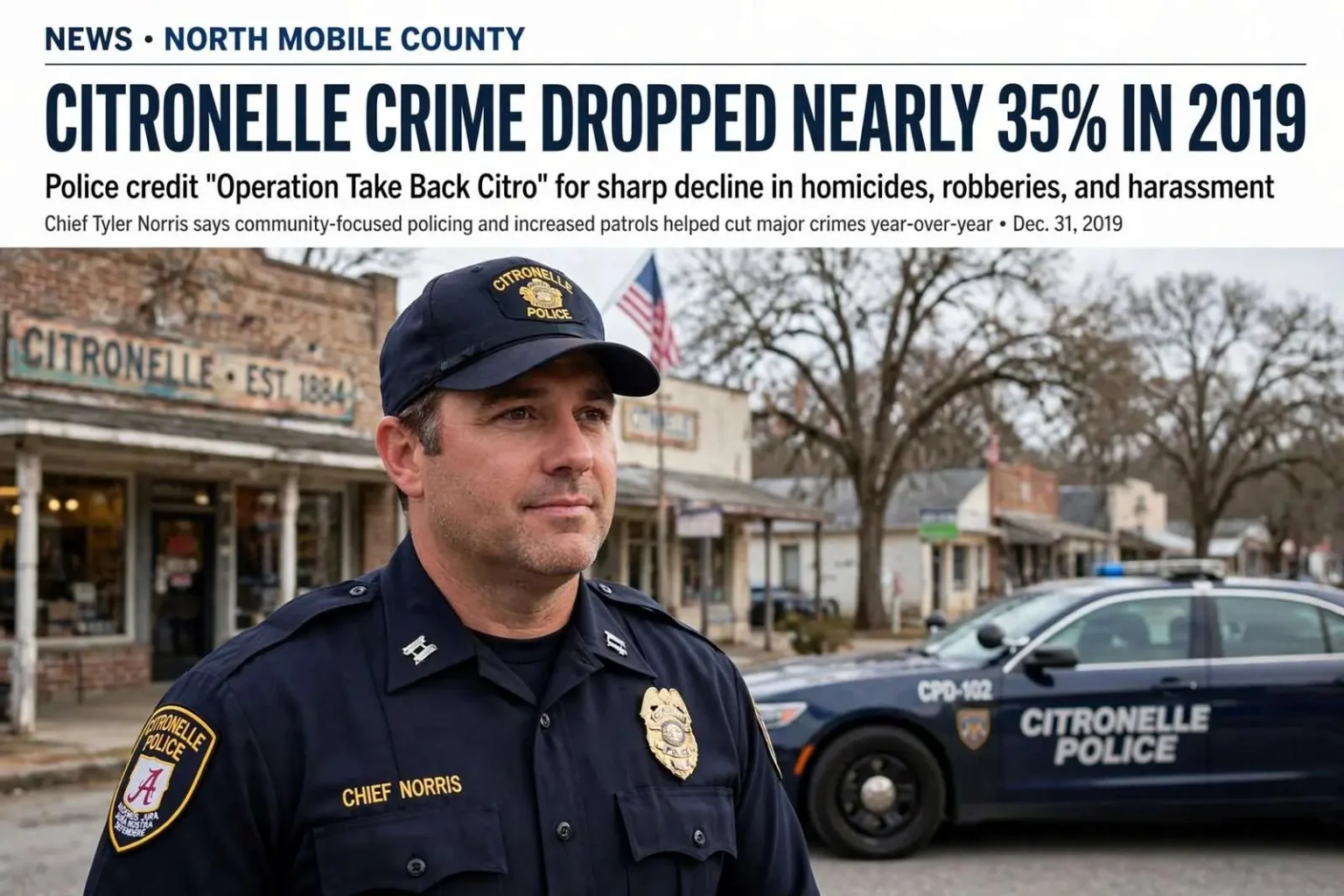
Citronelle police reported a sharp drop in major crimes for 2019, crediting a new community-focused policing strategy that put officers back on the streets and in constant contact with the people they serve. The department’s year-end numbers show major crimes — including robberies, shootings and harassment — fell nearly 35% compared with the previous year, a decline that stood out for a city of Citronelle’s size in north Mobile County.
The most striking number involved homicides. Citronelle recorded four killings in 2018 and one in 2019, a drop that mirrored the broader decline in serious offenses across the city during the same period. For a department the size of Citronelle’s, the year-over-year swing represented a significant change in the community’s safety picture.
Police Chief Tyler Norris, who took over the department in 2019, attributed the improvement to “Operation Take Back Citro,” an initiative aimed at cracking down on crime while keeping officers visible in the community. Norris launched the operation after assuming command, restructuring how his officers patrolled and how they engaged with residents across the city.
“That’s how you run bad guys out of town is you watch every move they make,” Norris said. “We’ve put people back in the community and we’ve put people back out riding and doing their job. It’s community oriented policing.”
The operation formally ended Jan. 24, one year after it launched, but Norris said the mission continues and his department remains committed to making the city safer. The end of the formal initiative did not mean a return to old practices, the chief indicated, but rather a transition of its methods into the department’s everyday routine.
How Operation Take Back Citro worked
The strategy behind the operation combined high-visibility patrol work with direct engagement in the neighborhoods where crime was concentrated. Officers were assigned to be “back out riding” — a phrase Norris used to describe constant mobile patrols that made a police presence routine rather than occasional, in a city where the department covers a wide municipal footprint with a small roster.
Visibility was only half the equation. The chief emphasized that officers spent time in the community itself, building relationships with residents, business owners and families so that information flowed in both directions. Community oriented policing, as Norris described it, depends on residents feeling comfortable reporting what they see, and in a small city those relationships carry weight that pure enforcement cannot replicate.
The watch-every-move element of the strategy targeted the individuals responsible for the city’s crime problems. By concentrating attention on known offenders and staying present in the areas where incidents clustered, the department aimed to make Citronelle a difficult place to operate for anyone committing robberies, shootings or harassment — the categories that drove the city’s major crime statistics.
The city behind the numbers
Citronelle sits at the northern edge of Mobile County, near the Washington County line, and serves as the commercial and civic hub for a wide stretch of rural north Mobile County. With a population of roughly 4,000 residents, the city maintains its own police department, fire protection and municipal government, and its crime trends are followed closely in a community where a single violent incident touches nearly everyone.
A 35% drop in major crime in a city that size translates into real lives changed — fewer residents victimized, fewer homes and businesses hit, and fewer families grieving. The homicide decline from four to one carried particular weight locally, because violent deaths in a small city resonate through schools, churches and neighborhoods for years afterward.
Chief Norris took over the department in 2019 with the expectation that a new approach could move those numbers, and the year-end statistics gave him the evidence to point to. Small departments often lack the specialized units and resources of larger city agencies, which makes strategy and staffing decisions — where officers ride, when they are visible, how they engage the public — the primary levers available to a chief.
The results also reflected a broader principle in American policing: crime rates in small communities tend to respond quickly to consistent presence and follow-through. When officers are seen daily, when tips are acted on, and when known offenders understand they are being watched, the calculation for committing crimes changes, and residents gain confidence that reporting problems will make a difference.
Sustaining the gains after the operation
The formal end of Operation Take Back Citro on Jan. 24, one year to the day after its launch, raised the question every department faces after a successful initiative: whether the gains will hold. Norris’s answer was that the mission continues — that the practices of visibility, engagement and focused enforcement had become the department’s standard operating method rather than a temporary campaign.
For Citronelle residents, the year-end report provided measurable reassurance after a difficult 2018. Community response to the department’s approach was generally positive, and the chief’s willingness to talk about the strategy publicly — including his plainspoken description of watching the movements of offenders — gave residents a clear picture of how their police department intended to operate going forward.
The Citronelle experience also offers a case study for other small departments in Mobile County and across south Alabama. Cities with limited budgets cannot simply hire their way out of crime problems, but the basic elements of the Citronelle approach — consistent patrol, community relationships and focused attention on repeat offenders — are available to any department willing to organize its people around them.
As the department moved into a new year, the challenge was to keep the downward trend going, converting a strong 2019 into a sustained standard. Norris expressed confidence that the direction was set, telling the community that the department’s commitment to making the city safer did not expire with the operation that bore its name.
For now, the numbers stand as the record: major crimes down nearly 35%, homicides down from four to one, and a small north Mobile County police department that credits its residents and its officers in equal measure for the turnaround.
Policing in north Mobile County
Citronelle’s location shapes its policing challenges. The city sits along U.S. Highway 45, the corridor that connects Mobile to the piney woods of south Mississippi, and its proximity to a county line brings the jurisdictional coordination that small-city departments handle constantly — cases that cross into Washington County, warrants served with neighboring agencies and offenders who move between jurisdictions to evade attention.
The department also covers a large municipal area relative to its staffing. Cities like Citronelle include rural fringes, wooded lots and long distances between addresses, which means response times and patrol coverage depend heavily on officers spending their hours in the field rather than at the station. That reality is what made the operation’s “back out riding” emphasis so central to its design.
Mobile County sheriff’s deputies work the unincorporated areas around the city, and the two agencies routinely share information about activity in the region. The northern part of the county has historically dealt with property crimes, drug activity and occasional violent incidents that move along the Highway 45 corridor, and cooperative relationships between agencies are part of the infrastructure that keeps such activity in check.
What the numbers measure
The year-end figures covered major crimes — the serious offenses that drive public safety debates, including robberies, shootings and harassment — rather than every incident the department handled. A nearly 35% decline in those categories means the most serious part of the city’s crime picture shrank dramatically in a single year, even as routine calls for service continued at their usual pace.
Crime statistics in small cities come with caveats that residents and officials both understand. A handful of cases can swing the percentages sharply — four homicides becoming one is a 75% reduction driven by three cases — which is why departments look at the full pattern of offenses rather than any single line item. In Citronelle’s case, the broader decline across robberies, shootings and harassment showed the drop was a trend, not a fluke of arithmetic.
Chief Norris’s approach aligned with a decade of national experience showing that community policing — officers who are known, visible and engaged — produces measurable results in towns of Citronelle’s scale. The strategy’s cost is measured in officer hours and consistency rather than equipment and budget, which made it a realistic fit for a small department’s resources. The savings in reduced crime, residents say, are paid back in a city that feels noticeably safer than it did a year before.
The story of Operation Take Back Citro ultimately rests on two commitments: officers who rode the streets every day, and residents who backed them. The 2019 numbers suggest both held for a full year, and the department’s stated intention is that they hold for many more.