Citronelle Kindergartner Who Dreamed of Being a Cop Gets His Wish as Junior Chief of the Day
Five-year-old Lucas Gaw was sworn in as Citronelle's Junior Chief of the Day after telling his teacher he dreamed of becoming a police officer.
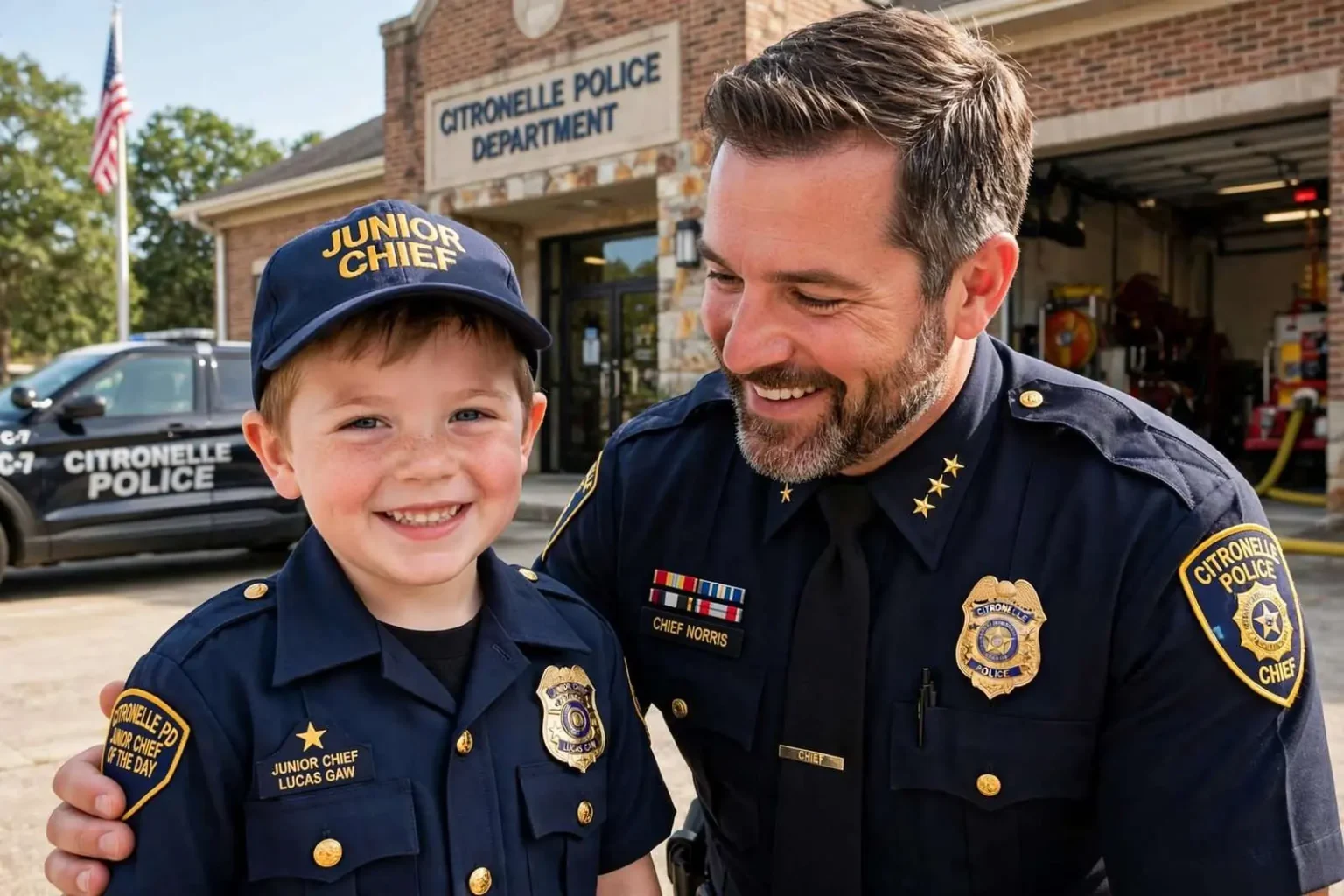
CITRONELLE, Ala. — A 5-year-old Citronelle boy who told his kindergarten teacher he wanted to grow up to be a police officer got the chance to live the dream early, serving a full day as Citronelle’s Junior Chief of the Day. For one day, the smallest member of the department wore the badge, toured the city’s emergency services, and received the kind of official recognition usually reserved for elected officials and retiring veterans.
When Lucas Gaw’s teacher asked her class at the end of the school year what they wanted to be when they grew up, Lucas said he wanted to be a cop so he could help people and protect the city — and, truthfully, because he wanted to hang out with Chief Norris. The chief heard about the answer and set out to make it happen, arranging a full itinerary that turned a kindergartner’s career day fantasy into a working schedule alongside the department’s real officers.
Small-town policing runs on exactly that kind of proximity. In a city the size of Citronelle in northern Mobile County, the police chief is a familiar figure rather than a distant authority, and children grow up seeing officers at school events, ballgames, and festivals. Lucas’s answer to his teacher reflected that everyday familiarity: his ambition was inseparable from his admiration for a specific person he already knew.
A Packed Schedule for Citronelle’s Youngest Officer
Lucas’s day on the job began with an official swearing-in ceremony to the force, the same oath ritual that marks the start of every officer’s career, scaled down to kindergarten size but carried out with full ceremony. The moment served as the day’s symbolic anchor — before the tours and the equipment demonstrations, the department’s newest and shortest member was formally on the roster.
From there, he met city firefighters — and even got his turn spraying the fire hose — before boarding an Alabama Law Enforcement Agency helicopter for a ride and meeting ALEA first responders. The fire hose moment delivered what every child imagines when they picture a firefighter’s job: the weight and power of the line in their own hands, water arcing across the station yard. The helicopter ride went further, lifting the day from a local tour into an experience few adults ever get, introducing Lucas to the state-level first responders who support rural communities like Citronelle during emergencies.
The itinerary amounted to a compressed tour of how small-city public safety actually works. Police and fire departments in towns like Citronelle operate with small crews who depend on mutual aid — from neighboring municipal departments and from state agencies like ALEA — when major incidents strike. A day that introduced Lucas to firefighters, local officers, and ALEA personnel captured the whole network in miniature.
Mayor Stringer capped the day by presenting Lucas with a proclamation, the city government’s formal way of marking an occasion, placing the boy’s accomplishment in the municipal record alongside proclamations honoring veterans, milestone anniversaries, and civic achievements. For a 5-year-old, the paperwork may have mattered less than the moment, but the gesture completed the day’s official arc: sworn in by the department, recognized by the city.
Why the Chief Made It Happen
Chief Norris said the timing mattered, coming during a period of confusion and detachment between the public and the policing profession. Departments across the country have spent recent years working to rebuild trust strained by national controversies over policing, and small departments like Citronelle’s feel the same distance between officers and residents that larger cities have confronted — sometimes more acutely, because a small town’s police force has nowhere to hide from public opinion.
Events like the Junior Chief program operate in that gap. A child who spends a day with officers sees them as people — professionals who swear oaths, work with firefighters, and partner with state agencies — and a child’s enthusiasm is contagious in a way no recruitment brochure can match. The audience extends beyond Lucas himself: his classmates, his school, and every family that sees the photos of a kindergartner in a department uniform absorb the message that the police department belongs to the community and welcomes it.
Norris called Lucas kind and compassionate, noted the same fascination with law enforcement the chief himself had as a child, and said he hopes the experience lights the boy’s fire even more. The chief’s recognition of his own childhood fascination in Lucas’s gave the day a personal dimension — a department leader remembering what first drew him to the work, and seeing the same spark in the city’s youngest resident.
A Program That May Become a Fixture
Norris added that he intends to make the Junior Chief program a permanent fixture in Citronelle. That commitment would turn a one-time gesture into an institution, giving future children the same opportunity and giving the department an annual tradition that strengthens its ties to the city’s schools and families.
Small departments across Alabama have long used youth engagement as a bridge to the community — school resource relationships, station tours, safety fairs, and junior academy programs. The Junior Chief concept distills those efforts into a single, personal experience for one child at a time, and its power comes from that intimacy. Where a tour touches dozens of students briefly, a full-day immersion creates a story one child tells for years, and that story travels through a small city quickly.
For Citronelle, a city of roughly 2,000 residents perched in the northern reaches of Mobile County, the program fits the town’s self-image. Communities of its size rely on institutions knowing their residents by name — the school, the volunteer organizations, the police and fire departments — and a program built around a single kindergartner’s dream is an extreme expression of that intimacy.
What the Day Meant
Lucas’s answer to his teacher — that he wanted to help people and protect the city — captured, in a 5-year-old’s vocabulary, the core of what police departments describe when they explain their mission. The fact that his third reason, hanging out with Chief Norris, reflected genuine affection for a local officer said something equally true about small-town policing: the relationship between the department and the community it serves is personal before it is anything else.
The day’s combination of ceremony and play — a swearing-in, a fire hose, a helicopter ride, a proclamation — gave Lucas the complete fantasy, but it also gave the adults involved something more lasting. A police chief demonstrating that his department has time for one child’s dream, a mayor willing to put it in writing, and a fire department that lets a kindergartner hold the hose together tell Citronelle’s families something about who these public servants are.
Whether Lucas ultimately pursues a badge as an adult, the city has already secured its return on the day: a story of a community that listened to its smallest member, and a police chief who intends to keep listening, one Junior Chief at a time.
Small-Town Policing in Northern Mobile County
Citronelle’s police department operates in an environment far removed from big-city policing, but its challenges are real. Covering a city spread across the rural landscape of northern Mobile County, officers handle everything from traffic and property crime to the occasional storm emergency, often with a roster small enough that every officer knows the community by name. In that setting, programs that build goodwill are not public relations luxuries; they are operational necessities, because small departments depend on residents reporting what they see, cooperating with investigations, and trusting officers enough to call.
The partnership with the Alabama Law Enforcement Agency reflected that mutual-aid reality. ALEA’s helicopters and first responders support local agencies across the state with capabilities — aerial search, transport, and specialized response — that a city the size of Citronelle could never maintain alone. Having a Junior Chief meet those state partners gave the boy a look at the full span of public safety, from the city’s own officers to the state assets that back them up when the worst happens.
The fire department’s participation completed the picture. In small municipalities, police and fire services are natural partners at every community event, and a day that gave Lucas time with both departments — including his turn on the hose — mirrored the way those services actually interlock during fires, crashes, and storms in rural Alabama.
A Kindergartner’s Day, a City’s Message
The details of the day — the oath, the proclamation, the hose, the helicopter — will fade for most residents into a pleasant local story. What may last is the precedent. Norris’s stated intention to make the Junior Chief program permanent means that next year’s kindergartners will grow up knowing the opportunity exists, and that the department will make room for one child’s ambition every year.
Communities across Alabama have experimented with versions of the idea — junior officer programs, student ride-alongs, youth academies — and the ones that endure share the trait Norris described: they become fixtures rather than events. A fixture gives a department an annual moment in which the community sees its officers at their most welcoming, and gives children a concrete, personal image of what public service looks like from the inside.
For Lucas Gaw, the record now shows a day when a 5-year-old from Citronelle was sworn in, rode in a state police helicopter, sprayed a fire hose, and received a proclamation from his mayor — all because he told the truth about what he wanted to be, and the people in charge of the city decided his dream was worth a day. In a period when relations between police and the public are often described in terms of distance and distrust, Citronelle demonstrated the opposite: a chief, a mayor, a fire department, and a state agency rearranging their day for a kindergartner who wanted to help people and protect the city. The fire Norris hopes the experience lights is, for now, a child’s dream — but the warmth it produced reached well beyond one boy.