Citronelle Police Push Human Trafficking Awareness on World Day Against Trafficking
Citronelle police marked World Day Against Human Trafficking with an awareness video built alongside other Mobile County agencies.
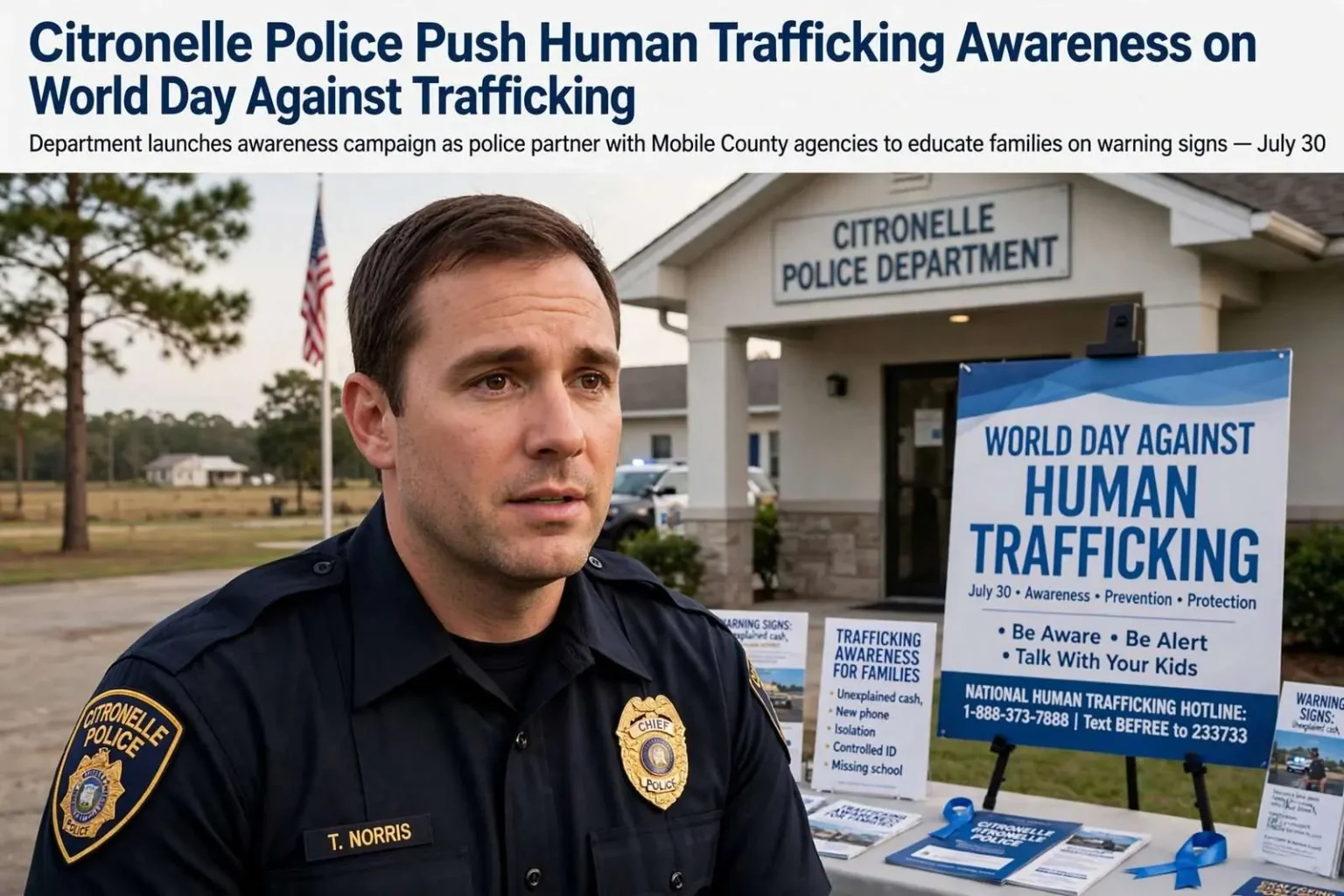
The Citronelle Police Department is working to educate the public about human trafficking, marking the World Day Against Human Trafficking with an awareness push aimed at families across north Mobile County.
Chief Tyler Norris said the department partnered with other agencies across Mobile County to produce a video sharing information and statistics about trafficking, aiming to draw attention to a global issue that rarely surfaces in local casework. The collaboration brought together departments that see the problem from different angles, and the finished video is designed to be shared widely on the platforms where residents already spend their time.
Norris acknowledged that trafficking is not something his department typically investigates or trains for, which is part of why the awareness effort matters. “It’s not one of those things I was educated about that it felt natural to me,” he said. “With this video, we pulled out some points, statistics that we thought would be something that would get people’s attention.”
The approach is deliberately simple: put the basics in front of ordinary families, in plain language, before an incident ever happens in their community. “This is a dining room table sit down as a family and explain to your kids this is real life,” Norris said. “Be aware, be alert. Look around, make sure you don’t engage in conversation with a total stranger.”
Citronelle’s Place in Mobile County
Citronelle is one of the northernmost municipalities in Mobile County, a small city surrounded by rural land, timber tracts and the winding roads that connect communities like Mount Vernon, Wilmer and Semmes. Small police departments in communities like this one handle a wide range of calls with limited staff, and specialized crimes such as human trafficking rarely appear in their case files. That rarity can breed a false sense of distance, and it is exactly the perception Norris said the department is trying to counter with the awareness campaign.
The World Day Against Human Trafficking, observed each year on July 30, was designated by the United Nations to raise awareness of trafficking in persons and to promote the protection of victims’ rights. Law enforcement agencies across the country mark the day with social media campaigns, school presentations and community meetings, using the occasion to explain what trafficking actually looks like close to home, which is often different from the dramatic portrayals people see in movies and television.
What Trafficking Looks Like in a Community Like Citronelle
Human trafficking is the exploitation of a person for labor or commercial sex through force, fraud or coercion. Contrary to common assumptions, most victims are not kidnapped by strangers; they are recruited or manipulated by someone who has earned their trust, sometimes over weeks or months of online contact. Traffickers frequently target young people who are isolated, struggling at home or hungry for attention and gifts, and the grooming process rarely looks dangerous to the victim while it is happening.
In rural and small-town areas, the warning signs that residents are asked to watch for include a young person who suddenly has unexplained money or a new phone, an adult who seems to control another person’s identification documents or movements, a teenager who stops attending school or appears fearful of a specific adult, and motel traffic that suggests commercial activity. None of those signs on its own proves anything, but police say patterns noticed by neighbors are often the first thread investigators can pull.
The National Human Trafficking Hotline, which operates around the clock, takes reports and tips from the public, and the national BeFree text line gives young people a discreet way to ask for help. Police departments encourage residents to report suspicious situations to local authorities as well, since a local officer can respond immediately while a hotline report is routed onward.
Talking to Children Without Frightening Them
Norris’s dining room table advice captures what child-safety advocates have long recommended: honest, age-appropriate conversations at home, repeated often enough that they become normal. The core lessons are consistent across agencies that work these cases. Children should know that no adult needs help from a child, that secrets an adult asks them to keep from their parents are a warning sign, and that anyone who makes them uncomfortable online or in person should be reported to a trusted adult immediately.
Online contact deserves particular attention. Investigators say the path from a friendly direct message to exploitation can be short, and traffickers deliberately move conversations to platforms parents check less often. Families who set expectations about online strangers, and who keep the door open for a child to disclose something uncomfortable without punishment, are practicing the earliest and most effective form of prevention.
For a police chief in a small city, the calculus is straightforward. A department that cannot realistically staff a trafficking unit can still shape the environment traffickers rely on, an unaware public, by making sure every household in Citronelle knows the warning signs. The video produced with partner agencies across Mobile County is the tool, and the World Day observance is the occasion, but the message is meant to outlast both.
Why Small Departments Join Forces
The partnership behind the Citronelle video reflects how Mobile County agencies have learned to approach crimes that cross jurisdictional lines. Trafficking networks, like drug and fraud operations, do not respect city limits, and no single small department has the manpower to investigate them alone. By pooling resources for public education, departments get a product far more polished and far more widely seen than any one office could produce, and the agencies build the working relationships they would need if a real case ever emerged.
Regional cooperation is already familiar ground in the county. Task forces and mutual-aid arrangements connect municipal departments, the Mobile County Sheriff’s Office and state and federal partners for everything from major-crimes investigations to disaster response. An education campaign is a lighter lift than a joint investigation, but it uses the same muscle: several agencies agreeing on a message and dividing the work of getting it out.
The video format also matches how residents in smaller communities actually receive information. Rather than a press conference or a lengthy report, a short video with concrete statistics and clear warning signs can be shared by churches, schools and civic groups, reaching grandparents and teenagers alike. Departments across the country have found that this kind of content generates tips not because it frightens people, but because it gives them the vocabulary to describe something they have already seen and dismissed.
The Reality Behind the Statistics
Public awareness campaigns about trafficking walk a careful line. Advocates want the public to understand that the problem is real and present, but they also caution against myths that make communities less safe, such as the belief that trafficking only happens to certain kinds of people, or that a stranger grabbing someone off the street is the typical scenario. The statistics that law enforcement agencies share on observances like the World Day Against Human Trafficking tend to emphasize the quieter truths: victims are most often exploited by people they know, recruitment increasingly happens online, and runaway and homeless youth are at dramatically elevated risk.
For police, the hardest part of trafficking work is often the victim’s own reluctance to come forward. Coercion can be psychological rather than physical, built on debt, threats to family members, shame or the belief that no one will believe them. That is why the public’s role matters: a neighbor, teacher or clerk who notices something wrong and calls it in can start a case that the victim could not start alone.
Norris’s candor about his own unfamiliarity with the subject is part of the department’s message. Most officers in small departments have not worked a trafficking case, and most residents have never knowingly seen one. Acknowledging that gap, rather than pretending expertise, makes the invitation to learn more credible: if the police chief needed to study the warning signs, so can everyone else.
What Residents Should Do With Their Suspicions
Police departments that run awareness campaigns generally ask residents to follow a few simple rules. Report suspicions to local law enforcement with as much detail as possible, including descriptions, vehicles and locations. Do not confront a suspected trafficker or attempt to rescue a suspected victim, both of which can escalate danger. Keep notes on patterns, such as repeated visits by the same vehicles, because patterns carry more weight than single observations. And when a young person discloses something troubling, take it seriously and pass it to authorities rather than investigating alone.
The hotline system exists precisely for situations where someone is unsure whether what they saw rises to the level of a crime. Callers can describe circumstances anonymously and get guidance on whether to report locally. Police would rather sort through a report that turns out to be innocent than miss the one that is not, a trade-off they describe in the same terms across every community where these campaigns run.
A Lasting Message for North Mobile County
When the World Day observance passes, the Citronelle Police Department’s hope is that the conversation it started keeps going, at dinner tables, in classrooms and on the church and civic-group schedules that anchor small-town life. The department’s investment in a video it hopes never becomes relevant to a local case captures the unusual character of prevention work: success is measured in the absence of incidents, and the payoff is a community that knows what to look for and is not afraid to say something.
For families in Citronelle and across north Mobile County, the practical takeaway is the one Norris put plainly: be aware, be alert, and talk to your children as if the danger were real, because somewhere it is, and the best protection any community has against it is people who are paying attention.