City of Mobile, Mobile Arts Council Launch Interactive Map of Downtown Public Art
The City of Mobile and the Mobile Arts Council have launched an interactive online map cataloging more than 70 public artworks throughout downtown Mobile.
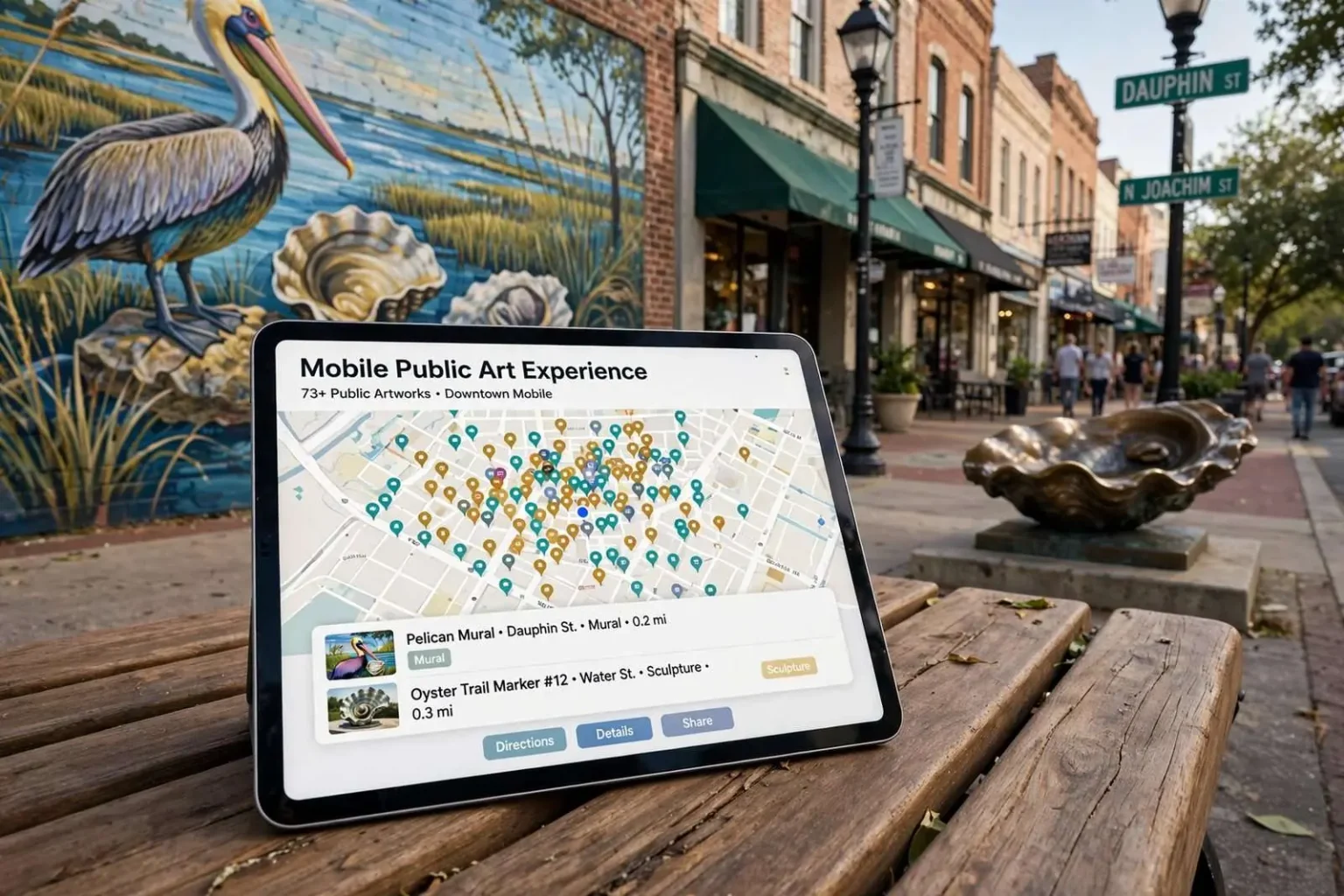
The City of Mobile and the Mobile Arts Council have partnered to create a new interactive map highlighting dozens of public artworks scattered throughout downtown Mobile, giving residents and visitors an easy way to explore the city’s growing collection of murals, sculptures and other creative installations. The project pulls together works that until now existed mostly as individual discoveries — a mural here, a sculpture there — into a single searchable resource that treats the whole of downtown as one open-air gallery.
More Than 70 Works of Art in One Map
Called the Mobile Public Art Experience, the online map catalogs more than 70 pieces of public art found throughout downtown, ranging from striking sculptures and large-scale murals to hand-painted utility boxes and stops along the Mobile Bay Oyster Trail. The range of media is itself a portrait of how public art has evolved in Mobile: traditional bronze and stone pieces share the map with painted traffic signal boxes and the sculpted oyster markers that trace a bay-themed trail through the streets, giving the collection a mix of the monumental and the playful.
The map was developed by the City of Mobile’s GIS Department, which built out the names, locations and details for each artwork included in the project. Geographic information systems staff, whose usual work involves the parcel maps and infrastructure data that run city operations, turned their tools toward cultural assets — plotting each piece with coordinates that place it correctly on a phone screen for anyone standing nearby. The Mobile Arts Council contributed research on the pieces and the artists who created them, rounding out a resource meant to serve both tourists exploring the city for the first time and longtime residents who want to discover public art they may have walked past for years.
The tool is designed to be simple to use, allowing people to search or browse the map to find artwork near them, learn a piece’s backstory and plan a self-guided walking tour of downtown Mobile’s public art scene. A visitor with an hour downtown can build a route that strings together murals, sculptures and oyster trail stops; a resident can check the map after passing a new installation on the way to work. Each entry carries details about the work and its maker, turning a casual glance at a wall or a plaza into a story about the artist and the piece.
Expansion Plans Beyond Downtown
While the initial version of the map focuses on downtown Mobile, city officials say the effort will expand in partnership with the Mobile Arts Council to include public art in other parts of the city. Future additions are expected to include the outdoor sculptures at the Mobile Museum of Art, artwork at the Geri Moulton Children’s Park, and pieces in other locations around Mobile, giving the map room to grow as the city’s public art collection continues to expand.
The museum’s sculpture garden and the children’s park, both located well west of the downtown core, represent the first wave of that broader geography. Their inclusion changes the practical character of the map: a user will eventually be able to plan a visit that spans the city rather than a single walkable district, and neighborhood-scale artworks that never attracted much notice will gain the same visibility as the signature downtown murals. The structure the GIS team has built allows new entries to be added as pieces are commissioned and installed, so the catalog is designed to be maintained rather than frozen at launch.
Recent and Ongoing Public Art Projects
The map arrives as Mobile has seen a steady stream of public art initiatives in recent years. Recent open calls and completed projects highlighted by the Mobile Arts Council include a tribute to Melvin Franklin, “Son of a Son of a Sailor” — a hometown memorial to musician Jimmy Buffett — and a partnership with the U.S. Army Corps of Engineers to commission local art.
The Franklin tribute honors the Mobile-born bass singer whose deep voice anchored the Temptations for decades, and the Buffett memorial claims the singer-songwriter whose songs put Gulf Coast imagery in front of audiences worldwide. Both pieces tap the same impulse: Mobile has produced more than its share of nationally known artists, and public art is how the city puts that heritage on the street where everyone can see it. The Corps partnership brought commissioned art to a federal project site, an arrangement that pairs infrastructure work with local artistic input and reflects how public agencies beyond city hall have become part of the art commissioning process.
Other projects include the Isom Clemon Civil Rights Memorial Park, a window art design contest for the Chickasabogue Park Conference Center, a broader utility box art program that has brought color to street-level infrastructure across the city, “Discovery,” a tribute to naturalist E.O. Wilson, and the Hall of Fame Courtyard.
The Clemon memorial grounds the city’s public art in its civil rights history, honoring a longtime Mobile activist and councilman whose career spanned the movement’s local chapters and his later years in elected office. The Wilson tribute claims the Mobile-born biologist whose work on ants and biodiversity earned him international standing, extending the city’s tradition of commemorating native sons and daughters into science. The utility box program, meanwhile, has turned dozens of ordinary signal cabinets into small canvases, demonstrating that public art does not have to be large or expensive to change how a streetscape feels.
Together, these projects reflect a broader push by the city and the Mobile Arts Council to weave public art more deeply into daily life downtown, giving residents new reasons to walk the city’s streets and discover something new at each turn. The Mobile Public Art Experience map gives that effort a public face and a permanent record, and it positions the city to keep adding works as the collection grows.
Why a City Maps Its Art
The Public Art Experience follows a model other American cities have adopted as their collections grew past the point where a printed brochure could keep up. A well-maintained digital map serves three audiences at once: tourists planning an itinerary, residents discovering works in their own neighborhoods, and the city itself, which gains a living inventory of what it owns and where it stands. For municipal staff, that last function matters more than it might seem — public artworks require maintenance, and a catalog that records each piece’s location, materials and artist makes it far easier to schedule cleaning, repairs and appraisals as the collection ages.
For the Mobile Arts Council, the map is also a gateway to deeper engagement. An entry that teaches a visitor about one mural leads naturally to the council’s programs — its gallery exhibitions, its open calls for new commissions, its work with schools. Arts councils across the Gulf Coast have increasingly positioned themselves as the connective tissue between artists, governments and developers, and a visible, easy-to-use inventory strengthens the case that public art deserves a line in development budgets rather than leftover space.
Public Art and Downtown’s Momentum
The timing places the map alongside Mobile’s broader downtown revitalization. The city center’s recovery over the past two decades — anchored by preserved historic buildings, the revitalized waterfront, a growing restaurant and nightlife scene, and cruise traffic from the Alabama State Port Authority — has leaned on quality-of-life investments to draw residents and visitors back after years of suburban drift. Public art has been part of that formula in cities across the country, and Mobile’s growing collection of murals and sculptures has given walking tours, event planners and photographers new material to work with.
The economic logic is straightforward. Visitors who come downtown for a convention or a port excursion extend their stays when there is more to see, and a self-guided art walk costs the visitor nothing while generating foot traffic for shops and restaurants along the route. Studies of public art programs in comparable cities have found that murals and sculpture installations correlate with increased pedestrian activity and, over time, reduced vacancy in surrounding storefronts. The oyster trail stops on the map carry an added layer, connecting the art walk to the bay’s oyster heritage and the restoration work that has made the reef a regional cause.
Seventy-plus entries is a substantial foundation, and the planned expansion toward the Mobile Museum of Art’s sculpture garden, Geri Moulton Children’s Park and other locations will push the catalog’s reach across the city. As new commissions from the recent wave — the Franklin tribute, the Buffett memorial, the Corps partnership, the civil rights memorial park — are joined by whatever comes next, the map gives Mobile something few of its peer cities have assembled: a complete, searchable record of its public imagination, one that grows a little larger with each new wall painted and pedestal filled.