City of Pensacola seeks public input on waterfront changes
The City of Pensacola is seeking public input on the Downtown Hashtag Connector Project, which would expand public access to the waterfront.
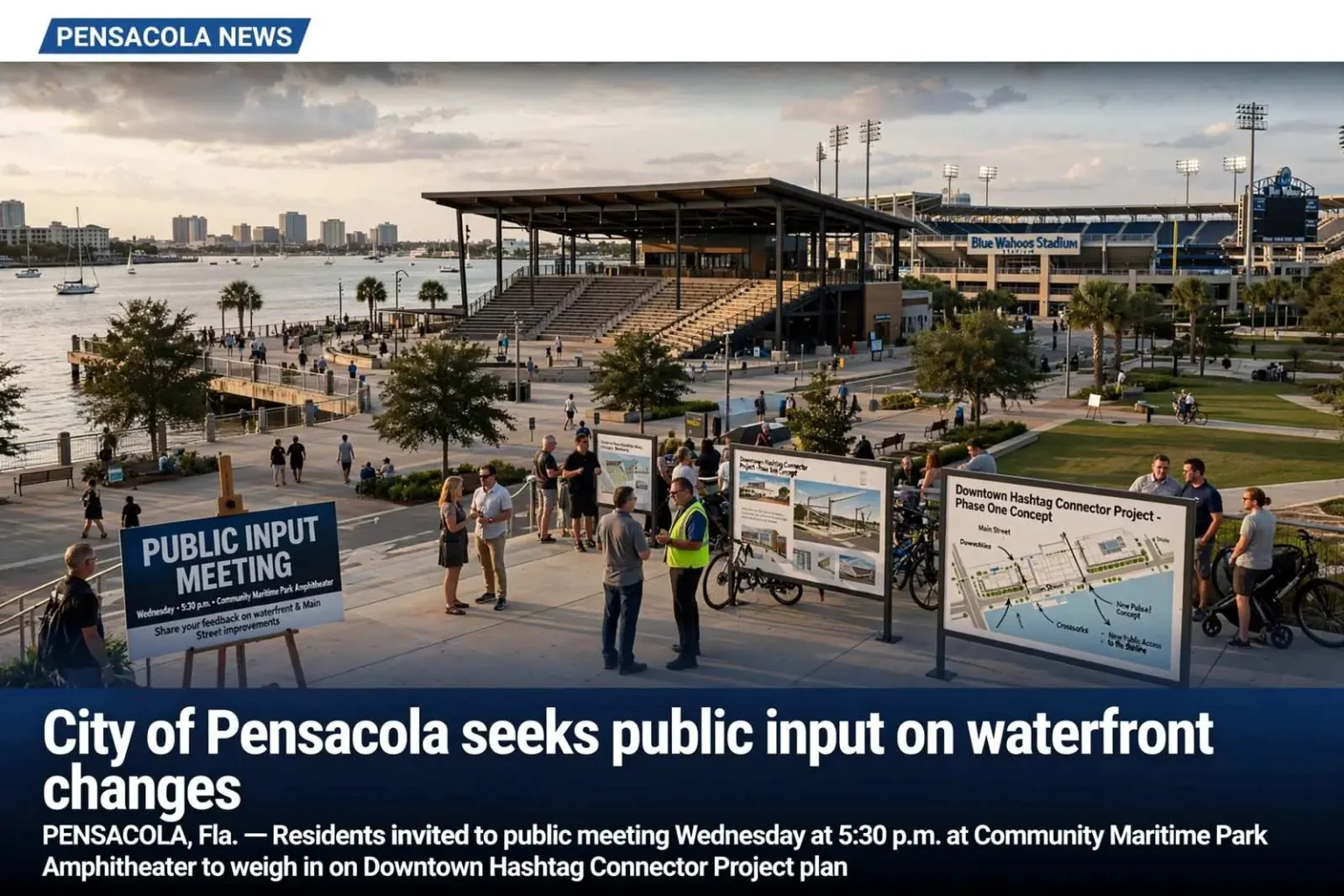
PENSACOLA, Fla. — Changes are coming to Pensacola’s waterfront, and the city is asking residents to weigh in at a meeting Wednesday evening. The input sessions are part of the planning work on phase one of the Downtown Hashtag Connector Project, an effort aimed at strengthening the links between downtown streets and the Pensacola Bay shoreline.
A virtual presentation and discussion were held Tuesday evening on phase one of the Downtown Hashtag Connector Project, giving residents who could not attend in person a first look at the concepts. The project would make Main Street more walkable and cyclist-friendly, provide more public access to the waterfront and encourage retail development along the corridor.
Those who want to give feedback or ask questions can attend a public meeting Wednesday at 5:30 p.m. at the Community Maritime Park Amphitheater behind Blue Wahoos Stadium.
What the Project Would Change
Main Street runs along the downtown edge of Pensacola Bay, and for years it has functioned more as a pass-through for vehicles than as a destination in its own right. The Downtown Hashtag Connector Project takes aim at that gap. By redesigning the street to be more walkable and cyclist-friendly, planners hope to slow traffic, make crossings safer and turn the corridor into a place people move along on foot rather than past at speed.
The second piece is public access. Much of Pensacola’s downtown waterfront is occupied by infrastructure, parking and institutional uses, and the project is intended to open more of the shoreline to everyday use. More access points, better connections from the grid of downtown streets to the water, and gathering spaces along the bay are the concepts on the table in phase one.
The third element is economic. Retail development along the corridor would give the waterfront frontages the kind of active ground floor, shops, cafes, services, that makes a district draw people throughout the day rather than only at event times. City officials have framed the connector concept as a way to bind the stadium, the park and the downtown business district into one continuous experience.
The Setting: Maritime Park and the Stadium
The Wednesday meeting site is no accident. Community Maritime Park sits on the downtown waterfront and is the centerpiece of the city’s decades-long effort to reconnect Pensacola to its bay. The park’s amphitheater, behind Blue Wahoos Stadium, hosts concerts and public events, and the stadium itself is home to the Pensacola Blue Wahoos, the city’s minor league baseball club.
The park transformed a former industrial and institutional parcel on the shoreline into a public destination, with waterfront promenades, open lawns and views across the bay. But the park’s success also exposed the challenge the connector project is meant to solve: downtown and the water are physically close, yet the streets between them do not invite the walk.
Main Street sits squarely in that gap. Widened for traffic and lined with uses that face inward rather than toward the bay, the corridor is what pedestrians must cross to reach the park. Phase one of the connector project would begin the work of flipping that equation.
Why Public Input Matters
The city scheduled two chances to weigh in: the virtual presentation and discussion Tuesday evening, and the in-person meeting Wednesday at 5:30 p.m. at the amphitheater. The format reflects a growing practice in municipal planning, where virtual sessions widen participation and in-person meetings allow the detailed back-and-forth that shapes design decisions.
Feedback gathered at this stage influences what moves forward into design and construction. Residents can comment on everything from crosswalk locations and bike lane treatments to the balance between parking, green space and retail frontage. Questions raised at the meeting also become part of the public record the planning team responds to in later phases.
Waterfront redesigns are expensive and long-lived, which is why the input window matters. Decisions made on paper now will shape how Pensacolians experience their bayfront for decades, and the city has asked the public to help make those choices before the drawings harden into construction documents.
The Broader Waterfront Momentum
The connector project is part of a longer arc in Pensacola’s relationship with its waterfront. The city’s downtown shoreline spent much of the twentieth century dominated by working and institutional uses, and the opening of Community Maritime Park marked a deliberate turn toward public access. Each successive project, the stadium, the amphitheater, the promenades, has extended that turn, and the connector is aimed at the seams between them.
The walkability push also mirrors what other Gulf Coast cities have discovered: waterfront investment pays its full return only when people can reach the water easily and safely on foot or by bike. A stadium draws crowds a few dozen nights a year, but a connected, walkable shoreline draws people every day, and the retail that serves them follows the foot traffic.
For Main Street property owners, the project could mark a shift in the corridor’s economics. Streets redesigned for pedestrians tend to see longer visits, more storefront activity and higher demand for ground-floor space, trends that have played out in downtowns across the region as they have reclaimed their waterfronts.
What Happens Next
Wednesday’s 5:30 p.m. meeting at the Community Maritime Park Amphitheater behind Blue Wahoos Stadium is the immediate next step for residents. Attendance is open, and the city has encouraged anyone with questions about phase one, or opinions about Main Street’s future, to come out, hear the presentation and speak.
After the input sessions, the planning team will refine the phase one concepts, incorporating what it heard before advancing toward design. Later phases of the Downtown Hashtag Connector Project would carry the work further, linking more of downtown to the waterfront as funding and design advance.
For a city whose identity has always been tied to the bay, the project represents another step in a decades-long effort to put the water back at the center of downtown life, and the meetings this week are where residents get to say what that should look like.
Getting to the Meeting
The Community Maritime Park Amphitheater sits at the heart of the waterfront park, behind Blue Wahoos Stadium along the bayfront. The 5:30 p.m. Wednesday start makes the meeting accessible to residents coming straight from work, and the park’s parking areas and surrounding downtown garages provide room for attendees. Those who prefer not to attend in person still have the Tuesday virtual session as an alternative, and the feedback channels tied to the project remain open through the planning process.
City planning staff typically use these sessions to present maps, renderings and concept drawings before opening the floor. Residents do not need any technical background to participate; the questions that matter most, where crossings belong, how much parking to keep, what kind of retail fits the corridor, are questions neighbors are best positioned to answer.
How Connector Projects Get Built
Projects of this kind move through a familiar sequence: visioning, concept design, public input, detailed engineering, funding and construction. Phase one represents the early stretch of that pipeline, where the big ideas are still fluid and public comment carries the most weight. Once a project advances into final engineering, the room for change narrows considerably.
Street redesigns that add walkability and bicycle facilities also involve trade-offs that residents weigh at meetings like Wednesday’s. Lane configurations, signal timing, tree plantings, on-street parking and loading zones all compete for the same right-of-way, and each choice affects businesses and commuters differently. That is precisely why cities bring the public in before the plans harden.
Funding typically arrives in stages as well, drawing on a mix of local capital budgets, state and federal grants, and in some cases tax increment or other district-based financing tied to the redevelopment the project is meant to stimulate. Each phase that clears design and public review strengthens the case for the next round of funding.
What Residents Are Watching For
For the people who live and work downtown, the details under discussion are anything but abstract. A more walkable Main Street changes how children cross to reach the park, how visitors move between the stadium and downtown restaurants, and how comfortably someone can bike from a neighborhood to the bayfront. Retail development along the corridor would put eyes on the street and activity on the sidewalks in the hours between events.
Access to the water itself is the emotional core of the project. Pensacola’s history, its economy and its identity all run through the bay, and residents who have watched parcels of the shoreline open to the public over the past two decades tend to have strong views about what comes next. The connector concept asks them to imagine a downtown where the bayfront is not a destination you drive to but a place woven into the street grid.
The virtual session Tuesday and the in-person meeting Wednesday at 5:30 p.m. behind Blue Wahoos Stadium are the city’s invitation to shape that picture. For a project whose purpose is to connect downtown to its waterfront, the feedback of the people who will use those connections every day is the raw material phase one is built from.