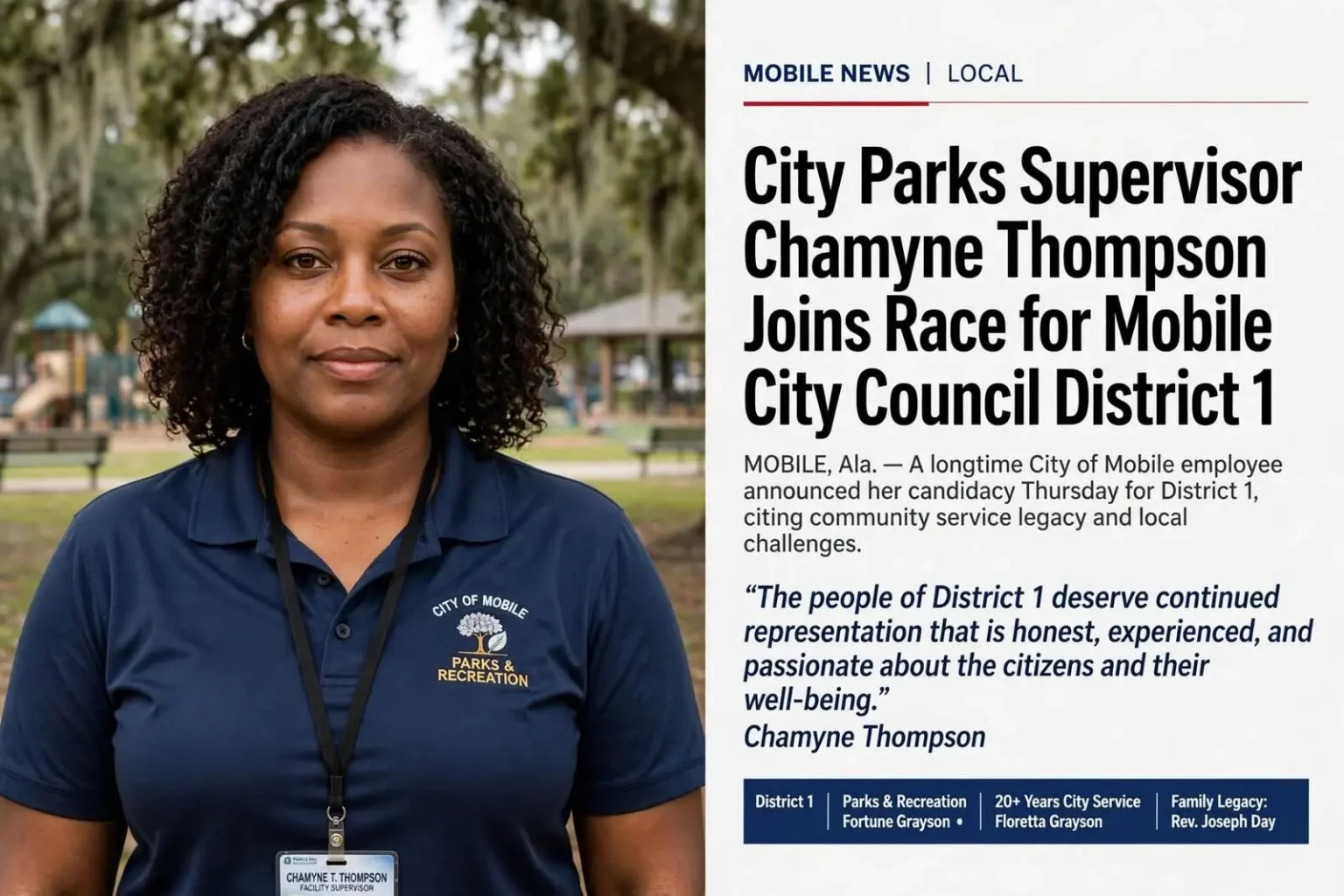
MOBILE, Ala. — A longtime City of Mobile employee has jumped into the race for Mobile City Council District 1. Chamyne Fortune Thompson, a facility supervisor with the city’s Parks & Recreation Department, announced her candidacy Thursday, saying she felt compelled to run after weighing community input.
“After careful consideration and community feedback, I could not ignore the calling,” Thompson said in a press release. “The people of District 1 deserve continued representation that is honest, experienced, and passionate about the citizens and their well-being.”
Thompson enters the race as a 20-plus-year veteran of the city work force she now hopes to help govern, and her announcement adds a candidate whose professional life has been spent delivering the neighborhood-level services — parks, recreation programs, community facilities — that District 1 residents interact with most directly. Her candidacy frames the race around experience earned inside city government rather than around it.
A Family Legacy of Public Service
Public service runs deep in Thompson’s family. She is the granddaughter of Floretta Grayson Fortune, a respected community leader who spent 54 years serving Mobile’s Parks and Recreation Department as a facility supervisor — the same job title Thompson holds today. The direct line from grandmother to granddaughter, across a half-century of city service, is the kind of legacy that changes how a campaign is received in the neighborhoods where both women worked.
She is also the great-niece of the Rev. Joseph Day, a local minister and community activist for whom Tricentennial Park’s Day Lake is named. Day’s place in Mobile’s civic landscape is literally mapped onto one of the city’s flagship parks, and Thompson’s family name carries that history into the race. In a district where community memory runs long, a candidate whose family helped build the parks, programs, and institutions of north Mobile is introducing herself to voters who may have known her family first.
The announcement positions Thompson within a tradition of north Mobile leadership built through churches, community organizations, and city service rather than through previous electoral office. Whether that tradition translates into votes will be decided against a field of challengers and whatever incumbent dynamics shape the race, but the legacy she presents is not a recent construction — it is two generations deep in the district she wants to represent.
The Case She Is Making
Thompson framed her campaign around the challenges she says the city must confront. “Our city government faces many difficult challenges: lagging infrastructure and community development, decrease in public services, fiscal shortfalls, rising crime, and limited economic opportunities,” she said. The list reads as a district-specific diagnosis: the infrastructure of north Mobile’s streets, drainage, and neighborhoods; the level of city services reaching its communities; and the economic development that has concentrated elsewhere in the city while her district’s corridors await investment.
Each item on that list corresponds to a pocket of District 1 reality. Aging infrastructure in the district’s older neighborhoods, the service demands of communities from Africatown to Trinity Gardens, and the persistent question of why commercial growth skips parts of north Mobile are standing themes of the area’s civic conversation. Thompson’s argument is that someone who has spent her career operating the city’s neighborhood-facing services knows where those gaps are because she has been filling them.
Understanding District 1
Mobile’s City Council districts carve the city into seven seats, and District 1 covers much of the city’s north side — a broad stretch of communities including historic Africatown, Orange Grove, Trinity Gardens, and the neighborhoods that run toward the city limits and the Prichard line. It is a district of deep roots: some of its communities predate the city’s modern growth, and its landmarks — from the Africatown community founded by the survivors of the Clotilda to the churches and schools that anchor its neighborhoods — carry stories that reach back generations.
The district’s needs are correspondingly distinctive. Its residents have watched redevelopment energy reshape downtown and west Mobile while their own corridors have waited, and issues that dominate the district’s civic meetings — drainage, street conditions, code enforcement, blight, public safety, and economic opportunity — are the same themes Thompson’s announcement names. Whoever holds the District 1 seat inherits a constituency that measures its council member by tangible neighborhood results rather than by citywide abstractions.
The council seat itself carries real authority over those outcomes. Mobile’s council members control district-level discretionary spending, approve zoning and development decisions, confirm major appointments, and sit at the table where the city budget — the document that determines every service level Thompson’s campaign statement references — is actually written. A council race in District 1 is therefore a race over the levers that shape the north side’s next decade.
What a Parks and Recreation Career Brings
Thompson’s professional background deserves attention from voters because parks and recreation work is, in practice, neighborhood governance. Facility supervisors run the community centers where after-school programs operate, manage the fields and gyms where leagues play, and staff the buildings that host everything from voting to violence-prevention meetings. The job requires budget discipline, personnel management, and daily contact with the residents a city serves — a skill set that maps directly onto the council member’s portfolio.
Her family’s 54-year history in the same department adds institutional memory to that experience. The Parks and Recreation Department’s facilities in north Mobile were built, staffed, and sustained across the decades by people like Floretta Grayson Fortune, and Thompson’s candidacy asks voters to view that generational investment as a qualification. In districts where trust in institutions is earned through decades of visible service, that argument carries weight.
The Race Ahead
Thompson’s Thursday announcement makes her one of the candidates in what has historically been one of Mobile’s most competitive council seats. District 1 races have drawn crowded fields, community forums in church basements and community centers, and campaigns fought block by block across communities whose interests do not always align. Newcomers to the ballot in this district face the practical challenge of introducing themselves across a wide and varied geography — from Africatown’s historic core to the neighborhoods along the district’s northern edge.
Her campaign will be built on the introduction she has already written: a city employee who followed her grandmother into public service, a family name attached to one of Mobile’s parks, and a list of district challenges she says she is ready to confront from the council dais. Voters in District 1 will now have months of forums, door-knocking, and community meetings to decide whether that introduction matches what they want in their next representative — and Thompson, having answered what she describes as a calling, will spend the race making her case one neighborhood at a time.
The Historic Ground Beneath the Campaign
Any race in District 1 is run on some of the most historically significant ground in Alabama. The Africatown community, founded north of downtown by the survivors of the Clotilda — the last known ship to bring enslaved Africans to the United States — has drawn international attention in recent years as researchers confirmed the vessel’s resting place in the Mobile River and descendants pushed for recognition, preservation, and investment. The district’s other communities carry their own deep histories: Orange Grove and Trinity Gardens grew up around churches, schools, and family land holdings that still anchor neighborhood identity today.
That history shapes the politics. District 1 voters have long evaluated candidates in part on their understanding of what the district’s communities have been promised and passed over for, from drainage projects to economic development deals. Candidates who arrive without that context struggle; those who come from the communities themselves — as Thompson does, through her family’s generations of Mobile service — begin the campaign with a fluency in the district’s story that cannot be assembled on the campaign trail.
The district’s relationship with the city’s growth is the practical expression of that story. While Mobile’s downtown and western corridors have absorbed most of the city’s visible development in recent decades, District 1’s commercial corridors and neighborhoods have chased the investment that follows growth — a gap Thompson’s campaign statement names directly in citing lagging community development and limited economic opportunity.
Neighborhood Services as Political Ground
There is a reason a parks and recreation veteran’s campaign resonates in a district like this one. Community centers and parks are among the few city facilities residents use every week, and in north Mobile they double as the settings where much of the district’s civic life happens — youth leagues, senior programs, neighborhood meetings, back-to-school drives. A facility supervisor has seen how those institutions are funded, staffed, and sometimes stretched thin, which is why Thompson’s reference to a “decrease in public services” reads as an insider’s observation rather than a talking point.
The connection between those facilities and the district’s broader challenges is also direct. Youth programming is consistently cited in discussions of public safety; functioning recreation centers are part of how neighborhoods hold their ground against blight; and the condition of a district’s parks is one of the most visible indicators of how the city budget divides its attention. Thompson’s career puts her on the delivery end of all three, and her campaign asks District 1 to hire someone who has already done the work the council funds.
Her family’s legacy gives the argument its closing line. Fifty-four years of service by Floretta Grayson Fortune, a lake in Tricentennial Park named for the Rev. Joseph Day, and a third generation now stepping forward as a candidate — that is a narrative District 1 voters can verify in their own memories and on their own streets. Whether it carries Thompson to the council seat will be decided at the polls, but as opening statements in a council race go, hers comes with receipts the district has watched accumulate for two generations.