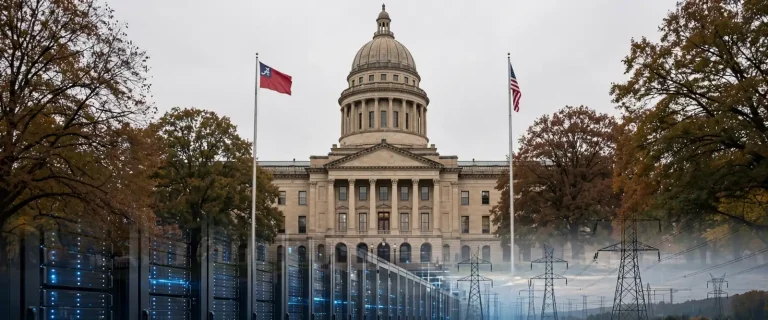
Katie Britt Warns Mobile County GOP Against Complacency, Seeks Middle Ground on Data Centers
With less than a month until the Nov. 3 midterms, Sen. Katie Britt told a packed Mobile County Republican Party meeting not to take voters for granted, outlined data center “guardrails” and discussed holding AI companies accountable.
MOBILE, Ala. — U.S. Sen. Katie Britt brought a blunt warning to a packed Mobile County GOP meeting Monday: in an election year when Democrats are showing unusual strength in one of Alabama’s most reliably Republican counties, the GOP cannot afford to coast. Speaking at Regency Church of Christ less than a month before the Nov. 3 midterm election, Britt urged local Republicans to focus on voter turnout, laid out her position on data centers — a defining issue in this year’s governor’s race — and described her push to hold artificial intelligence companies accountable for the harm their chatbots can do to children.
Update, Oct. 7, 2026: More from Monday’s Mobile County GOP meeting: Sheriff Paul Burch and former U.S. Sen. Jeff Sessions voiced concern about weak Republican primary turnout, Britt acknowledged gas prices and the conflict with Iran are challenges for the party, and the secretary of state nominee warned that the 2nd Congressional District race will be close.
Latest developments: Turnout worries voiced by GOP leaders
Britt was not the only speaker at Regency Church of Christ to sound the alarm about turnout. Mobile County Sheriff Paul Burch said more Democrats voted in Mobile County’s May 19 primary than at any point since the 1990s.
“We have to get our people to vote or we’ll turn blue,” Burch said.
Democratic turnout also rose sharply compared with Republican participation statewide. In Mobile County, some Republicans who face little or no opposition in their own races are contributing as much as $25,000 to get-out-the-vote efforts.
Former U.S. Attorney General and former U.S. Sen. Jeff Sessions said the numbers worry him, too. “It is troubling for me,” Sessions said of the stronger Democratic turnout and softer Republican participation in the primaries. He said he believes “turnout makes a difference” on Nov. 3 and encouraged Britt to keep campaigning around the state and beyond.
Britt on the issues facing Republicans
Britt acknowledged that Republicans need to address issues such as gasoline prices and the conflict with Iran, which polling suggests voters largely blame for rising fuel costs. She argued that other issues remain strengths for the GOP, including voter identification requirements and restrictions on transgender athletes competing in women’s sports.
The senator continued to frame the choice between the parties as “common sense” versus “crazy.” She used similar language over the weekend in an exchange on social media with Doug Jones, the former U.S. senator now running as the Democratic nominee for governor.
“When people assess where the Democratic Party is moving under the Democratic Socialists of America or the common sense approach of the 80-20 issues we’re pushing, I believe they will come home,” Britt said.
Campaigning beyond Alabama
Britt said she plans to travel to Iowa and other states in the coming weeks to campaign for Republican candidates in competitive races. She also pointed to recent generic-ballot polling, which asks voters which party they prefer for Congress without naming candidates, as a sign that Republicans may be gaining momentum.
“I think that will continue for the next 29 days and lead us to victory on Nov. 3,” Britt said.
The polling picture
- Congress: National polling indicates Republicans could be at risk of losing both their narrow U.S. House majority and their Senate majority. A recent Siena College poll showed Democrats tied or leading in several traditionally Republican-leaning states, and many forecasts project Democrats retaking the House.
- Trump nationally: President Donald Trump’s approval rating stands at 34%, according to a Civiqs rolling average.
- Trump in Alabama: 47% approve and 43% disapprove of his job performance. In a news release Monday, Jones said Trump’s standing with Alabama voters “has slipped” from 59% approval when he took office in January 2025. Trump carried Alabama by 30.5 percentage points in 2024.
Republicans hold polling leads or are considered favorites in most major statewide races in Alabama.
Concern in the 2nd Congressional District
Republicans remain worried about Alabama’s 2nd Congressional District, which was redrawn and later upheld by the U.S. Supreme Court. The GOP views the district as favorable territory, but Democratic U.S. Rep. Shomari Figures and Republican state Rep. Rhett Marques remain in a competitive race.
“It will be a close race,” said Caroleene Dobson, the Republican nominee for Alabama secretary of state. “We got to make sure we send Rhett Marques to Washington, D.C. Even though it’s a Republican-leaning district, it’s a close race. It’s not overwhelmingly Republican.”
Britt was the headliner at Monday’s gathering, but she was not the only speaker. Several other Republican leaders also addressed the crowd, and turnout and the stakes of the November election were recurring themes throughout the meeting.
Mobile County GOP meeting centers on voter turnout
Britt’s core message to the Mobile County Republican Party was simple: don’t get complacent. Republicans are accustomed to winning big in Mobile County, but she told the audience that past results do not guarantee future turnout.
“We can’t take anything for granted. There is way too much at stake in this election, not just for our state but from coast to coast.” — U.S. Sen. Katie Britt
Britt said voters need to understand what is actually being decided on the ballot. “We got to make sure that people understand the policies that are on the ballot and the plan that we have,” she said. “We have done a lot of good things, but we have a lot more things that we’ve got to get to work on.”
She also said she believes the state will stay in the Republican column. “I believe that Alabama is a Republican state,” Britt said. “I believe our policies of common sense are the ones that will prevail.”
During her remarks, Britt criticized Democratic policies on several fronts, including transgender policies, health care and the use of taxpayer dollars. She also discussed voter identification requirements. Alabama requires voters to show an acceptable photo ID at the polls, and voters who do not have one can obtain a free voter ID card through the state.
Why Republicans are worried about complacency
The emphasis on turnout reflects some uncomfortable numbers for local Republicans. In the May primary, more Mobile County voters cast ballots in the Democratic primary than in the Republican one — something that had not happened in the county since 1994.
Alabama has open primaries, meaning voters do not register by party and can choose either party’s ballot on primary day. That makes primary participation an imperfect predictor of how people will vote in November, but it is one of the few hard measures of voter enthusiasm available before a general election, and party organizers on both sides watch it closely.
The governor’s race is adding to the pressure. Some polls show Democrat Doug Jones within striking distance of Republican Tommy Tuberville in the contest for governor. Tuberville, a former Auburn University football coach, has served in the U.S. Senate since 2021. Jones is a former U.S. attorney who represented Alabama in the Senate from early 2018 until early 2021, when Tuberville defeated him.
The concern extends beyond Alabama. Republicans currently hold the U.S. Senate majority, and Democrats are seeking to gain seats in November. Recent polling has shown Democrats competitive in several Republican-held Senate races, which has prompted Republicans to devote more attention and resources to getting their voters to the polls.
Trump’s Mobile visit was part of the same push
Monday’s meeting came just days after President Donald Trump’s rally in Mobile. Trump has been campaigning in heavily Republican states as the Nov. 3 election approaches, and his Mobile stop was part of that effort, with the president urging Republican voters to turn out. Britt also spoke at that event. (Read our earlier coverage: Trump tells Alabama voters to “pretend I’m on the ballot” and Britt’s remarks at the Mobile rally.)
The pairing of a presidential rally with local party meetings is a familiar late-campaign strategy. Large events generate attention and enthusiasm, while county party organizations handle the less visible work — recruiting volunteers, reminding supporters of deadlines and making sure people actually cast ballots.
Britt stakes out middle ground on data centers
The second major theme of Britt’s appearance was data centers, the large facilities that house the computer servers powering cloud services and artificial intelligence. They have emerged as one of the top issues dividing the two candidates for governor.
- Tommy Tuberville, the Republican nominee, considers data centers essential.
- Doug Jones, the Democratic nominee, has called for a one-year moratorium.
Britt sought to strike a middle ground. She said she does not want to stop construction of data centers, and she does not support a national, one-size-fits-all policy. At the same time, she said she favors “guardrails” to make sure data centers do not receive special tax breaks and that they pay their own way when it comes to electricity and water usage.
“What we have to understand is what’s good for one community may not be good for another, and that’s why I reject that we have to have a moratorium across the country because for some communities, this is the right pathway forward. And I also don’t believe that we should put one in every corner.” — Sen. Katie Britt
Britt framed the issue partly in terms of national security and competition with China, warning that the United States cannot fall behind.
“Guys, you don’t want our greatest adversary having capabilities that we do not,” Britt said. “So we have to do that, but I think we also have to do that in a very smart and measured way.”
Why data centers matter locally
Data centers are not an abstract issue on the Gulf Coast. These facilities can use large amounts of electricity and, depending on how they are cooled, significant amounts of water, which is why questions about utility costs, water supply and tax incentives come up wherever they are proposed. Proposals in the region have drawn public debate in recent months, and the split between Tuberville and Jones has made the topic a fixture of the governor’s race. For more on where the candidates stand, see our report: Data centers split the governor’s race.
Britt’s call for guardrails touches the two concerns most often raised by residents: whether the facilities will drive up costs for ordinary utility customers, and whether taxpayers will subsidize them through incentives. Her position — allow construction, but without special tax breaks and with the companies covering their own electricity and water costs — is aimed at both.
Holding AI companies accountable for chatbots
Britt also talked about her efforts to hold artificial intelligence companies accountable. She pointed to conversations she has had with parents whose children died by suicide after receiving encouragement to do so from chatbots.
Britt, a mother of two, has made the safety of children online a recurring focus in the Senate. Her remarks Monday tied that focus to the rapid spread of AI chatbots, which are designed to hold humanlike conversations and are increasingly used by teenagers and children.
If you or someone you know is struggling or in crisis, call or text 988 to reach the 988 Suicide & Crisis Lifeline, available 24 hours a day.
Who is Katie Britt?
Britt, a Republican from Enterprise, was elected to the U.S. Senate in 2022 and took office in January 2023, becoming the first woman elected to the Senate from Alabama. Before running for office, she served as chief of staff to longtime U.S. Sen. Richard Shelby, whose seat she won, and as president and CEO of the Business Council of Alabama. Her own Senate seat is not on the ballot this year; she has been campaigning on behalf of other Republican candidates.
What we know and what we don’t
What we know:
- Britt headlined the Mobile County Republican Party meeting Monday at Regency Church of Christ, and several other Republican leaders also spoke.
- Her central message was that Republicans cannot take Mobile County or Alabama for granted.
- More Mobile County voters chose the Democratic primary than the Republican primary in May, for the first time since 1994.
- Some polls show Doug Jones within striking distance of Tommy Tuberville in the governor’s race.
- Britt opposes a nationwide data center moratorium but supports guardrails on tax breaks and on electricity and water costs.
What we don’t know yet:
- Whether the higher Democratic primary participation in May will carry over into November turnout.
- How the governor’s race polling will shift in the final weeks of the campaign.
- What specific legislation, if any, will emerge from Britt’s push for AI accountability or for data center guardrails.
Key dates for Mobile County voters
The general election is Tuesday, Nov. 3. Voters will choose a governor and decide U.S. Senate, congressional, statewide and local races. Alabama voters can check their registration status and polling place through the Alabama secretary of state’s office, and absentee voting is available to voters who qualify under state law. Voters should bring an acceptable photo ID to the polls.
With Election Day less than a month away, Republican leaders are emphasizing voter participation as they work to mobilize their base. Democrats, buoyed by the May primary numbers and competitive polling, are making a push of their own — setting up what could be one of the more closely watched midterm elections in Mobile County in decades.