Clarke County Grand Jury Upgrades Charges to Attempted Murder in Shooting of Uninvolved Driver
A Clarke County grand jury upgraded charges to attempted murder against Quenterio Washington, 22, and Jalin Pace, 24, in a January shooting that wounded a woman driving to work.
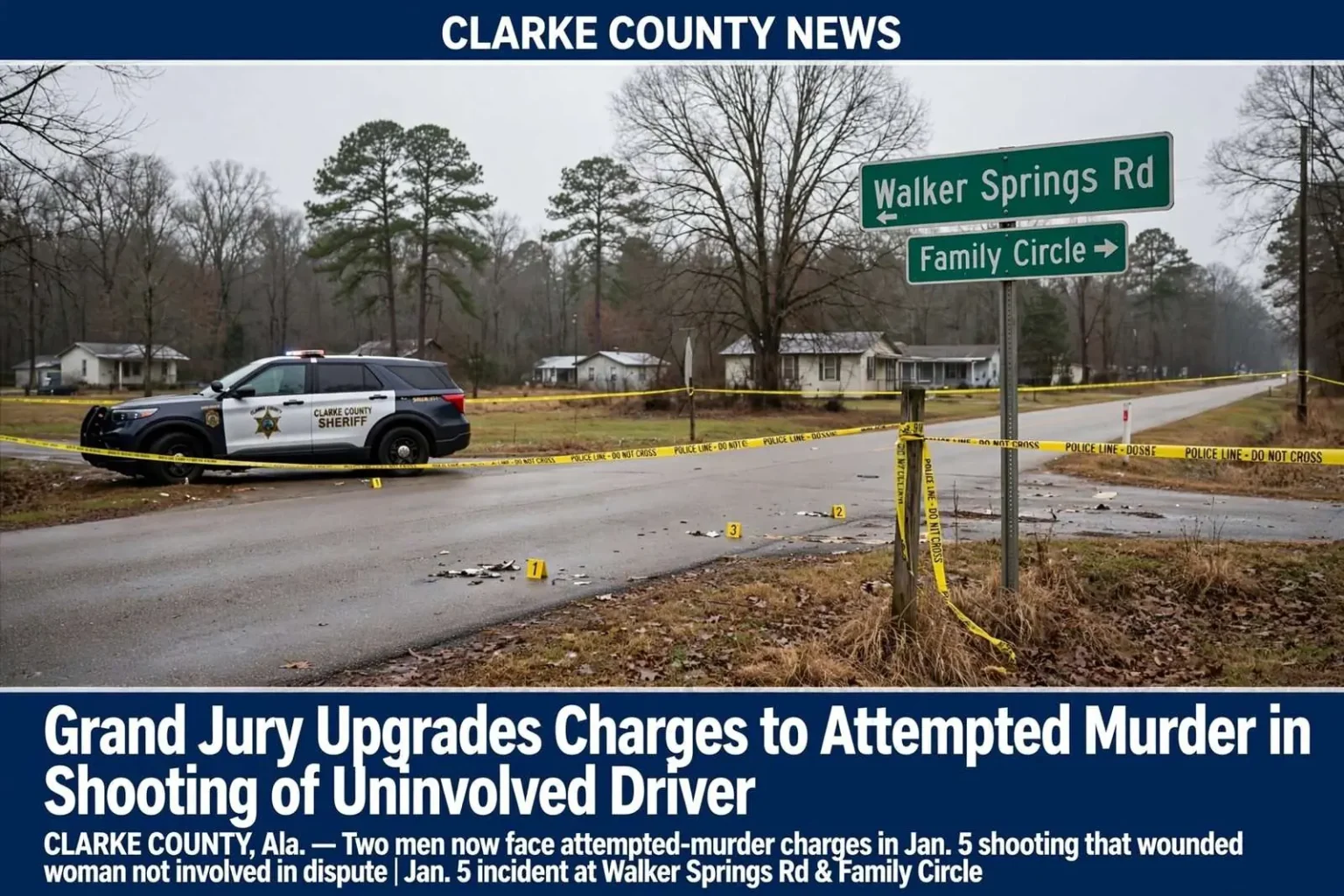
CLARKE COUNTY, Ala. — A grand jury has indicted two Clarke County men on attempted murder charges in connection with a January shooting that wounded a woman investigators say had nothing to do with the dispute. The case began as a pair of first-degree assault arrests, but months of additional evidence gathering persuaded prosecutors to present the matter to a grand jury, which returned the more serious charges this month.
The shooting occurred Jan. 5 at the intersection of Walker Springs Road and Family Circle in the Gainestown community, according to the Clarke County Sheriff’s Office. Investigators say a woman who was driving to work was shot in the leg. Her vehicle was struck by nearly two dozen bullets, a volume of fire that authorities say made clear the danger to anyone on the road that morning.
The arrests and the upgraded charges
Deputies arrested Quenterio Washington, 22, in January and charged him with first-degree assault. Sheriff Dewayne Smith said deputies arrested Jalin Pace, 24, last month on the same charge. Both men remained charged with first-degree assault until court documents filed this month showed the grand jury had upgraded both cases to attempted murder.
The upgrade reflects how charges evolve in Alabama’s criminal justice system. An arrest charge is filed quickly, based on what deputies can establish in the hours and days after an incident. A grand jury indictment, by contrast, comes after investigators have had time to complete forensic work, pull phone records and re-interview witnesses — and after prosecutors have presented that fuller picture to a panel of local citizens who decide whether the evidence supports the charge.
Why the charge changed
Sheriff Smith said the upgraded indictment followed months of continued evidence gathering. “On attempted murder, you have to have intent and a couple of other elements,” Smith said. “When it’s presented to the grand jury, sometimes we have more evidence than what we had when we made the initial arrest. But we’re not going to change it until it goes to the grand jury. But let’s say we charge you with one thing when we arrested you, but we still don’t quit gathering evidence. So sometimes in these cases, we have a lot more evidence by the time it gets to the grand jury. So, when it’s presented, it meets enough elements to a higher charge.”
Smith’s explanation describes a common progression in Alabama criminal cases. Under state law, first-degree assault generally requires that a person intentionally cause serious physical injury to another, while attempted murder requires proof that the defendant intended to kill. The distinction turns on intent, and establishing intent often depends on evidence that is not available on the day of the arrest — ballistic comparisons, digital records and testimony assembled over weeks and months.
In rural counties like Clarke, where the sheriff’s office is the primary investigating agency, that work is done by a small detective staff working with the district attorney’s office and the Alabama Department of Forensic Sciences. Cases move at the pace of that evidence, not the pace of the arrest, which is why several months can pass between an initial charge and a grand jury presentation.
The wrong vehicle
Investigators say the woman was not the intended target. Washington and Pace were looking for someone else who drove a similar vehicle, according to the sheriff’s office, and the woman happened to be behind the wheel of a car that matched the description when the gunfire started. She was wounded in the leg but, authorities say, her injuries were not life-threatening.
The randomness of the episode is a large part of what made the case significant locally. Gainestown is a small community in the southern part of Clarke County, sitting near the Alabama River, where residential streets intersect with the rural corridors that connect the river communities to Grove Hill and the rest of the county seat area. Walker Springs Road is one of those corridors, and the intersection with Family Circle is residential rather than commercial — the kind of stretch where morning traffic is thin and a passing car is conspicuous.
According to investigators, bullets recovered at the scene matched the caliber of a firearm owned by Pace, and records show his cell phone data placed him in the area at the time of the shooting. Those two strands of evidence — the ballistic comparison and the location data — are the sort of material that typically accumulates after an initial arrest and that prosecutors weigh when deciding what charge to present to a grand jury.
How grand juries work in Alabama
In Alabama, felony cases bound over from district court go to a grand jury, which hears evidence presented by the district attorney and decides whether probable cause exists to indict. The proceedings are one-sided by design — the defense does not participate — and jurors can indict on the charge presented, a lesser charge, or no charge at all. When a grand jury returns a charge more serious than the one filed at arrest, it is usually because the evidence presented supports the higher offense’s elements.
That is what Smith described in this case. The initial assault charges reflected what deputies could establish at the scene and in the days immediately after. By the time the case reached the grand jury, the additional evidence — the ballistics, the phone records, the completed witness interviews — supported the attempted murder charges, which carry substantially more prison exposure upon conviction than assault.
Both men are presumed innocent, and the indictments move the cases into Clarke County Circuit Court, where felony trials are held. The circuit court process, from arraignment through potential trial, typically takes many more months, and plea negotiations in cases like this are common before a trial date arrives.
A sheriff’s broader concern
Smith framed the case as an example of young people making decisions driven by emotion, and described efforts to intervene earlier. “We’re trying to implement some leadership programs, based off the leadership traits and principles inside the schools, even in jail,” Smith said. “We have been making good progress with this. We’ve actually had inmates that have gone out and shared testimonies, and crusades that we had up here a few months ago. We’ve had inmates that go and help me in talking into the schools about trying to get the kids to make smarter decisions, not end up in jail. Don’t base your decisions off of emotions and a split second can not only cost you, but it can cost others. And, oh, by the way, there’s innocent people that get caught in the crossfires when we don’t make good decisions on that.”
The sheriff’s comments reflect a wider conversation in rural Alabama counties about juvenile outreach and detention. County jails across the state have in recent years hosted faith-based programs, reentry initiatives and mentoring efforts that bring inmates before school groups to describe the consequences of their choices. Clarke County, with a population of roughly 23,000 spread across Grove Hill, Jackson and Thomasville and the smaller river communities, has fewer institutional buffers than a metro area — fewer after-school programs, fewer diversion resources — which is part of why the sheriff’s office has leaned on the schools and the jail itself as venues for prevention.
Smith’s point about split-second decisions and bystanders is also a recognition of how shootings like the Jan. 5 incident unfold. The victim in this case was, by every account, an ordinary commuter on her way to work. She was shot because her car resembled another car, on a road she took routinely. In rural areas, where response times are longer and there are fewer witnesses, indiscriminate gunfire on a public road endures as one of the more dangerous forms of a dispute — a point prosecutors are expected to emphasize as the attempted murder cases proceed.
What’s next
Court records show Pace and Washington are scheduled to return to court in December. Until then, both remain in the custody arrangements set after their indictments, and the discovery process — the exchange of evidence between prosecutors and defense attorneys — will continue.
An indictment is not a finding of guilt, and both men are presumed innocent unless and until convicted. The attempted murder charges will have to be proven to a jury beyond a reasonable doubt, with the intent element at the center of any trial.
For the community in Gainestown, the resolution of the case will not undo the morning of Jan. 5, when a woman driving to work was caught in gunfire meant for someone else. But the upgraded charges, and the evidence that produced them, are the system’s answer to what happened on Walker Springs Road — and a signal, county officials say, that cases involving uninvolved victims will be pursued at the level the conduct deserves.
The case also serves as a reminder to drivers across Clarke County and the wider region that disputes between individuals rarely stay contained to the people involved. When guns are involved, the sheriff’s office says, the person harmed is as often a stranger as an enemy — a lesson this case illustrates as clearly as any.