
Clarke-Washington EMC Warns Members of Overpayment Refund Phone Scam
Clarke-Washington EMC is warning members about scam calls falsely claiming an account overpayment and asking for banking information, urging anyone contacted to hang up and call the co-op directly.
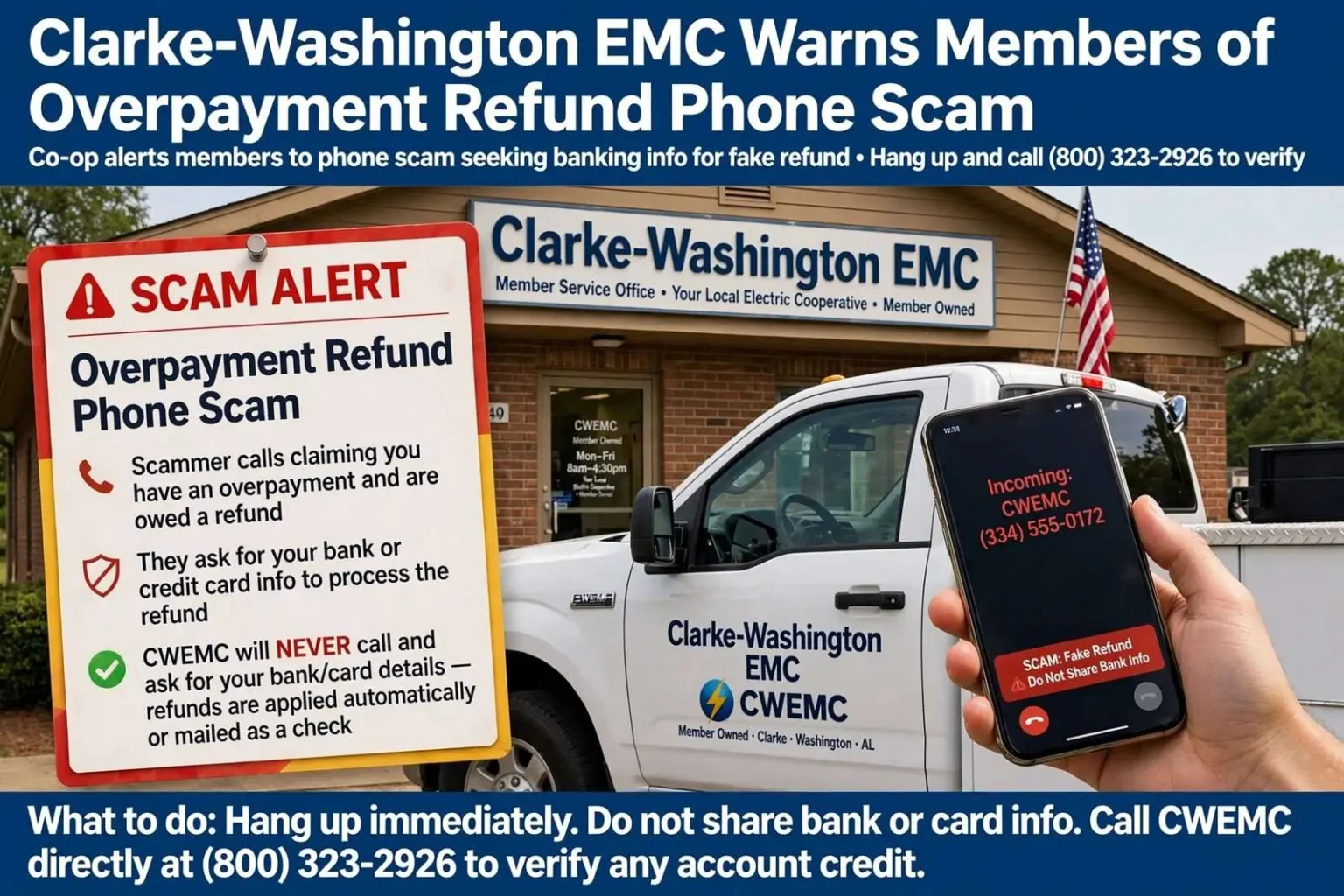
Clarke-Washington EMC is alerting its members to a phone scam in which callers falsely claim a member has overpaid their electric bill and try to collect banking information to issue a fake refund.
According to the cooperative, the scammers tell members they are owed money back on their account and ask for a credit card number or checking account information so the “overpayment” can be credited back.
CWEMC said the request itself is a red flag: if a member’s account genuinely has a credit balance, the cooperative simply leaves that credit in place on the account rather than calling to solicit payment information over the phone.
How the Scam Works
Scams built around fake utility refunds or overpayments are a long-running tactic nationally, often relying on caller ID spoofing to make the call appear to come from a legitimate local number.
Scammers create a sense of urgency, telling the target they need to act quickly to receive money that is supposedly owed to them, then pivot to asking for sensitive financial details such as a debit or credit card number, a bank routing and account number, or remote access to a computer or banking app.
Legitimate utilities, including electric cooperatives like CWEMC, do not need a customer’s card or bank account number to apply a credit that already exists on file.
Refunds tied to an actual account credit are typically handled automatically, applied to a future bill, or mailed as a check — not collected over the phone through an unsolicited call.
What CWEMC Recommends
Clarke-Washington EMC is urging members who receive a suspicious call to hang up immediately rather than engage with the caller, and to independently contact the cooperative using a number they know is correct, such as the one printed on a bill, rather than calling back a number left by the caller.
Members who believe they have received one of these scam calls, or who want to verify the status of their account, are asked to call CWEMC directly at (800) 323-2926.
The warning comes as utility impostor scams continue to rank among the most common frauds reported nationwide, with the Federal Trade Commission and state attorneys general logging thousands of complaints annually. The overpayment variant is a twist on the older disconnection scam, in which callers threaten to shut off power unless an immediate payment is made. Both exploit the same vulnerability: customers’ genuine fear of losing electricity and their trust in a caller who knows their utility’s name.
Caller ID spoofing has made the problem harder for consumers to navigate. Modern phone systems can display any number the caller chooses, which means a call showing the cooperative’s actual local number may still originate from a scammer overseas or across the country. That reality has pushed utilities and regulators to repeat the same message: the caller ID is not proof of identity.
Why Co-ops Are Frequent Targets
Electric cooperatives like Clarke-Washington EMC serve rural and small-town members across southwest Alabama — Clarke, Washington and surrounding counties — where many households live on fixed incomes and manage accounts closely. Scammers tailor their scripts to that reality, presenting themselves as helpful rather than threatening in the overpayment variant: the member is owed money, and all the caller needs is the account details to release it.
The cooperative structure itself makes co-ops a credible-sounding target. Members are also owners, bills flow through the co-op’s own customer service, and many members have dealt with the same office staff for years. A caller who says they are “with the EMC” starts with a measure of trust that a call claiming to represent a large investor-owned utility might not receive.
Cooperatives across Alabama have run periodic warnings about scam waves, and the tactics evolve: some versions demand prepaid debit cards or gift cards for fake balances, some push members to download remote-access software to “process a refund,” and the overpayment script reverses the usual threat into a promise. The common thread is the request for financial credentials or payments outside the co-op’s normal channels.
CWEMC’s advice mirrors the guidance consumer protection agencies give for any unsolicited financial call: never verify personal or account information for a caller, no matter how plausible the story, and initiate contact independently through the number on a bill or the co-op’s published office lines.
Spotting the Red Flags
The overpayment scam carries several tells that members can learn to recognize. The caller initiates contact — no utility calls a member out of the blue to hand out money. The caller asks for financial details — no refund requires the member’s card or bank account number to process. And the request comes with pressure — a deadline, an expiration, a limited window to claim the credit.
Members who pause on any of those points have the advantage. A real account credit can wait indefinitely; it sits on the account until it is applied to a future bill or refunded through the co-op’s standard procedures. Nothing about a legitimate credit requires immediate action by phone, and nothing about it requires the member to prove their banking information to a stranger.
Remote-access requests deserve special suspicion. No utility needs to see a member’s screen or operate their computer to process any transaction, and callers who coach targets to install software or open a banking app while on the line are executing one of the most damaging fraud patterns — one that can extend well beyond a single utility account to the victim’s entire financial life.
What to Do After a Suspicious Call
Members who have already shared information with a scammer are urged to act quickly. Contacting the bank or card issuer to flag the account, placing fraud alerts, and reporting the call to law enforcement and the FTC’s complaint portal are the standard first steps, and speed matters in stopping unauthorized transfers.
Members who merely received a call can still help the wider effort by reporting it to the cooperative, which tracks the numbers and scripts being used and shares patterns with other co-ops and investigators. Reports from members have repeatedly been the first signal of an active scam wave in a service territory.
The cooperative’s member-service offices handle account questions through published local numbers and its toll-free line, and staff can confirm in moments whether any credit exists on an account. For a scam built on the promise of money owed, that simple verification call defeats the entire scheme.
Clarke-Washington EMC’s warning will reach members through billing inserts, social media and local media, continuing the cooperative sector’s running campaign against impostor fraud. The message officials most want members to internalize is simple: a real refund never needs your card number over the phone — and anyone who asks for one is not calling from your electric co-op.
The Broader Scam Landscape in Alabama
Alabama consumers have faced a steady run of impostor scams in recent years, with utilities, the IRS, tech support and grandchild emergencies among the most common scripts. The state Attorney General’s Consumer Interest Division and county sheriffs’ offices periodically warn residents when a particular scheme surges in their area, and utility impostors reliably return several times a year, especially during summer and winter when extreme temperatures make the threat of disconnection feel more urgent.
The prepaid card era gave these scams their most damaging phase, because cards bought at retail were effectively untraceable cash. Payment apps and peer-to-peer transfers have since been folded into the scripts, and victims are sometimes walked through multiple payment methods in a single call until one succeeds. The overpayment version skips the payment step and goes straight for account credentials — a quieter approach that can be more dangerous precisely because the victim believes they are receiving money rather than paying it.
Banks and card issuers have added friction — verification texts, transaction holds — but the first line of defense remains the consumer who recognizes the script. Consumer educators teach the same three-question test for unsolicited callers: Who is calling, how can I verify that independently, and why would they need information I have never had to give my utility before?
For Clarke-Washington EMC’s members, the answers are built into the warning. The cooperative already knows its members’ accounts, already applies credits without phone calls, and already mails checks when refunds are owed. A caller claiming to need what the co-op already has is, by definition, not the co-op.
Protecting Older Family Members
Fixed-income and older households are disproportionately targeted by refund and utility scams, and consumer advocates encourage families to talk through the scripts before the phone rings. A simple household rule — no financial information to any inbound caller, ever — closes most of the avenues these scams exploit, and a second rule, hang up and call the utility back on the bill’s number, turns every attempt into a dead end.
Community organizations and senior centers across southwest Alabama have incorporated scam awareness into regular programming, and cooperatives often supply speakers and materials for those sessions. The investment reflects the stakes: a drained checking account is not merely an inconvenience for a household on a fixed income, and recovery of funds transferred to scammers is rare.
CWEMC’s member notice closes the loop on this wave, but the cooperative’s larger point stands beyond the current script: scammers change stories the way weather changes along the Gulf Coast, and the defense that works against every version is the same — verify independently, share nothing with inbound callers, and report every attempt so the next member gets the warning before the phone rings.


