Closing Arguments Wrap in Mobile Trial Over Fatal Crash That Killed Runner Training for Ironman
Closing arguments concluded Friday in the Mobile County trial of a man accused of causing the 2022 crash that killed runner and postal worker Victor Birch, sending the case to the jury.
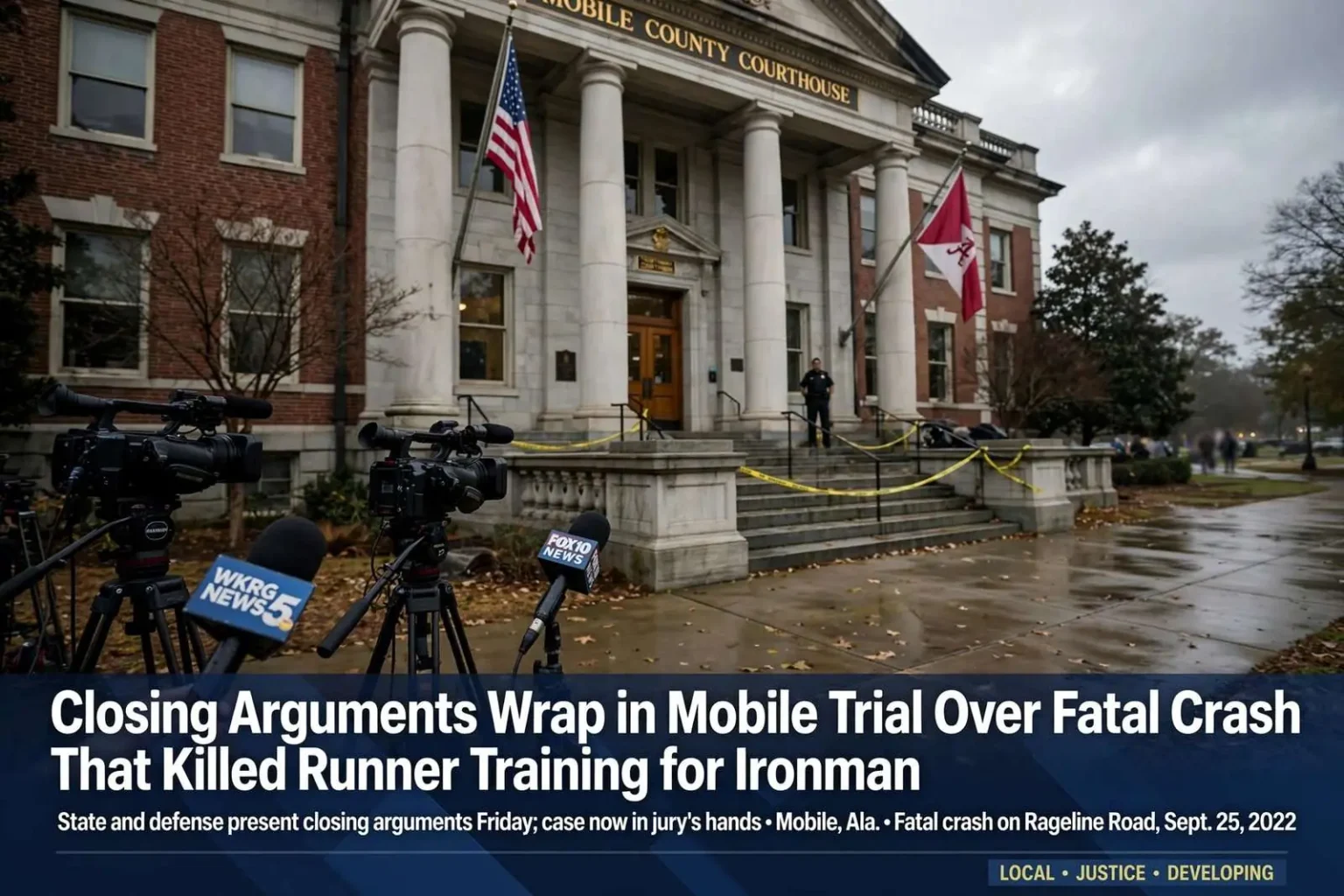
State and defense attorneys presented closing arguments Friday in the reckless murder trial of a Mobile County man accused of causing a crash that killed Victor Birch, a well-known local runner and postal worker, in 2022. The case has now gone to the jury.
Prosecutors say that on Sept. 25, 2022, Birch was traveling on Rageline Road training for an upcoming Ironman competition when, around 6:22 a.m., 23-year-old Aubrey Pate’s vehicle crossed the centerline and collided with Birch’s vehicle, killing Birch on impact and leaving Pate with minor head injuries. Pate has not been convicted and is presumed innocent unless proven guilty.
Former Mobile County District Attorney Ashley Rich, representing the state, told jurors that plasma samples taken from Pate at the hospital indicated he was under the influence of marijuana and alcohol at the time of the crash, with a blood alcohol level of around 0.021 percent — below the legal limit of 0.08 for driving but, prosecutors argued, evidence Pate had been drinking. Rich pointed to medical records, body camera footage and a crash-scene reconstruction to argue Pate was knowingly impaired when he crossed into oncoming traffic.
Body camera video played during the trial showed a Mobile police officer making a comment that Rich said referred to Pate being “high as hell.” Defense attorney Jeff Deen, representing Pate, argued the officer was actually saying Pate was “by himself,” and played a slowed-down version of the recording during his closing argument. Rich maintained that even at a slower speed, the recording made clear the officer believed Pate was impaired, and noted that a responding medic reported smelling ethanol while treating Pate at the scene.
When asked by police if he had been drinking, Pate acknowledged that he had but said he did not know how much, according to testimony. Deen urged jurors to discount that statement, arguing Pate was suffering from a head injury at the time and could not recall the crash or the events leading up to it. A reconstruction video presented by a state expert showed Pate’s vehicle swerving into the opposite lane for roughly the length of a football field and a half before the collision.
Deen also pointed to crash data indicating both drivers were speeding at the time, with Birch traveling around 62 mph and Pate around 69 mph. Rich asked the jury to find Pate guilty of extreme indifference, or “depraved heart,” murder in Birch’s death.
How Alabama defines reckless murder
The charge Pate faces, sometimes called reckless or “depraved heart” murder, does not require proof of intent to kill. Under Alabama law, a person commits murder if, under circumstances showing extreme indifference to human life, he recklessly engages in conduct that creates a grave risk of death to another person and thereby causes someone’s death. Murder is a Class A felony in Alabama, punishable by 10 to 99 years or life in prison.
Alabama’s 0.08 blood alcohol limit applies to drivers 21 and older, but a driver can also be found impaired by alcohol, drugs or a combination of substances regardless of a specific test number. The jury’s verdict must be unanimous.