Coast Guard Helicopter Hoists Man and Dog to Safety as Hurricane Ida Nears Gulf Coast
A Coast Guard helicopter crew transiting to avoid Hurricane Ida hoisted a grounded boater and his dog to safety south of Dauphin Island.
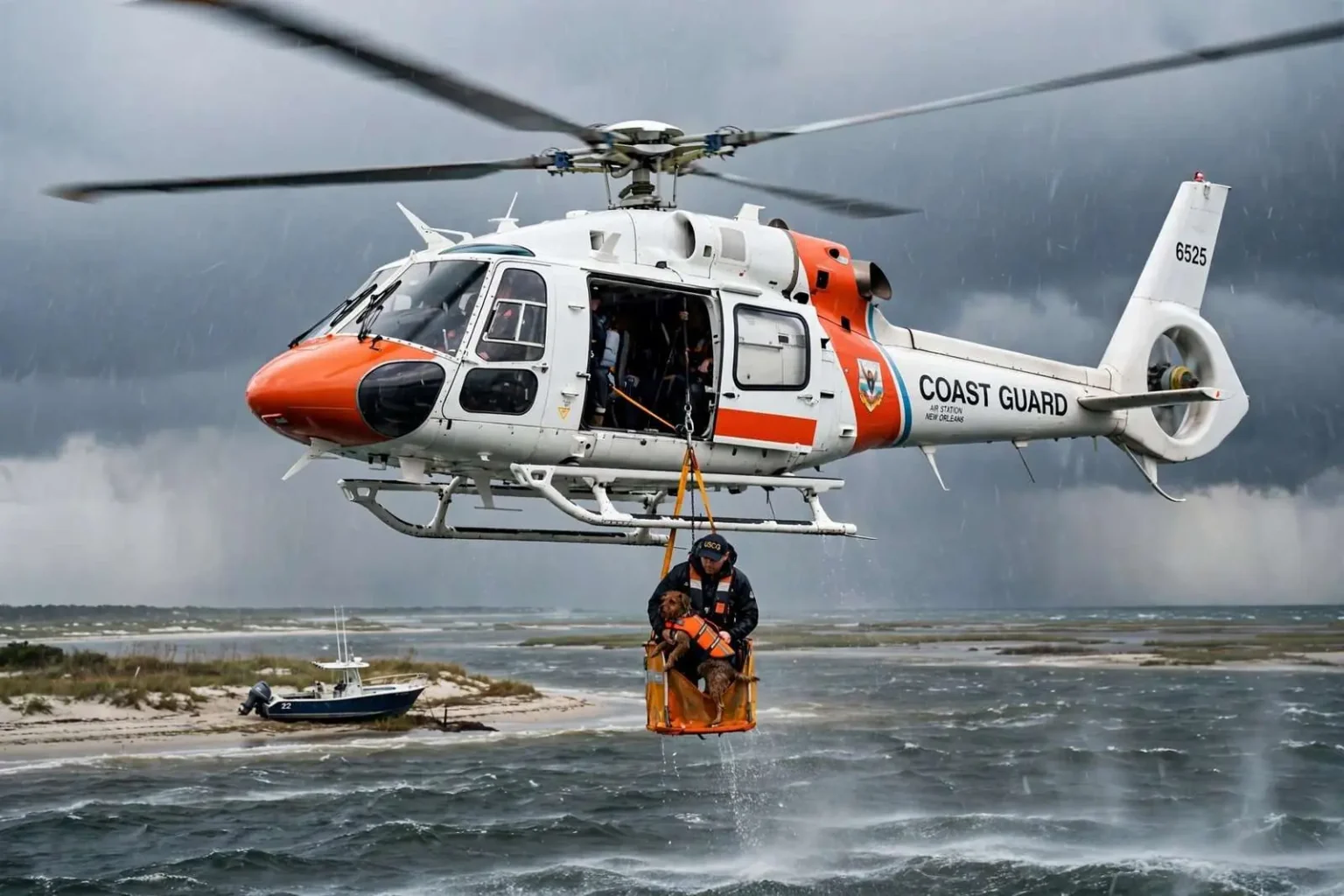
A boater and his dog were airlifted to safety by a Coast Guard helicopter crew south of Dauphin Island late last month, as the aircrew was already transiting to avoid Hurricane Ida.
The rescue unfolded on Aug. 29 when the MH-65 Dolphin helicopter crew from Air Station New Orleans, en route to a safer location ahead of the approaching storm, received a distress call from a vessel that had run hard aground. The aircrew diverted to the scene and hoisted both the man and his dog aboard the helicopter.
They were transported to safety with no reported injuries. The Coast Guard confirmed the rescue via its official Facebook page, noting the aircrew had been in transit for Hurricane Ida avoidance when the call came in.
The episode compressed into a single flight the paradox that defines Gulf Coast storm seasons: the same crews positioning themselves out of a hurricane’s path were, in the same hour, the region’s best hope for a mariner who stayed in it too long.
A Rescue on a Storm-Prep Timeline
Air Station New Orleans sits on the shore of Lake Pontchartrain, directly in the territory a major hurricane threatens. As Ida strengthened in the Gulf and took aim at the Louisiana coast, the station followed the playbook Coast Guard aviators have refined through decades of Gulf storms: fly the aircraft out before the weather arrives, relocating crews and machines to airfields beyond the projected impact zone so that search and rescue capability survives the storm.
That transit put the Dolphin helicopter over the waters south of Dauphin Island when the distress call arrived. Running hard aground is among the most disorienting emergencies a boater can face — the vessel stops answering, waves push it further onto shoals or a barrier island, and the only way off is a helicopter basket or a boat crew willing to approach a surf line.
For the Dolphin crew, the hoist was routine in technique and extraordinary in timing. The helicopter was carrying no storm-delay margin: every minute spent at the scene delayed its own escape from Ida’s reach. The crew weighed the call, diverted, completed the hoist and resumed the flight out with the boater, his dog and their own mission intact.
Why Transiting Aircraft Stay Ready
As tropical systems approach the Gulf Coast, Coast Guard air stations routinely reposition aircraft to airfields outside the projected impact zone. Those repositioning flights remain fully mission-capable, meaning crews can respond to emergencies even while moving to safety themselves.
The practice exists because grounding the fleet is not an option the Coast Guard can accept. A hurricane’s aftermath generates its own emergencies — vessels sunk at their moorings, mariners injured, waterways blocked — and a station that flies its helicopters to safety in pieces, without crews or fuel plans, cannot answer any of it. Repositioning with full capability means the aircraft that leaves New Orleans ahead of a storm can turn around and work the rescue circuit the moment the weather allows.
The MH-65 Dolphin is the Coast Guard’s workhorse for exactly this kind of mission. Compact enough for ship operations and fast enough for coastal work, the twin-engine helicopter carries a crew of pilot, copilot, flight mechanic and rescue swimmer, and its hoist can pluck a person from a deck, a surf line or a flooded neighborhood in minutes.
South of Dauphin Island, the geography added urgency. The barrier island sits at the mouth of Mobile Bay, edged by shoals and open Gulf water that turn hostile quickly in the building winds and seas ahead of a tropical system. A grounded vessel there is exposed from every direction, and each hour of building weather shrinks the window in which any rescue can be attempted at all.
The Coast Guard’s Standing Warning
The incident also illustrates a point the Coast Guard emphasizes every hurricane season: boaters should stay well clear of the water once a tropical system enters the Gulf. Seas build quickly, navigation aids can be displaced, and rescue resources are simultaneously stretched thin and repositioning.
The math behind the warning is unforgiving. When a storm enters the Gulf, every offshore asset — cutters, boats, aircraft — has two jobs instead of one: prepare to survive and remain ready to save. Aircraft are flying out, boats are being hauled or secured, and stations are sandbagging and boarding up. A mariner who calls for help in that window reaches a system operating at a fraction of its usual strength, positioned to leave rather than to respond.
Ida made that calculus vivid. The storm would go on to strike the Louisiana coast as one of the strongest hurricanes to hit the state on record, and in the hours before landfall the Gulf’s rescue network was largely in motion — moving assets and people inland, exactly when a distress call came from a grounded vessel south of Dauphin Island.
Marine weather forecasters note that the window closes earlier than most boaters expect. Conditions offshore and in the passes deteriorate well before the storm arrives, as outer bands push building seas and squalls across the approaches to Mobile Bay and the barrier islands. A departure that feels safe on a sunny afternoon can strand a vessel within hours.
Dauphin Island and the Northern Gulf’s Rescue Network
The waters south of Dauphin Island sit within one of the busiest search and rescue regions on the Gulf Coast. The barrier island guards the entrance to Mobile Bay, where commercial shipping, recreational fishing fleets and pleasure craft all converge, and its shoals — shallow, shifting and deceptively placid in fair weather — have grounded vessels for as long as boats have worked the approaches.
Rescue coverage in the region is layered. Coast Guard stations and aircraft from the Gulf Coast’s air stations share the workload with county marine patrols, tow services and good Samaritan vessels, and the system works well in ordinary conditions. A tropical system compresses that network: patrol boats come out of the water, aircraft fly inland, and the only remaining response option for many calls is a helicopter passing through.
That is precisely what happened over Dauphin Island. The distress call reached a crew that happened to be in the air at the edge of the storm’s reach — a coincidence that was not really a coincidence at all, but the intended result of a policy that keeps transiting aircraft ready to work.
What Boaters Should Take From It
The Coast Guard’s message to mariners during hurricane season is blunt: secure your vessel early, monitor the forecasts, and stay off the water once a system enters the Gulf. Boat owners are urged to haul out or double their moorings, remove loose gear, and file float plans when they must be on the water — the kind of preparation that turns an emergency into an inconvenience.
For mariners caught out despite those warnings, the protocol is to contact the Coast Guard by radio on channel 16, the international hailing and distress frequency, and to stay with the vessel if it is safe to do so. A grounded boat is easier to find than people in the water, and the rescuer’s first preference is always to bring the crew off the vessel rather than search for them in it.
The boater rescued south of Dauphin Island followed the course that ends well: he called for help while there was still help to send, and he and his dog came off the vessel into the hoist of a crew that was, by its own mission plan, on its way out of the storm.
For the Dolphin crew from Air Station New Orleans, the flight out with two extra passengers ended where such flights end — at a quiet airfield beyond the storm’s reach, the helicopter secured, the crew and their unplanned passengers safe on the ground while Ida finished its approach to the coast. The next flight they would fly would be back toward the destruction, once the weather cleared. That, too, is part of the same plan: the Coast Guard leaves to come back.
Coast Guard officials also use rescues like this one to remind the boating public that storms generate emergencies far from their centers. A system still hundreds of miles offshore can build seas along the entire northern Gulf, and vessels running inlets or crossing bars face conditions that no fair-weather operator expects. The safest departure is the one made days early — or not made at all.
The image of a dog in a rescue basket has become a familiar one along the Gulf Coast, where mariners frequently ride out with pets aboard, and crews train for them as they train for any survivor. On the day the boater and his dog came off the grounded vessel south of Dauphin Island, the training and the storm-prep plan happened to converge — and both man and dog came through without a scratch.