Coast Guard Helicopter Rescues Overdue Boater Off Dauphin Island After Personal Watercraft Capsizes
A personal watercraft operator who failed to return from a fishing trip was located by a Coast Guard helicopter two miles south of Dauphin Island.
A Father’s Day fishing trip on a personal watercraft turned into a rescue mission when the operator failed to return as expected, prompting a multi-asset Coast Guard search that ended with the boater hoisted from the water by helicopter.
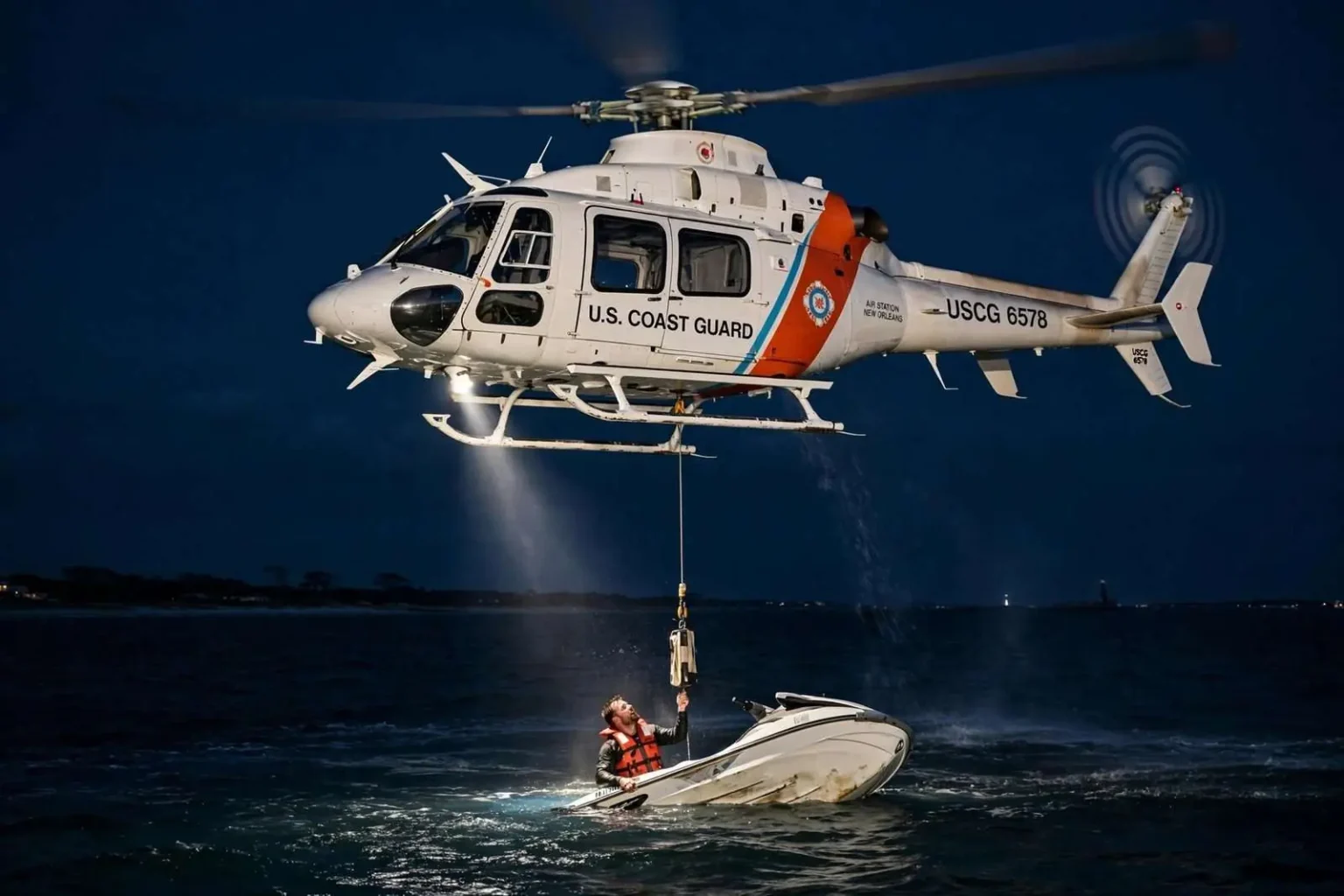
Baldwin County 911 alerted Coast Guard Sector Mobile around 8:50 p.m. Sunday, reporting that a man had left Fort Morgan on a personal watercraft bound for Dauphin Island and had not been heard from in roughly three hours. An MH-65 Dolphin helicopter crew from Air Station New Orleans launched on the search and spotted the missing man about two miles south of Dauphin Island.
The aircrew noticed a white object on the water that was not breaking — later identified as the capsized personal watercraft — and located the operator nearby. The helicopter crew hoisted the man aboard and flew him to Jack Edwards National Airport in Gulf Shores. He was evaluated and released with no medical concerns.
The rescue brought together units from across the Coast Guard’s Gulf Coast network. Sector Mobile, headquartered on Mobile Bay, coordinates search and rescue across a section of the northern Gulf that includes the Alabama coastline and the waters around Dauphin Island, while aviation assets like the New Orleans-based Dolphin helicopter can cover that same territory from the air in a fraction of the time a boat crew would need.
The crossing that went wrong
The route the man attempted is one experienced local boaters respect. The open water between Fort Morgan, at the western end of the Fort Morgan peninsula, and Dauphin Island spans the mouth of Mobile Bay, where currents from the bay’s ship channel meet the Gulf and conditions can change quickly with wind and tide. On a personal watercraft — a small, low-profile craft designed for protected waters — the crossing leaves little margin for error.
Personal watercraft are among the most capable small boats in calm conditions and among the most vulnerable in rough ones. A craft that capsizes or floods in open water offers its rider no shelter, and a rider in the water sits low enough to the surface that searchers can pass within sight and miss them. After dark, the challenge multiplies: without lights, a person in the water is nearly invisible except from directly overhead or at close range.
The overdue report came from the man’s family, whose timeline of his departure gave rescuers a search area to work from. That kind of detail — where someone left, where they said they were going, when they were expected — is what turns a search of open water into a search of a manageable box on a chart.
Life jacket and staying with the craft credited with survival
The boater’s decision to remain with his capsized watercraft and his use of a life jacket gave rescuers a stationary reference point and kept him afloat until help arrived. Coast Guard officials say that combination — wearing a life jacket and staying with the vessel — is the single most effective step a recreational boater can take to improve the odds of being found alive after a capsize.
“The Coast Guard recommends that everyone wear life jackets when they are using small recreational crafts,” said Cmdr. Kara Lavin, head of the Sector Mobile response department. “This case could have been significantly worse if the survivor was not wearing a life jacket. It is also critical to know that if someone’s vessel capsizes they should stay as close to the vessel as possible so they can be more easily discovered and assisted by rescuers.”
The reasoning behind the advice is practical. A capsized boat, even a small one, floats and presents a much larger visual target than a swimmer, and it holds position far better than a person fighting current. A life jacket extends survival time from minutes to hours by removing the need to tread water, and on Gulf waters in summer, where dehydration and exhaustion set in quickly, that difference decides outcomes.
Swimmers who strike out for shore often make searches harder, moving away from the last known position of the craft and arriving at points rescuers cannot predict. Search planners build their patterns around where the vessel was when things went wrong; a survivor who stays there is found first.
How the search unfolded
The response to an overdue boater follows a pattern designed to compress time. A report to 911 is passed to the Sector Mobile command center, which verifies details, assigns a case number and launches the assets best matched to the search area — surface boats for close-in work, helicopters for wide sweeps, and crews from the nearest stations. In this case, the Dolphin helicopter’s range and speed made it the lead asset for water south of Dauphin Island.
The MH-65 Dolphin is the Coast Guard’s workhorse rescue helicopter, crewed to fly search patterns at low altitude and equipped with hoists that lift survivors directly from the water. Night searches add difficulty, but the helicopter’s sensors and searchlights are built for them, and much of the Coast Guard’s rescue flying happens after sunset, when overdue boaters are first reported.
Once the aircrew spotted the capsized craft and the man beside it, the hoist took minutes: a rescue swimmer or rescue device is lowered, the survivor is secured and both are brought into the helicopter. From there, the crew selects the nearest suitable landing zone for medical handoff — in this case Jack Edwards National Airport in Gulf Shores, where awaiting EMS could evaluate the survivor.
His release without medical concerns closed out a rescue that could easily have ended differently. Water temperatures, currents and darkness each had the potential to turn a capsize into a fatality, and rescuers and family members alike credited the outcome to the survival decisions made in the water.
The float plan habit
Cmdr. Lavin also urged anyone heading out on the water to file a float plan with a friend or family member, so that overdue reports can be made as early as possible. A float plan is simple: a written note of who is going, on what vessel, leaving from where, bound for where and expected back when, left with someone reliable before departure.
The document does nothing while a trip goes well. Its value comes when a trip does not — because the person holding it knows when to worry and can describe the vessel, the route and the timeline to 911 and the Coast Guard without guessing. Search and rescue officials say that in cases like this one, the difference between an alert raised on time and one raised a day later is often the difference between a rescue and a recovery.
For small craft, the habits matter even more. Personal watercraft, kayaks and small fishing boats sit low to the water, offer no cabin for shelter and are frequently operated alone, and their operators sometimes treat a short trip as though it carries no risk. The waters around the mouth of Mobile Bay — popular with anglers and paddlers on both sides — are open to the Gulf, and conditions there are closer to offshore than to bay conditions when the wind picks up.
A reminder for the season
The rescue landed on Father’s Day, one of the busiest boating weekends of the year along the Alabama coast, when traffic peaks in the bays, passes and Gulf waters from Orange Beach to Dauphin Island. Coast Guard units across the region typically use holiday weekends to remind boaters of the basics: wear the life jacket rather than stowing it, carry communication equipment that works when wet, and tell someone the plan.
For the man rescued, the trip ended with a hoist, a helicopter ride and a clean bill of health — an outcome his life jacket, his decision to stay with his craft and his family’s timely report combined to make possible. For everyone else on the water this season, the Coast Guard’s message from the case is the same one it repeats after every rescue like it: wear the jacket, stay with the boat, and make sure someone on shore knows where you are.
Sector Mobile’s response area makes cases like this one routine in location and anything but in outcome. The sector coordinates rescue operations across the Alabama coast and the approaches to Mobile Bay, working with stations, cutter crews and aviation units from across the Gulf region, and its watchstanders stand behind every mayday and every overdue-boater call that comes in from Baldwin County’s beaches to the Florida line.
Summer is the busy season for that work. Warm water, long days and holiday traffic fill the region’s waterways from May through Labor Day, and the same conditions that draw boaters out — afternoon sea breezes, pop-up storms, crowded launches — produce the capsizings and breakdowns that keep rescue crews flying.
For boaters planning their own crossings of Mobile Bay’s mouth or any other open-water run on a small craft, the rescued man’s case offers a checklist: check the weather before leaving, wear the life jacket the whole trip, carry a waterproof way to call for help, and leave a float plan with someone on shore. None of it costs more than the trip itself, and any one of the four can decide how the day ends.