
Coca-Cola named exclusive beverage partner at Hank Aaron Stadium
Mobile Sports and Entertainment Group named Coca-Cola the exclusive carbonated beverage of Hank Aaron Stadium in a new two-year partnership.
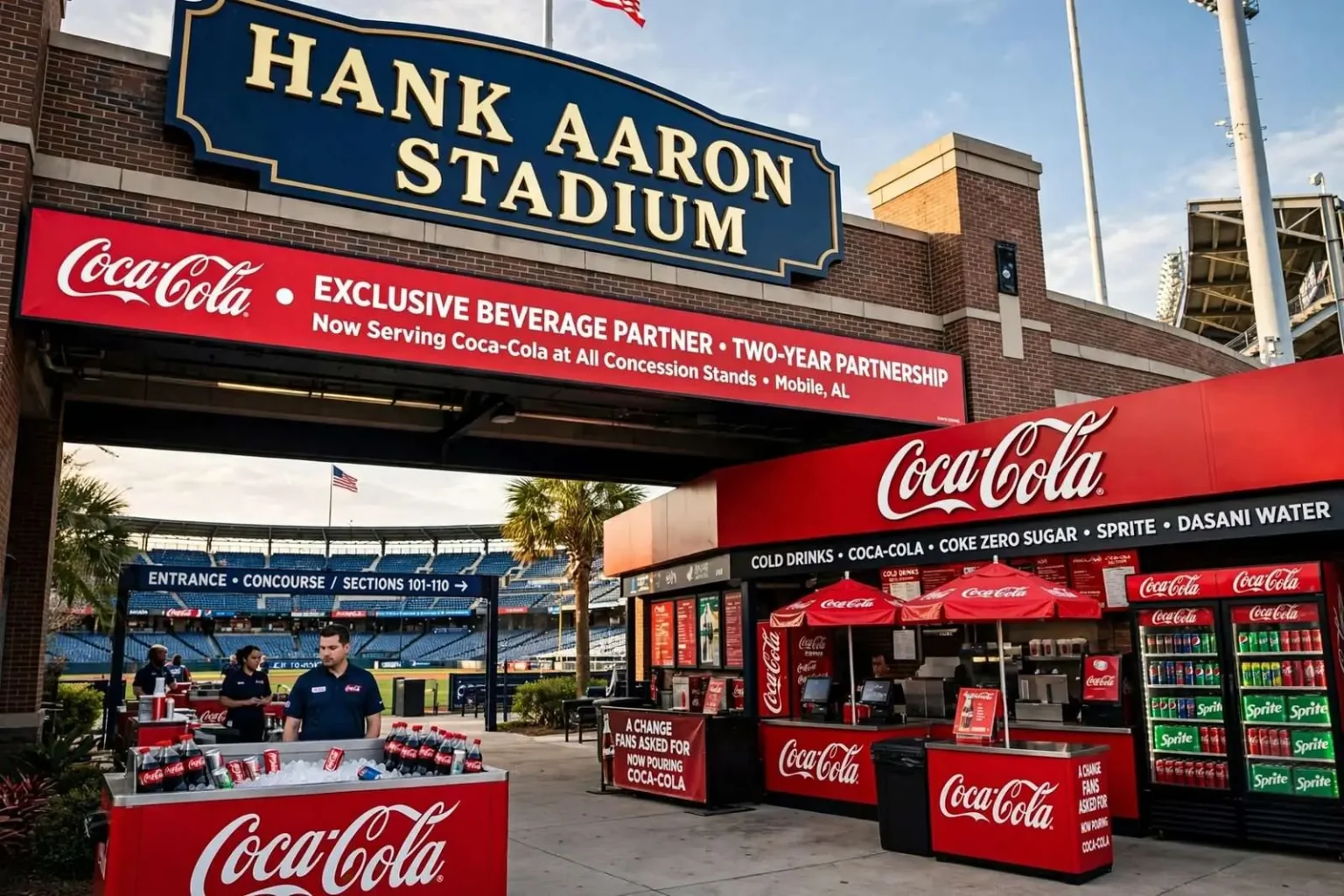
Coca-Cola is coming to the concession stands at Hank Aaron Stadium. Mobile Sports and Entertainment Group announced Wednesday a two-year partnership making Coca-Cola the exclusive carbonated beverage of the Mobile ballpark, a switch from the Pepsi products that had previously been served at the facility. The deal puts one of the country’s most recognizable brands behind the counters of a ballpark reinventing itself as a year-round venue.
“Fans asked if we had plans to bring Coke to the facility or if we would even consider it. Well, we were listening,” said MSEG president Ari Rosenbaum. Beverage partnerships of this kind are among the most visible sponsorships a stadium can carry, touching every ticket holder at the gate. Pouring rights agreements, as they are known in the industry, typically cover not just fountain drinks at the concession stands but coolers in suite areas, branded signage around the concourse and product presence at concerts and special events held at the venue.
A change fans had asked for
The announcement was framed by MSEG as a direct response to customer feedback, with fans having asked whether Coke products might ever be served at the Hank. Concession preferences are a surprisingly passionate corner of the ballpark experience, and brand loyalty runs deep among soft drink drinkers. For a venue trying to build goodwill and repeat attendance in a market dominated by personal habits, aligning the concession stands with what customers actually ask for is a low-cost way to show responsiveness.
The timing mattered too. MSEG announced the Coca-Cola deal on Wednesday, only a day after revealing an agreement to sell Cammie’s Old Dutch Ice Cream at the stadium. Back-to-back announcements of this kind signal a management team working to build out the food and beverage program quickly, in the months before a full schedule of events arrives. Cammie’s is a Mobile institution, a homegrown ice cream company with roots in the city stretching back generations, and pairing a beloved local dessert brand with a national beverage brand gives the concourse a mix of familiar and nostalgic that few minor league markets can match.
The stadium’s new chapter
MSEG took over management of Hank Aaron Stadium last December, a major turning point for the facility. The ballpark had been the home of the Mobile BayBears, the city’s longtime Southern League franchise, but the team relocated to Madison, Alabama, in the Huntsville area, where it now plays as the Rocket City Trash Pandas. The move left Mobile as one of the larger cities in the region without affiliated professional baseball, and it left a modern ballpark sitting largely idle unless someone found new uses for it.
The loss of the BayBears was felt deeply by local fans who had followed affiliated baseball at the stadium since it opened in the late 1990s. Generations of Mobile families had grown up attending BayBears games, and the ballpark bears the name of the city’s most celebrated sports figure, Hank Aaron, the Mobile native whose record-setting career made him one of the most revered players in baseball history. A stadium with that name and that history carries expectations that go well beyond an ordinary venue, and the community watched closely to see whether it would be maintained or allowed to decline.
A schedule built on amateur baseball
The answer MSEG arrived at was to build an event calendar anchored by amateur and youth baseball. Dozens of high school baseball games are scheduled for the Hank in 2020, along with the 16-18-year-old Babe Ruth World Series, a national tournament that will bring teams and families from around the country to Mobile. That kind of slate fills dates on the calendar, puts fans in seats, and gives the stadium a role in the community that is different from but complementary to what the BayBears provided.
Youth and amateur events also change the crowd profile in ways that matter to sponsors and concessionaires. High school games draw students, parents and local businesses connected to the schools, and a national tournament like the Babe Ruth World Series brings out-of-town visitors who spend money across Mobile restaurants, hotels and attractions during their stay. For a beverage partner, a summer full of youth tournaments means long stretches of steady attendance rather than the boom-and-bust of a professional schedule, and exposure to families who may become long-term customers.
What pouring rights mean for a venue
For the stadium itself, an exclusive beverage deal is more than a supply contract. Companies that win pouring rights typically pay for the rights and then invest further in signage, promotional nights and co-marketing, which means the venue gains both revenue and a partner with an interest in driving attendance. In a year when the Hank is trying to prove it can thrive without a professional tenant, that kind of partner support matters, and the visible rebranding of the concourse is itself a signal to the community that the facility is open for business.
The deal also gives concession operators a single product line to stock, which simplifies ordering and storage in a stadium kitchen. Facilities that serve multiple competing brands end up dedicating cooler space and fountain lines to products that may sell unevenly, while an exclusive arrangement concentrates volume in one system. Fans rarely think about the logistics, but they notice the results when the lines move faster and the drinks are cold.
Mobile’s baseball legacy
Any conversation about baseball in Mobile eventually comes back to the city’s astonishing history of producing major league talent. Mobile has sent an extraordinary number of players to the big leagues for a city of its size, including Hank Aaron, Willie McCovey, Billy Williams, Satchel Paige and Ozzie Smith, a lineage that has led baseball writers to call the city one of the most productive talent pipelines in the sport’s history. The ballpark on the city’s west side carries Aaron’s name specifically, honoring the homegrown superstar who broke Babe Ruth’s career home run record.
Hosting a Babe Ruth World Series at a stadium named for Aaron, in a city with that heritage, ties the facility’s new identity directly to the game’s past and future. Youth players coming to Mobile for a national tournament get to compete in a full-size professional ballpark, and local families get to watch high-level amateur baseball without traveling. Those events also keep the stadium in the public eye in a way that empty summer dates would not, and they give sponsors like Coca-Cola events to activate around.
The broader plan for the Hank
MSEG’s approach since taking over management has been to treat the ballpark as a multipurpose community asset rather than a single-tenant stadium. Beyond baseball, venues of this type host concerts, festivals, corporate events, watch parties and community gatherings, and each of those events creates another occasion for the food and beverage program the company has been assembling. The additions announced this week, from a national beverage brand to a hometown ice cream favorite, are the kinds of building blocks that make the venue attractive to event promoters deciding where to book.
There is competition for that business across the Gulf Coast. Mobile competes with venues in Pensacola, Biloxi and Baldwin County for concerts and tournaments, and facilities that cannot offer modern concessions and sponsor support lose bookings to those that can. Every upgrade to the Hank’s fan experience is therefore part of an economic argument as much as a comfort argument, aimed at keeping event spending and visitor traffic inside the city.
For now, the changes fans will actually see are simple: new brands at the concession stands, local ice cream alongside them, and a schedule full of games for players from Mobile and beyond. If the season at the Hank goes well, MSEG will have demonstrated that the ballpark can carry a full calendar without affiliated baseball, and the two-year beverage partnership will have a foundation to extend on.
Why Coca-Cola invests in local ballparks
National beverage companies build their regional presence through agreements like this one, especially in markets where community events drive consumption. A ballpark in Mobile gives the brand visibility during high school playoffs, tournament weeks and community celebrations, occasions where coolers, umbrellas and banners are photographed and shared widely. It also locks in a competitive win, because an exclusive deal by definition keeps the rival brand off the property for the length of the agreement, in this case two years.
Local bottling and distribution operations are part of the story too. Product sold at the stadium is supplied through regional operations that employ local workers, and community sponsorships are a standard way for those operations to maintain their presence and goodwill in the markets they serve. A stadium announcement reads like a marketing story, but underneath it is a distribution network that has been part of the Mobile area economy for decades.
The ice cream partnership fits the same playbook
The Cammie’s Old Dutch Ice Cream agreement announced a day earlier follows a similar logic from the other direction. Cammie’s is a beloved local name, and venues gain credibility when they partner with hometown brands that residents already trust. Ice cream is also a natural ballpark product, particularly for family events, youth tournaments and hot Gulf Coast summer evenings, when a cold dessert sells as steadily as a cold drink.
Together the two deals sketch out what the MSEG food and beverage program will look like: recognizable national brands for the staples, local favorites for character, and an emphasis on products that work for the amateur baseball crowds that will make up most of the attendance this year. That combination mirrors what successful independent venues across the country have done after losing professional tenants, leaning into community identity rather than trying to replicate a major league experience they cannot match.
What fans can expect in 2020
The practical test comes quickly, with dozens of high school games and the 16-18-year-old Babe Ruth World Series on the calendar for 2020. Fans arriving for those events will see the new beverage branding in place and the expanded dessert options on the concourse, and the stadium will get a season-long audition in front of the families, coaches and athletic directors who book future events. Every well-run tournament strengthens the argument that Mobile can host more of them.
For longtime followers of the BayBears, none of this replaces affiliated baseball, and nothing will. The team that left for Madison, Alabama, now draws fans in the Huntsville area as the Rocket City Trash Pandas, and bringing a professional franchise back to Mobile remains a separate question that market studies and ownership groups would have to answer. What the current management can control is whether the ballpark stays active, well maintained and financially sustainable in the meantime, and this week’s announcements are steps in that direction.
The naming of the stadium keeps all of it in perspective. Hank Aaron’s career began in Mobile sandlots and ended in the record books, and a facility that carries his name has always stood for more than any single tenant. With Coca-Cola products pouring at the concession stands, Cammie’s ice cream on the menu and a summer of youth baseball ahead, the Hank’s operators are betting that the community will keep coming out for the game itself, and that the ballpark named for the city’s greatest athlete can find its footing in a new era.


